





























Trading GBP/USD (Cable) From the UK: Drivers, Sessions and Risk
GBP/USD trading comes down to two central banks, a handful of data releases and the London/New York overlap. Here is what moves cable, when it moves in UK time and how to size it in pounds.
 WriterAbir KhanWriterWrites the guides · checks every figure against primary sources View profileAbout Abir →
 Market analysisTanbir Habib RiyadForex & Crypto AnalystForex and crypto analyst · technical and fundamental analysis View profileAbout Tanbir →
 Fact-checking & riskJannatul FerdaushFact-Checker & Risk AnalystFact-checks every figure · risk analysis · Applied Statistics, University of Dhaka View profileAbout Jannatul →
 Trading reviewJowel RanaCo-Founder & Forex TraderCo-founder · forex trader · reviews guides from a trader's view View profileAbout Jowel →
 Final approvalRanjan NiskrityFounder, Owner & Forex TraderFounder and owner · forex trader · signs off every guide View profileAbout Ranjan →
GBP/USD, known on dealing desks as cable, is the price of one pound in US dollars. It moves mainly on the gap between Bank of England and Federal Reserve policy, on UK and US inflation and jobs data, on gilt and Treasury yields, and on global risk mood. For a UK trader the busiest window is roughly 13:00 to 17:00 UK time, when London and New York are both open. In September 2026 the pair traded somewhere around 1.32 to 1.35, and on a £1 per point spread bet each pip of movement is worth £1 to you.
Plenty of pages explain the nickname and stop there. We go further: the specific drivers in 2026, the release times in UK clock terms, what a pip is worth in pounds for spread bets and CFDs, and a worked sizing example so you can see the margin and the loss before you place anything.
Market education, not investment advice. FX Recap does not give trade signals or price targets. Price levels quoted here are approximate, dated and will have moved by the time you read this. CFDs and spread bets are leveraged and most retail accounts lose money.
| Nickname | Cable, after the 19th-century transatlantic telegraph cable |
|---|---|
| Approx range, September 2026 | About 1.32 to 1.35 (secondary sources, approximate) |
| Bank Rate | 3.75%, held 17 September 2026 by 6-3 |
| Busiest UK window | About 13:00 to 17:00 UK time (London/New York overlap) |
| UK retail leverage | 30:1 (3.33% margin): both currencies are majors |
| Pip value, £1 per point spread bet | £1 per pip |
Why GBP/USD is called cable
The name is usually traced to the transatlantic telegraph cable of the mid-1800s. A first cable was laid in 1858 but failed within weeks, and a lasting link followed in 1866. Once London and New York could exchange prices by wire, the sterling and dollar rate was among the quotes sent across it, and the label stuck. Traders still say "cable is bid" or "selling cable" and mean GBP/USD, nothing else.
It matters for one practical reason: you will see the word in broker commentary, Bank of England coverage and market news, and it helps to know nobody is talking about an obscure instrument. Cable is one of the most traded currency pairs in the world, which is why spreads on it are tight at FCA-authorised brokers most of the day.
What moves GBP/USD for UK traders in 2026
Any currency pair is a comparison. When sterling rises against the dollar, either the UK outlook improved, the US outlook worsened, or money moved for reasons that have little to do with either economy. Separate those three and the pair becomes easier to read.
Bank of England versus the Federal Reserve
Interest rate expectations sit at the centre. Money tends to flow towards the currency where rates are expected to be higher or to rise faster. The Bank of England held Bank Rate at 3.75% on 17 September 2026 with three of nine members voting to raise it to 4%. That split tells the market a hike is possible, so every UK data release now gets read for what it says about November. The same logic runs on the US side with the Federal Reserve. Our piece on trading Bank of England decisions covers the UK half in detail.
Inflation and jobs data
UK CPI rose to 3.1% in the 12 months to August 2026, up from 2.9% in July, and the Bank expects it to go above 4% in early 2027 as energy costs feed through. Inflation prints matter because they shift rate expectations. In the US, the monthly jobs report and US CPI do the same job for the dollar. A US release can move cable more than a UK one, which surprises people who assume a sterling pair is mostly about Britain.
Gilt yields and fiscal risk
Normally higher UK yields attract money and support the pound. In 2026 the link has been messier. The 30-year gilt yield was reported at about 5.89% on 1 September 2026, the highest since 1998, yet sterling did not rally on it. When yields rise because investors want more compensation for fiscal risk, the currency can fall alongside gilts. We look at that in the Budget, gilts and sterling.
Global risk mood
The dollar tends to gain when investors get nervous, because it is the main reserve currency and dollar funding is in demand. Sterling is more exposed to growth and energy shocks. So a sharp sell-off in equities or a spike in oil prices can push cable lower even on a quiet day for UK news.
When cable moves in UK time
The convention is that the London session runs about 08:00 to 17:00 UK local time, and the London and New York overlap is about 13:00 to 17:00. Liquidity and volume peak in that overlap, so spreads are usually tightest and moves are often largest. The Asian session is thinner for sterling, though spreads at most FCA brokers stay reasonable.
| UK time (BST) | What usually happens | Why it matters for you |
|---|---|---|
| 07:00 | ONS releases (CPI, GDP, labour market) | First big UK move of the day, liquidity still building |
| 08:00–12:00 | London open and morning trade | Spreads tighten, European data lands |
| 12:00 | Bank of England decisions (on MPC days) | Sharp moves, spreads can widen for a minute or two |
| 13:30 | Main US data (jobs, CPI) in most weeks | Often the largest scheduled cable move |
| 13:00–17:00 | London/New York overlap | Deepest liquidity of the day |
| 19:00 | Fed decisions (on FOMC days, BST) | After London closes, liquidity thinner |
| 22:00–07:00 | Late US and Asia | Quieter for GBP, wider spreads around the daily rollover |
Clocks matter here. The UK moves back to GMT at 2am on 25 October 2026, while US clocks change a week later on 1 November. For that one week US data and the Fed arrive an hour earlier in UK terms than usual, so a 13:30 release lands at 12:30. Check the economic calendar in UK time that week rather than trusting habit.
What a pip is worth in pounds
A pip on GBP/USD is the fourth decimal place, 0.0001. How much that is worth depends on the product you trade.
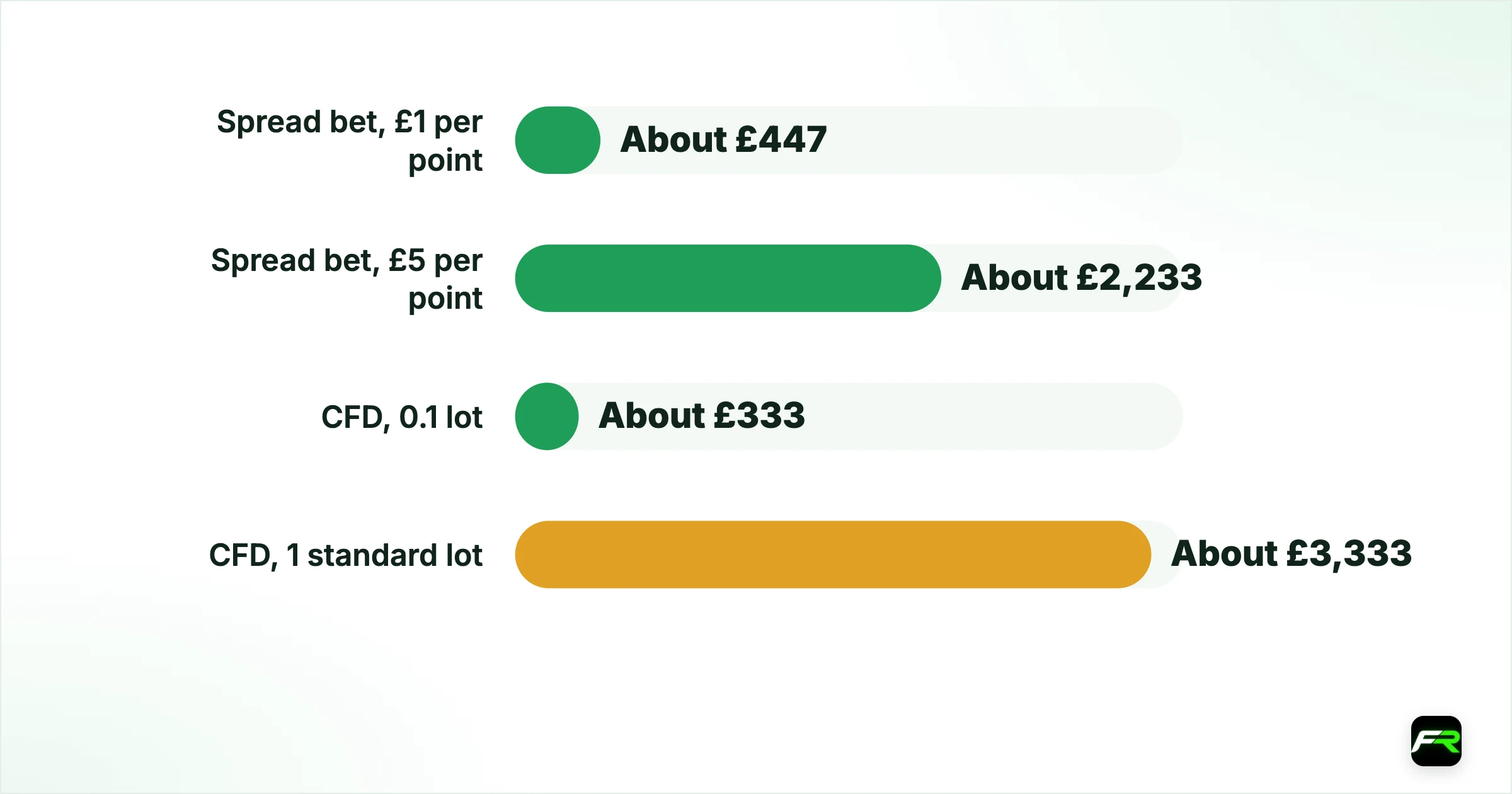
| Product and size | Value of one pip | Margin at 1.3400 (3.33%) |
|---|---|---|
| Spread bet, £1 per point | £1 | About £447 |
| Spread bet, £5 per point | £5 | About £2,233 |
| CFD, 0.1 lot (10,000 GBP) | $1, about £0.75 | About £333 |
| CFD, 1 standard lot (100,000 GBP) | $10, about £7.46 | About £3,333 |
A spread bet is quoted in pounds per point, so the arithmetic is simple: £2 per point on cable means £2 gained or lost for every pip. CFDs on GBP/USD pay out in dollars, which your broker converts to pounds if your account is in sterling. At 1.3400, $10 is about £7.46, and that figure changes a little as the rate moves. Our pip calculator does it for any size.
Margin is set by FCA rules. Retail clients get a maximum of 30:1 on major pairs, meaning 3.33% of the position value, and both sterling and the dollar count as majors. The UK leverage limits article explains the full table.
How big a normal day is
We have not found a primary source we trust for a single "average daily range" figure, and those numbers change with volatility anyway. Qualitatively, cable is a medium-volatility major: it usually moves more than EUR/GBP and less than GBP/JPY. On data days and central bank days its range can be a multiple of a quiet day's. The honest approach is to measure it yourself with the Average True Range indicator on your platform over the last 14 days, and to size your stop from that rather than from a number on a website.
Put ATR(14) on a daily chart before you plan a trade. If your stop is smaller than a fraction of a normal day's range, ordinary noise can stop you out.
A sizing method that survives a bad week
Position size should come from the loss you can accept, not from the margin available. Most professionals think in terms of risking a small, fixed share of the account per trade, commonly 0.5% to 1%. With leverage at 30:1 you could open a position far larger than that rule allows, and many retail losses start there.
- Decide the maximum you will lose on this trade in pounds, for example 1% of a £10,000 account, £100.
- Set the stop at a level that makes sense on the chart, and measure its distance in pips, for example 40 pips.
- Divide: £100 ÷ 40 pips = £2.50 per point for a spread bet.
- For a CFD, divide by the pip value per lot: £100 ÷ (40 × £7.46) ≈ 0.33 lots.
- Check spread and slippage: on a news release the fill can be several pips worse than the stop, so the real loss may exceed £100.
The position size calculator runs the same sum. Read our risk management basics if the 1% idea is new.
Poppy has £6,000 in a spread betting account with an FCA-authorised provider. She wants to trade cable around the US jobs report but decides to wait until 14:00, half an hour after the release, when the spread has settled. Her rule is to risk 1%, so £60. The chart gives her a stop 30 pips away, which works out at £2 per point. Margin at 1.3400 comes to about £893, well within her balance. Unfortunately the trade goes against her and closes at the stop, but the fill comes 2 pips worse because price was still moving quickly. She loses £64 plus the spread, not the £60 she planned, and now allows a few pips of slippage in every news-day plan.
Risks specific to cable
- Event gaps: Bank of England, Fed and data releases can jump price past your stop. A guaranteed stop, where your broker offers one, costs a premium but removes that slippage.
- Weekend gaps: political or geopolitical news on a Saturday can open Monday's price far from Friday's close.
- Overnight funding: holding a spread bet or CFD past the daily cut-off costs a financing charge. The FCA's November 2025 review found these charges often poorly disclosed, so check your broker's rate.
Cable and EUR/USD move together: don't double your risk
GBP/USD and EUR/USD share a quote currency, so anything that shifts the dollar shifts both. A strong US jobs report or a hawkish Fed tends to push the two pairs down together, and a weak one lifts them. For long stretches they travel in the same direction even when the UK and eurozone stories differ. Long positions in cable and EUR/USD at once look like two trades on your platform but behave like one larger bet against the dollar.
The arithmetic shows where the pairs part company. Divide EUR/USD by GBP/USD and you get EUR/GBP, so the only thing separating them is how the euro fares against the pound. If your view is really about sterling rather than the dollar, trading EUR/GBP expresses it more directly. For a sterling view against a far more volatile partner, our GBP/JPY guide explains why the stake has to shrink.
One simple rule keeps this honest: add up the risk on every open position that shares a currency and hold that total to your usual limit. With a 1% cap on a £10,000 account, long cable plus long EUR/USD should risk £100 between them, perhaps £50 each, not £100 apiece.
Between about 61% and 74% of retail CFD accounts at the large UK brokers lose money, according to their own published figures in September 2026. Cable's liquidity does not change that. Keep position sizes small enough that a run of losing trades is survivable.
For a daily read on the pair, see our GBP/USD forecast page. Treat any forecast, ours included, as a set of scenarios rather than a prediction.
Frequently asked
Why is GBP/USD called cable?
The name is usually traced to the transatlantic telegraph cable of the mid-1800s, with a lasting link in place from 1866. Sterling and dollar prices were among the quotes sent between London and New York by wire, and dealers kept calling the rate cable. Today it simply means GBP/USD.
What is the best time to trade GBP/USD from the UK?
By convention the London and New York overlap, roughly 13:00 to 17:00 UK time, has the most liquidity and usually the tightest spreads. It also holds most US data releases at 13:30. Quieter hours can suit people who dislike sudden moves, but spreads may be wider.
How much is a GBP/USD pip worth in pounds?
A spread bet pip is worth your stake, so £1 per point is £1 per pip. On a CFD, one standard lot of 100,000 pounds makes $10 per pip, which is about £7.46 at a rate of 1.3400. Mini lots are a tenth of that.
What leverage can I get on cable as a UK retail trader?
Up to 30:1 under FCA rules, which is a margin of 3.33% of the position value. GBP/USD is a major pair because both currencies are majors. Professional clients can get more but lose retail protections such as negative balance protection.
Does UK data or US data move cable more?
Both matter, and neither always wins. US jobs and inflation figures often produce the largest scheduled moves because they shift expectations for the Fed and the dollar across every pair. UK CPI, jobs and Bank of England decisions drive the sterling side.
Is spread betting or a CFD better for trading cable?
For most UK residents a spread bet is simpler, as it is quoted in pounds per point and profits are currently free of capital gains tax. CFD profits fall under CGT but losses can be offset. Our spread betting versus CFD article compares the two.
Why did sterling not rise when gilt yields hit their highest since 1998?
Because the yields rose partly on worries about UK public finances and inflation, not on hopes of stronger growth. When investors demand a premium for fiscal risk, they can sell gilts and the pound at the same time, so higher yields do not attract money into sterling.
Related reading
The team behind this guide
Researched, checked and approved by five forex specialists
Every guide is written, fact-checked and edited before it goes live, and updated when the facts change. Spotted an error? Tell us.