





























Is Forex Trading Legal in the UK? Rules for Retail Traders
Yes. Forex trading with your own money is legal in the UK and needs no licence. The rules bite on firms: brokers need FCA authorisation, and unauthorised promotion is a crime.
 WriterAbir KhanWriterWrites the guides · checks every figure against primary sources View profileAbout Abir →
 Market analysisTanbir Habib RiyadForex & Crypto AnalystForex and crypto analyst · technical and fundamental analysis View profileAbout Tanbir →
 Fact-checking & riskJannatul FerdaushFact-Checker & Risk AnalystFact-checks every figure · risk analysis · Applied Statistics, University of Dhaka View profileAbout Jannatul →
 Trading reviewJowel RanaCo-Founder & Forex TraderCo-founder · forex trader · reviews guides from a trader's view View profileAbout Jowel →
 Final approvalRanjan NiskrityFounder, Owner & Forex TraderFounder and owner · forex trader · signs off every guide View profileAbout Ranjan →
Yes, forex trading is legal in the UK. You can buy and sell currencies, spread bet on GBP/USD or trade CFDs on EUR/GBP with your own money, and you do not need a licence, a qualification or permission from anyone to do it. The law is aimed at the businesses around you. A broker that deals with UK retail customers must be authorised by the Financial Conduct Authority (FCA), anyone promoting investments to the public needs authorisation or approval, and managing other people’s money is a regulated activity in its own right.
So for most readers the question that matters is whether the firm you trade with, and the person who sold you on it, are operating legally. That decides what protection you have when something goes wrong.
General information, not legal or tax advice. FCA rules and UK tax law can change, including at the Budget on 28 October 2026. If your situation is unusual, speak to a qualified adviser.
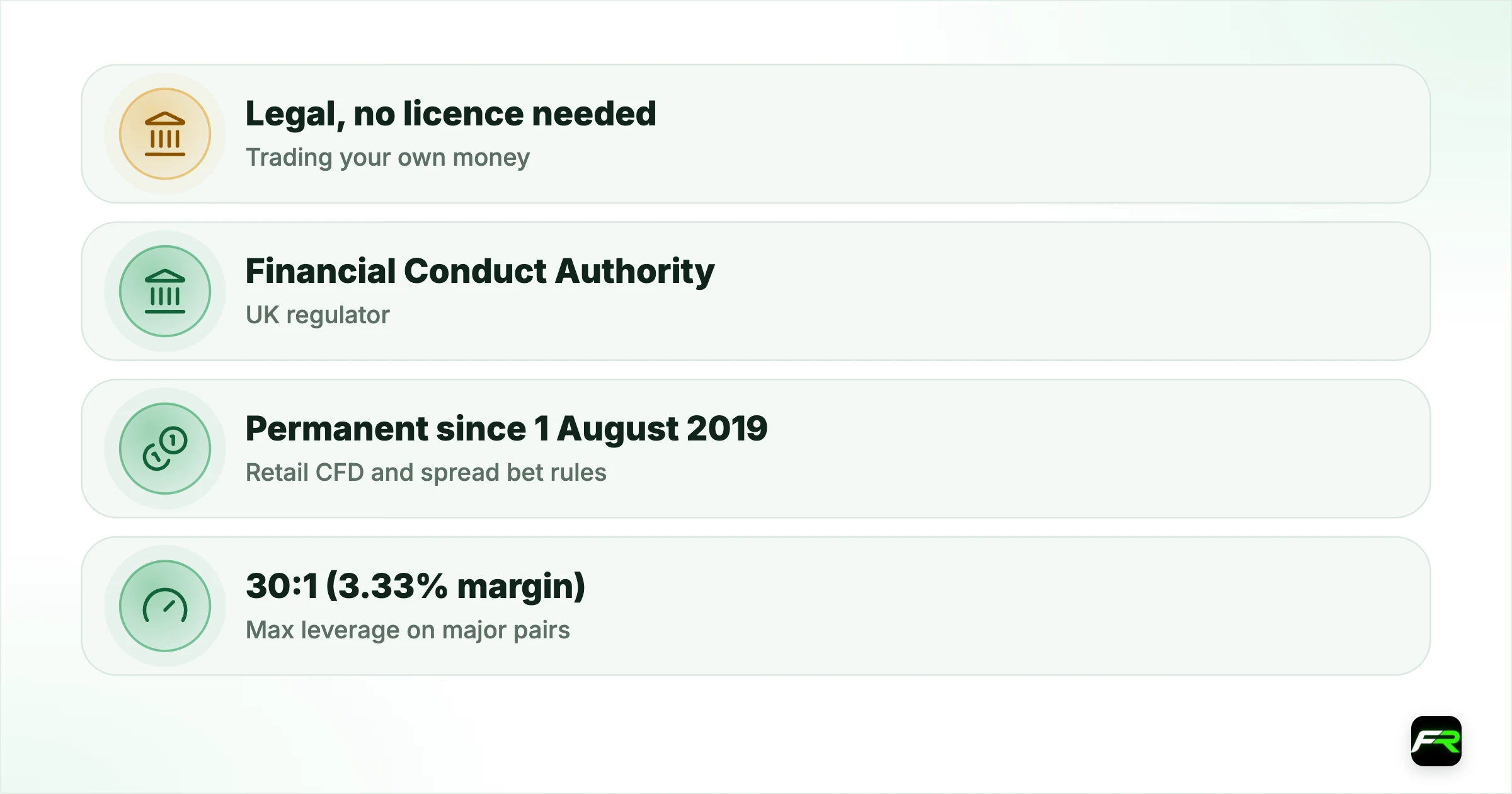
| Trading your own money | Legal, no licence needed |
|---|---|
| UK regulator | Financial Conduct Authority (FCA) |
| Retail CFD and spread bet rules | Permanent since 1 August 2019 |
| Max leverage on major pairs (retail) | 30:1 (3.33% margin) |
| Unauthorised promotion | Criminal offence under FSMA s21 |
| Check a firm | FCA Firm Checker and Register |
What the law allows you to do
A private individual placing trades for their own account is not carrying on a regulated activity in the way a broker is. That is why nobody asks you for a licence when you open an account. You can trade from a laptop at the kitchen table, hold positions overnight, trade the London session before work or the New York close after it. There is no minimum age beyond the 18 that brokers set in their own terms, and no cap on how many trades you can place.
For UK residents, retail currency speculation almost always happens through one of three products. Spread bets let you stake a set amount per point, such as £2 per point on cable (GBP/USD). CFDs (contracts for difference) let you trade a notional amount, such as 10,000 units of EUR/USD. Rolling spot FX is the leveraged currency position that most offshore platforms offer on MetaTrader. The FCA treats all three the same way for retail customers: its rules say references to CFDs include financial spread bets and rolling spot forex.
Physical currency is a separate matter. A swap of £1,000 into euros at a bureau or through a multi-currency card before a holiday is also legal, and you are not trading in any regulatory sense. This article is about leveraged speculation, which is where the rules and the risks sit.
What FCA rules mean for you as a retail trader
Since 1 August 2019, UK-authorised firms selling CFDs and spread bets to retail clients have had to follow permanent product rules. These are protections, not restrictions on you as a person, but they shape what an FCA broker can offer:
| Rule | What it means in practice |
|---|---|
| Leverage caps | Major FX pairs 30:1, minor pairs, gold and major indices 20:1, other commodities and minor indices 10:1, shares 5:1 |
| 50% margin close-out | Your broker must start closing positions when your equity falls to half the margin required |
| Negative balance protection | Your losses are limited to the money in your trading account |
| No bonuses | Firms cannot offer deposit bonuses or trading incentives to retail clients |
| Risk warning | Every firm shows the percentage of its retail accounts that lose money, updated quarterly |
| Crypto derivatives | Banned for retail clients since 6 January 2021 |
In pounds, the leverage cap means a £10,000 position on GBP/USD needs at least £333 of margin with a UK firm. An offshore platform might let you open the same position with £20. The FCA view, which we share, is that the higher figure keeps many beginners in the game longer. Our UK leverage limits article sets out every tier.
You can ask to be treated as a professional client if you meet at least two of three tests on trading frequency, portfolio size and industry experience. Professional status is legal to request, though it removes the leverage caps, the bonus ban and negative balance protection as a right. The FCA warned in October 2025 that some firms pressure people into this. See our professional client status guide before you sign anything.
What is illegal: the firm side
Under the Financial Services and Markets Act 2000 (FSMA), carrying on a regulated activity in the UK without authorisation breaks the general prohibition. The activities caught include dealing in investments with customers, arranging deals for them and managing their money. A broker that takes UK retail clients without FCA authorisation, and without a legal exemption, is acting unlawfully. The FCA publishes warnings about such firms on its Warning List: 2,240 warnings in 2024 and 2,329 in 2025.
Financial promotions are the second trap. Section 21 of FSMA stops anyone from communicating an invitation to engage in investment activity unless they are authorised or the promotion is approved by an authorised firm. A breach is a criminal offence punishable by up to two years in prison, an unlimited fine, or both. That covers websites, adverts and social media posts, which is where finfluencers come in.
- Unauthorised brokers taking UK clients or advertising to them.
- Clone firms copying a real FCA firm’s name, address and firm reference number (FRN) to take your money.
- Account managers and signal sellers who trade your account for you, or pool money from friends and followers, without authorisation.
- Finfluencers pushing trading schemes or brokers in exchange for payment when neither they nor the content has FCA authorisation or approval.
Finfluencers and enforcement in 2026
Enforcement has become much more visible. In June 2025 the FCA led an international week of action against illegal finfluencers that produced three UK arrests, 50 warning alerts and more than 650 requests to take down content. On 20 February 2026, seven social media influencers, several of them known from reality TV, were sentenced at Southwark Crown Court after pleading guilty to promoting an unauthorised FX trading scheme. Fines ranged up to £3,750, two received discharges, and all were ordered to pay costs. Other finfluencers, including Charles Hunter, Kayan Kalipha and Luke Desmaris, have been charged and have pleaded not guilty; those cases are allegations until a court decides them.
Brokers are under pressure too. On 25 September 2026 the FCA said 24 CFD firms have closed or are closing after it challenged firms that use their UK authorisation as a badge for linked overseas companies. Our write-up of the FCA’s 2026 CFD crackdown explains what that means for your account.
You break no law by following an influencer’s trades or paying for a Telegram signal group. People lose everything when they hand over a login, or send money to someone who promises to trade it. Read our finfluencer and Telegram scams guide.
What if your broker is not FCA regulated?
As the customer, you commit no criminal offence by opening an account with an overseas broker that is not authorised in the UK; the offence sits with the firm if it carries on regulated business here or promotes itself to UK residents without authorisation. Legal is not the same as protected, though. At an offshore firm you lose FCA conduct rules, the Financial Ombudsman, FSCS cover of up to £85,000 if the firm fails, and guaranteed negative balance protection. Our article on offshore brokers for UK residents goes through the trade-off in detail, and we are frank there: for most beginners it is a poor deal.
Tax: legal trading is still taxable trading
HMRC does not care where your broker is based. For most individuals, CFD and rolling spot FX profits are capital gains, taxed at 18% or 24% once your gains for the tax year exceed the £3,000 annual exempt amount. Spread betting profits for an ordinary private trader are treated as betting winnings and fall outside income tax and capital gains tax, which is why spread betting is so popular with UK traders. Losses on spread bets are not relievable either. Our spread betting vs CFD comparison shows which suits which kind of trader.
Profits from a prop firm challenge payout are a different animal and are usually treated as self-employment income. For the full detail see our forex trading tax guide. The rates quoted here apply for 2026/27 and could change at the 28 October 2026 Budget.
Bethany saw a TikTok creator posting screenshots of £4,000 weeks on gold and a link to "my broker". The broker offered 1:500 leverage and a 100% deposit bonus, which she now knew UK firms are not allowed to offer retail clients. She searched the name on the FCA Firm Checker and found a Warning List entry saying the firm was not authorised and may be targeting people in the UK. Nothing about her trading would have been illegal, but her £2,000 would have sat outside the FSCS and the Ombudsman. She opened a spread betting account with an FCA-authorised firm instead, started at £1 per point on GBP/USD, and reported the creator’s post through the FCA’s online form.
A quick legality checklist before you trade
- Search the firm on the FCA Firm Checker and confirm its status is Authorised, with permission to deal in investments.
- Match the website, email and phone number against the Register entry, because clone firms copy real FRNs.
- Read your client agreement and note the legal entity you are contracting with.
- Treat any offer of a deposit bonus or leverage above 30:1 on majors as a sign the account is not under UK retail rules.
- Never let a third party trade your account or collect your money unless they are FCA-authorised to manage investments.
- Keep records of every trade and deposit for tax, whichever product you use.
Step-by-step screenshots and a table of Register statuses are in our walkthrough on checking a broker on the FCA Register.
Frequently asked
Do I need a licence to trade forex in the UK?
No. Trades for your own account are not a regulated activity, so you need no licence, exam or registration. Firms need FCA authorisation. You only need authorisation yourself if you start managing other people’s money, advising them for payment or promoting investments to the public.
Is forex trading legal for under-18s in the UK?
There is no specific FCA rule on age for traders, but brokers require you to be 18 or over because you must be able to enter a binding contract. An account opened with false details to get around that breaches the broker’s terms and could see the account closed and funds frozen.
Is it illegal to trade with a broker not regulated by the FCA?
Not for you as the customer. The firm commits the offence if it carries on regulated business in the UK or promotes to UK residents without authorisation. You lose UK protection, including the Financial Ombudsman and FSCS, and the FCA advises people to avoid firms on its Warning List.
Can I trade forex for friends or family?
Trades placed with other people’s money, even for a share of profits, count as managing investments, which needs FCA authorisation. A pot of money pooled from friends in your account creates legal and tax problems too. Each person should hold and control their own account.
Is copy trading legal in the UK?
Yes, through FCA-authorised platforms that are permitted to offer it. You can also copy signals yourself legally. The risk comes from unauthorised account managers and paid promoters, where you may have no protection and the person running it may be breaking the law.
Is forex spread betting legal and tax-free?
Spread betting is legal and offered by FCA-authorised firms under the same retail CFD rules. For most private traders, profits are outside income tax and capital gains tax, and losses cannot be offset. The treatment can differ if betting is part of a business, such as hedging.
Can finfluencers be prosecuted for promoting brokers?
Yes. A financial promotion communicated without authorisation or approval breaches section 21 of FSMA, a criminal offence carrying up to two years in prison and an unlimited fine. Seven influencers were sentenced in February 2026, and further cases have been charged.
Does UK law treat forex trading as gambling?
Not in the legal sense. Leveraged forex with a broker is investment business regulated by the FCA, not the Gambling Commission. Section 10 of the Gambling Act 2005 goes further and excludes bets whose making or accepting is a regulated activity under FSMA, which takes financial spread bets out of gambling law. HMRC still taxes spread bet winnings like betting, and that is where the confusion starts.
Is the US pattern day trader rule relevant in the UK?
No. It was a FINRA margin rule for customers of US broker-dealers, requiring $25,000 of equity from anyone making four or more day trades in five business days. FCA rules have no equivalent cap on how often you trade. FINRA itself adopted new intraday margin standards in April 2026 to replace the rule, with firms allowed to phase them in until October 2027.
Can I trade forex on a Student or work visa?
The Student visa page on gov.uk lists "be self-employed" among the things you cannot do, and work visas carry their own conditions. Trades placed with your own savings usually look like personal investing, while prop firm payouts look much more like self-employment. Visa rules were not written with trading in mind, so check your conditions and ask a regulated immigration adviser before you start.
Why did a broker turn down my account application?
Most often because of the appropriateness test. A CFD or spread betting firm has to assess your knowledge and experience of leveraged products before you trade, and it can decline you if your answers suggest the product is not appropriate. An FCA review found firms let too many failed applicants carry on regardless, so a refusal is the firm doing its job. Failed identity checks are the other common cause.
Related reading
The team behind this guide
Researched, checked and approved by five forex specialists
Every guide is written, fact-checked and edited before it goes live, and updated when the facts change. Spotted an error? Tell us.