IC Markets





































The Yen Carry Trade: Why Unwinding It Shakes Global Markets
Borrow cheap yen, buy higher-yielding assets, keep the difference, until it unwinds in days. How the carry trade works and its warning signs.
 WriterAbir KhanWriterWrites the guides · checks every figure against primary sources View profileAbout Abir →
 Market analysisTanbir Habib RiyadForex & Crypto AnalystForex and crypto analyst · technical and fundamental analysis View profileAbout Tanbir →
 Fact-checking & riskJannatul FerdaushFact-Checker & Risk AnalystFact-checks every figure · risk analysis · Applied Statistics, University of Dhaka View profileAbout Jannatul →
 Trading reviewJowel RanaCo-Founder & Forex TraderCo-founder · forex trader · reviews guides from a trader's view View profileAbout Jowel →
 Final approvalRanjan NiskrityFounder, Owner & Forex TraderFounder and owner · forex trader · signs off every guide View profileAbout Ranjan →
The yen carry trade is one of the largest and longest-running trades in global finance, and it is also one of the most dangerous when it turns. The idea is simple: Japan has kept interest rates near zero for decades, so you can borrow yen cheaply, convert it to a currency with higher rates or buy higher-yielding assets, and keep the difference. It works quietly for years. Then something changes, everyone tries to unwind at once, and the yen surges while risk assets fall around the world.
How the trade works
A fund or an individual borrows yen (or uses yen-denominated leverage) and buys, say, US Treasuries, Australian dollars, US tech stocks, or Mexican bonds. As long as the yen does not strengthen and the higher-yielding asset holds up, the position earns the interest-rate differential plus any gain on the asset. The retail version is being long USD/JPY or AUD/JPY, which earns a positive swap because you hold the higher-rate currency against the yen. The swap guide shows those numbers.
Why it is stable for years
As money flows into the carry trade, it sells yen (weakening it) and buys the target assets (supporting them). That price action rewards the people already in the trade, which draws in more money, which pushes the same direction further. Low volatility makes the leverage feel safe. The trade becomes crowded and comfortable, and it can run for years, with USD/JPY grinding higher and the yen looking permanently weak.
Why it unwinds violently
The carry trade reverses when the interest-rate gap is expected to narrow, when volatility spikes, or when the yen starts strengthening for any reason. When that happens, every carry position is losing money in two ways at once: the yen borrowing is getting more expensive to repay, and the target asset is often falling too. Positions are leveraged, so losses force selling, which strengthens the yen further, which forces more selling. What took years to build up unwinds in days. USD/JPY can fall 500 to 1,000 pips in a week, global equities sell off, and the Australian dollar and emerging-market currencies get hit hard. There have been several sharp episodes of this in recent years, and 2026 has had its own.
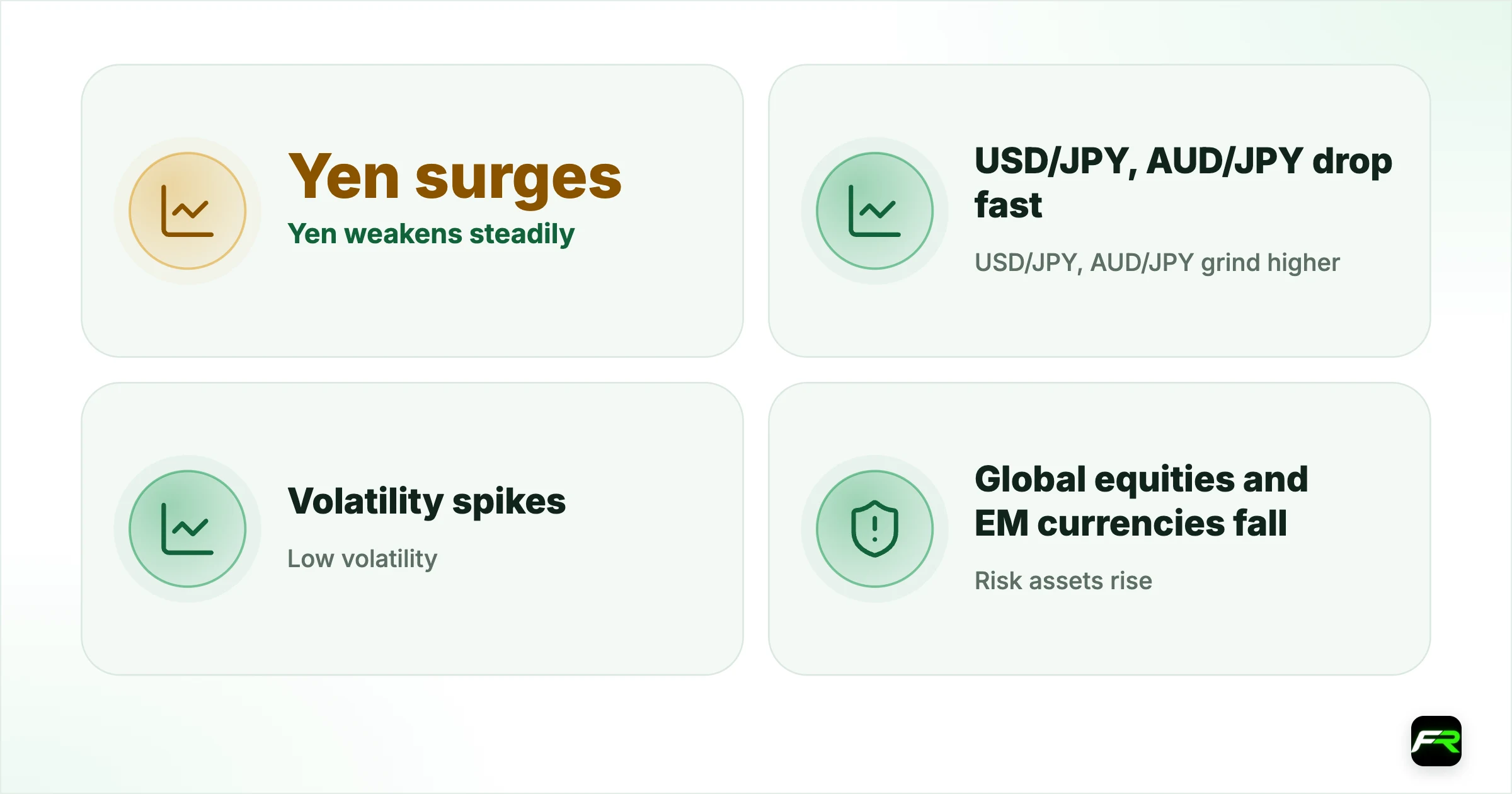
| Carry build-up | Carry unwind |
|---|---|
| Yen weakens steadily | Yen surges |
| USD/JPY, AUD/JPY grind higher | USD/JPY, AUD/JPY drop fast |
| Low volatility | Volatility spikes |
| Risk assets rise | Global equities and EM currencies fall |
| Positive swap accrues | Leveraged losses force liquidation |
A Real Example: How a Past Carry Unwind Actually Played Out
The clearest recent case is July-August 2024. USD/JPY had ground up to a 37-year high of 161.62 in early July, with AUD/JPY and other yen crosses drifting higher alongside it in a long, quiet carry build-up. The Bank of Japan hiked its policy rate on July 31 (from near zero to about 0.25%), and a weak US jobs report followed on August 2. USD/JPY fell from about 149.8 on August 2 to 141.68 by August 5, a drop of roughly 810 pips in three trading days, squarely inside the 500-to-1,000-pip range this guide describes. The unwind was not confined to FX: Japan’s Nikkei 225 fell 12.4% on August 5 alone, its steepest one-day drop since 1987, and the S&P 500 fell 3% the same day as leveraged carry positions were liquidated across markets, not just in yen crosses.
A retail trader is long AUD/JPY for the positive swap, up nicely over six months, treating the daily swap credit as passive income. Volatility spikes on a Bank of Japan comment and AUD/JPY drops 400 pips in three days. The swap income of the last six months is wiped out in an afternoon. The trader, who thought of the position as low-risk because it paid them to hold it, learns that the swap was compensation for exactly this tail risk.
Warning signs to watch
- The Bank of Japan signalling tightening, or the Fed signalling cuts: both narrow the rate gap that funds the trade.
- A jump in the VIX or in FX volatility indices after a long calm period.
- The yen strengthening sharply for no obvious domestic reason, which can be the first leg of a broader unwind.
- Commentary about carry positioning being at extremes.
A positive-swap position is not a low-risk position. The swap is payment for holding the risk of a carry unwind, which arrives suddenly and can erase months of swap income in days. Size these positions for the tail move, not the calm.
For the rules and brokers that apply where you live, see our guide to forex brokers in Japan.
Frequently asked
What is the carry trade in simple terms?
Borrowing money in a low-interest-rate currency (the yen) and putting it into a higher-return asset or currency, keeping the difference. For retail traders it usually means being long USD/JPY or AUD/JPY for the positive swap.
Why does the yen surge when the carry trade unwinds?
Unwinding the trade means buying back the yen that was borrowed. When many leveraged positions unwind at once, that concentrated yen buying drives the currency up fast, which forces more unwinding in a feedback loop.
Is holding AUD/JPY for the swap a good strategy?
It can accrue income for long stretches, but the position carries full price risk plus the specific risk of a carry unwind that can wipe out months of swap in days. It is not passive income; the swap is compensation for that risk.
How do I know an unwind is coming?
You often cannot time it precisely. The setup is a narrowing rate gap, a volatility spike after a calm period, and the yen strengthening without an obvious domestic cause. When those align, carry positions are vulnerable.
Does the carry unwind affect stocks?
Yes. Carry-trade money is often invested in equities and other risk assets, so a forced unwind involves selling those too. Sharp yen strength has coincided with global equity sell-offs in past episodes.
Related reading
The team behind this guide
Researched, checked and approved by five forex specialists
Every guide is written, fact-checked and edited before it goes live, and updated when the facts change. Spotted an error? Tell us.