





























FSCS Limit for Trading Accounts: £85,000, Not £120,000
A CFD or spread betting account has FSCS investment cover of up to £85,000 per person per firm. The £120,000 limit is for bank deposits, and trading losses are never covered.
 WriterAbir KhanWriterWrites the guides · checks every figure against primary sources View profileAbout Abir →
 Market analysisTanbir Habib RiyadForex & Crypto AnalystForex and crypto analyst · technical and fundamental analysis View profileAbout Tanbir →
 Fact-checking & riskJannatul FerdaushFact-Checker & Risk AnalystFact-checks every figure · risk analysis · Applied Statistics, University of Dhaka View profileAbout Jannatul →
 Trading reviewJowel RanaCo-Founder & Forex TraderCo-founder · forex trader · reviews guides from a trader's view View profileAbout Jowel →
 Final approvalRanjan NiskrityFounder, Owner & Forex TraderFounder and owner · forex trader · signs off every guide View profileAbout Ranjan →
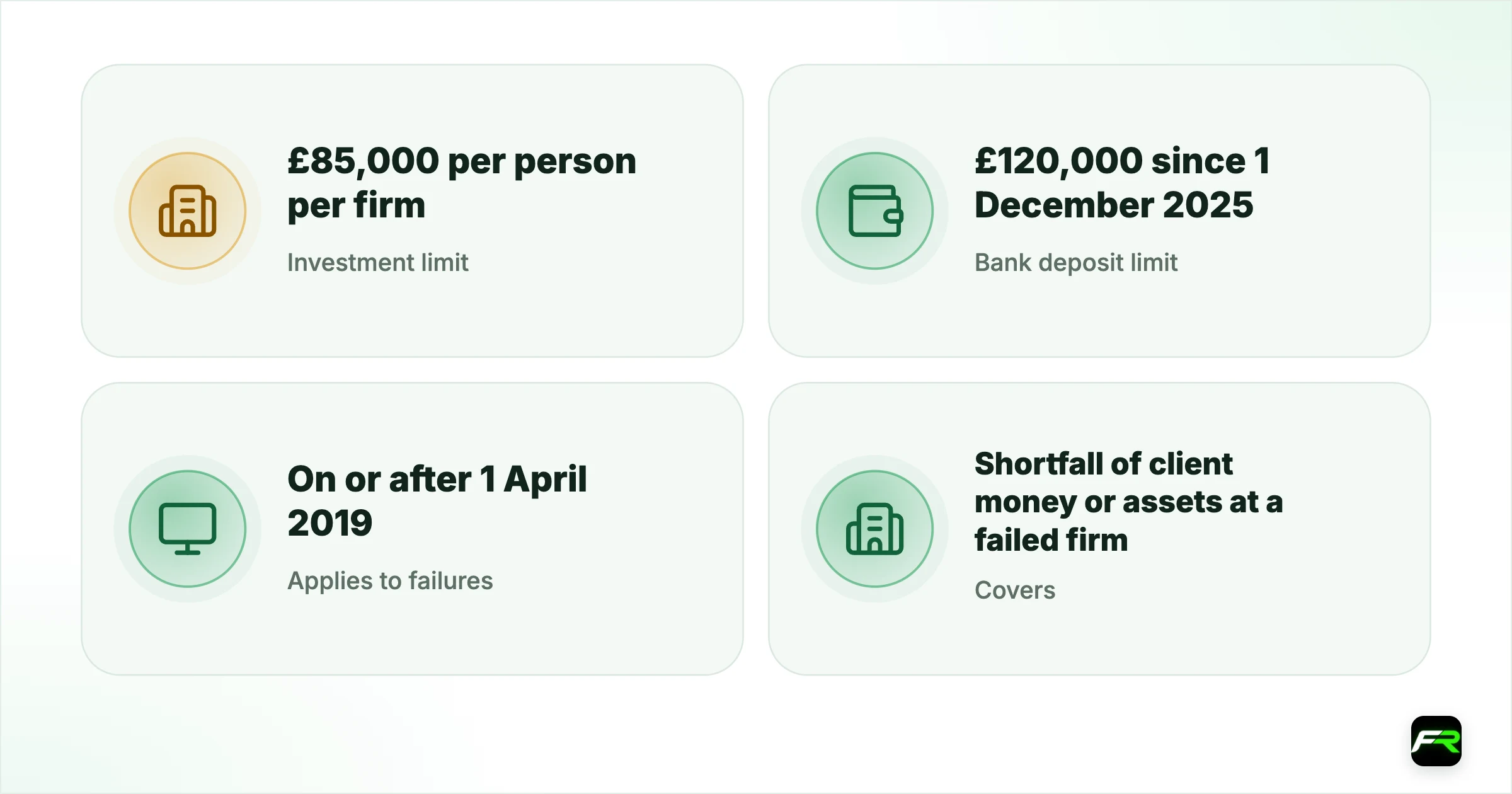
The FSCS limit for a trading account with a UK broker is £85,000 per person, per firm. It applies if an FCA-authorised firm fails on or after 1 April 2019 and cannot return money or assets it held for you. The £120,000 figure you may have seen is the bank deposit limit, which rose from £85,000 on 1 December 2025. It does not apply to CFD, spread betting or forex accounts with investment firms, even though plenty of comparison pages still say it does.
Two more points matter as much as the number. FSCS cover pays out on a shortfall at a failed firm, never on trading losses. And it only exists if the company you contract with is authorised by the FCA. An offshore broker, or the offshore arm of a UK-looking brand, is not covered at all.
| Investment limit (trading accounts) | £85,000 per person per firm |
|---|---|
| Bank deposit limit | £120,000 since 1 December 2025 |
| Applies to failures | On or after 1 April 2019 |
| Covers | Shortfall of client money or assets at a failed firm |
| Does not cover | Trading losses, poor performance, offshore firms |
| Cost to you | Free, paid for by the industry levy |
Why £85,000 and not £120,000
The Financial Services Compensation Scheme runs separate limits for different kinds of product. Deposits held with a bank, building society or credit union are protected up to £120,000 per person per institution from 1 December 2025. Investments held with or through an investment firm are protected up to £85,000 per person per firm, for failures on or after 1 April 2019. A CFD provider or spread betting firm is an investment firm, so your trading account falls under the investment limit.
| Where your money is | FSCS category | Limit per person |
|---|---|---|
| Current or savings account at a UK bank | Deposits | £120,000 per banking licence |
| Cash ISA | Deposits | £120,000 per banking licence |
| Stocks and shares ISA or share dealing account | Investments | £85,000 per firm |
| CFD or spread betting account with an FCA firm | Investments | £85,000 per firm |
| Rolling spot FX account with an FCA firm | Investments | £85,000 per firm |
| Any account with an offshore or unauthorised broker | None | £0 |
The confusion is understandable. Many trading firms mention the FSCS on their websites without saying which limit applies, and some websites wrongly applied the new £120,000 figure to broker accounts after December 2025. If a page tells you a broker account is protected to £120,000, treat everything else on that page with caution.
What the FSCS covers for traders
FCA rules on client money (the CASS sourcebook) require brokers to hold retail clients’ money in segregated client bank accounts, separate from the firm’s own money. If the firm goes bust, that money belongs to clients, not to the firm’s creditors. An insolvency practitioner pools it and returns it. The FSCS steps in if the pool comes up short: because records were wrong, because money was misused, or because it was never segregated properly.
In the scheme’s own words, it may be able to protect you "if a provider goes out of business and there’s a shortfall in the money or assets it’s holding for you." There is a real precedent in our corner of the market. FIXI plc, which offered FX, CFDs and spread betting, was declared in default by the FSCS on 30 August 2019, which opened the way for its customers to claim.
- Covered: the gap between what you were owed by a failed FCA firm and what the administrators return, up to £85,000.
- Not covered: losses on your trades, however large, including losses from slippage or a gap over the weekend.
- Also excluded: the firm simply being difficult or slow while it is still trading. That is a complaint for the firm and then the Financial Ombudsman.
- Outside the scheme: any company that is not authorised by the FCA, including overseas affiliates of UK brands.
Worked examples in pounds
Suppose you hold £40,000 with an FCA-authorised spread betting firm that collapses. The administrators find the client money pool is 90% intact and return £36,000. FSCS cover can pay the £4,000 shortfall, so you end up whole, though it may take months.
Now say you hold £120,000 with the same firm and the pool returns 70%, or £84,000. Your shortfall is £36,000. That is under the £85,000 cap, so the FSCS can cover it. If the pool returned only 20%, your shortfall would be £96,000 and the FSCS would pay a maximum of £85,000, leaving £11,000 lost.
Finally, imagine you lose £9,000 on GBP/JPY in a volatile week and your broker then fails. The £9,000 is gone because of the market, not because of the firm, and nothing about the FSCS changes that. Only the balance left in your account at the point of failure counts.
How a claim works if your broker fails
Nothing happens overnight. When a UK firm holding client money gets into trouble, the FCA can restrict its business first, and the court then appoints insolvency practitioners. For investment firms that hold client assets this can be the special administration regime, which the Treasury created after Lehman Brothers collapsed in 2008. The special administrators work out what sits in the client money pool, agree each client’s balance and return money under a distribution plan approved by the court.
Open positions do not survive the process. AFX Markets Ltd, an FCA-authorised forex and CFD broker, is the clearest recent example. The FCA froze its assets and required it to stop regulated activity except to close all open positions, and the High Court appointed special administrators on 27 August 2019. It was declared in default by the FSCS on 24 August 2021, with claims opening on 19 October 2021, roughly two years later. What you can claim is the balance the administrators agree you were owed, not the profit a trade might have made had it stayed open.
You do not always have to fill in a form. In some failures the FSCS agrees bulk payments with the administrators, so customers are paid without individual claims. Where there is no bulk payment, as with AFX, you claim through the FSCS online service once the administrators have confirmed you were a client and agreed your balance. Follow the FSCS page for your firm, ignore anyone who calls offering to speed up a claim for a fee, and remember the scheme costs you nothing to use.
Per person, per firm: the brand trap
The limit applies per authorised firm, not per brand or per account. If two trading brands operate under the same FCA authorisation, holding £60,000 with each gives you one £85,000 limit, not two. Check the firm reference number on the FCA Register for each brand you use. Separate authorised firms, each with its own FRN, give you separate limits.
Your share of any joint account, plus every other account you hold at the same firm, counts towards one limit. If you trade with large balances, spreading money across two or three unconnected FCA firms is the simplest way to keep each within cover. It also reduces your exposure to a single firm’s withdrawal problems, which happen far more often than outright failure.
Professional clients and title transfer
Elective professional status changes more than your leverage. Professional clients can be put on title transfer collateral arrangements, where the money you deposit becomes the firm’s property in return for a contractual promise to pay it back. That money is no longer segregated client money, so in an insolvency you would rank as a creditor rather than having a claim on the client money pool. FCA client money rules do not allow title transfer for retail clients.
Your FSCS eligibility itself is not lost just because you became an elective professional, as far as we can tell from the compensation rules, but a title transfer arrangement can leave you with a weaker claim and a slower route. Ask your broker in writing whether your money is held under title transfer before you accept any professional upgrade. Our professional client status guide covers the rest of what you give up.
Tegan had £140,000 spread across two spread betting brands, £70,000 in each, and assumed she was covered twice. She looked both up on the FCA Register and found they shared one FRN, so her protection would be a single £85,000. So she moved £70,000 to an unrelated FCA-authorised firm with its own FRN. Each balance now sat within its own £85,000 limit. Her trading costs barely changed, and she noted the FRN of each firm and the date she checked it in her records.
Offshore accounts have no FSCS cover
The FSCS only protects customers of firms authorised by the FCA or the PRA, for regulated activities. A broker in the Seychelles, Vanuatu or St Vincent is outside it, as is a Cypriot firm without its own UK authorisation. Some offshore brokers advertise private insurance on client funds. That can be better than nothing, but it is a commercial policy with its own terms, not a statutory scheme, and you cannot claim on it through the FSCS. Our article on IC Markets, the FSCS and the Ombudsman works through one well-known example.
The FCA’s 25 September 2026 statement that 24 CFD firms have closed or are closing, after it challenged firms using a UK authorisation as a badge for overseas companies, is a reminder that the brand on a website is not the same as the entity holding your money. Read our offshore broker explainer for the full list of what you give up.
Keep a copy of your client agreement, a monthly statement and a screenshot of the firm’s Register entry. If you ever need to claim, the FSCS will ask what you were owed and by which firm.
Frequently asked
Is my trading account protected up to £120,000?
No. The £120,000 limit, in place since 1 December 2025, is for deposits with banks, building societies and credit unions. CFD, spread betting and forex accounts with investment firms fall under the investment limit of £85,000 per person per firm.
Does the FSCS cover trading losses?
No. It only compensates you if an authorised firm fails and cannot return money or assets it held for you. Losses from market moves, slippage, gaps or your own trading decisions are never covered.
Are spread betting accounts covered by the FSCS?
Yes, when the spread betting firm is authorised by the FCA. Spread betting is treated as investment business for FSCS purposes, so the £85,000 investment limit applies if the firm fails with a shortfall in client money.
Does the FSCS cover offshore or EU brokers?
No. Only firms authorised by the FCA or PRA are covered. EU brokers lost UK passporting at the end of 2020, so a Cypriot or Irish firm without its own FCA authorisation is outside the scheme, as are offshore brokers.
Is £85,000 per account or per person?
Per person, per authorised firm. Several accounts, or several brands sharing one FCA authorisation, all count towards the same £85,000. Separate firms with separate FRNs give you separate limits.
What happened with FIXI plc?
FIXI plc, which offered FX, CFDs and spread betting, was declared in default by the FSCS on 30 August 2019. That allowed eligible customers to claim for money the firm could not return, within the investment limit that applied.
How long does an FSCS claim take for a failed broker?
It varies. The insolvency practitioner first has to establish what is in the client money pool and return it, and the FSCS then pays eligible shortfalls. Expect months rather than weeks, and longer in a complicated failure: at AFX Markets, claims opened about two years after special administrators were appointed.
Related reading
The team behind this guide
Researched, checked and approved by five forex specialists
Every guide is written, fact-checked and edited before it goes live, and updated when the facts change. Spotted an error? Tell us.