





























Financial Ombudsman CFD and Spread Betting Complaints Explained
Complain to the broker first. If it rejects you or eight weeks pass, you have six months to go to the Financial Ombudsman, which is free and can award up to £455,000 for newer cases.
 WriterAbir KhanWriterWrites the guides · checks every figure against primary sources View profileAbout Abir →
 Market analysisTanbir Habib RiyadForex & Crypto AnalystForex and crypto analyst · technical and fundamental analysis View profileAbout Tanbir →
 Fact-checking & riskJannatul FerdaushFact-Checker & Risk AnalystFact-checks every figure · risk analysis · Applied Statistics, University of Dhaka View profileAbout Jannatul →
 Trading reviewJowel RanaCo-Founder & Forex TraderCo-founder · forex trader · reviews guides from a trader's view View profileAbout Jowel →
 Final approvalRanjan NiskrityFounder, Owner & Forex TraderFounder and owner · forex trader · signs off every guide View profileAbout Ranjan →
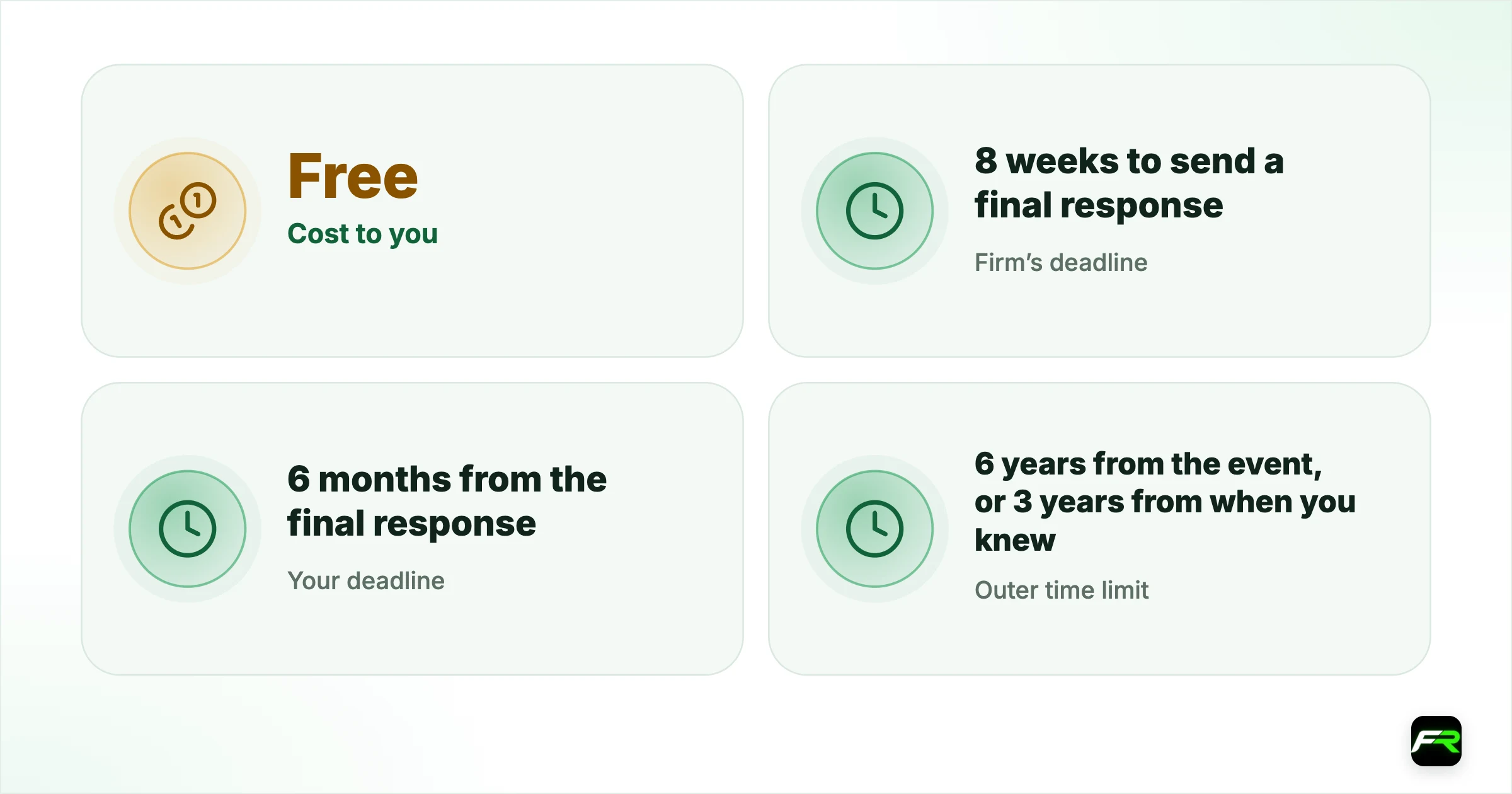
You can take a complaint about a UK-authorised CFD or spread betting broker to the Financial Ombudsman Service, free of charge. First you must complain to the broker in writing. The firm then has eight weeks to send a final response. If it rejects your complaint, offers too little or misses the deadline, you have six months from the date of the final response to refer the case to the Ombudsman. For complaints referred on or after 1 April 2026 about events on or after 1 April 2019, the Ombudsman can award up to £455,000.
What it will not do is refund money you lost because the market went against you. The complaints that succeed are about how the firm behaved: prices, execution, close-outs, classification and whether it followed FCA rules. This article explains which is which, and how to build a case that gets taken seriously.
General information, not legal or tax advice. FCA rules and UK tax law can change, including at the Budget on 28 October 2026. If your situation is unusual, speak to a qualified adviser.
| Cost to you | Free |
|---|---|
| Firm’s deadline | 8 weeks to send a final response |
| Your deadline | 6 months from the final response |
| Outer time limit | 6 years from the event, or 3 years from when you knew |
| Award limit | £455,000 (events from 1 April 2019, referred from 1 April 2026) |
| Offshore brokers | Not covered |
Who the Ombudsman can help
The Ombudsman handles complaints against businesses regulated by the FCA, about activities carried on from the UK. If your broker is FCA-authorised and your client agreement names that UK company, you are almost certainly in scope. An offshore broker, or the overseas affiliate of a UK-looking brand, is out of scope, and no amount of evidence changes that; our piece on IC Markets and the Ombudsman shows how that plays out for one offshore brand. Check the entity in your agreement against the FCA Register before you start. Our Register walkthrough shows how.
Individuals trading for themselves usually keep access to the Ombudsman even if the firm classified them as an elective professional client, because what counts is whether you were acting as a consumer. That matters for one of the most important complaint types, covered below.
Step by step: from complaint to decision
- Write to the broker. Use its published complaints procedure, usually an email address or form. Say clearly that you are making a formal complaint, what happened, the trades or dates involved, and what you want: a refund of a specific amount, a re-pricing, or a reclassification.
- Wait up to eight weeks. The firm must acknowledge the complaint and send a final response within eight weeks. Many reply sooner. Keep all correspondence.
- Read the final response. It must tell you about your right to go to the Ombudsman and the six-month deadline. Some firms make an offer; you can reject it and still refer the case.
- Refer the case to the Ombudsman online or by phone within six months. Attach the final response and your evidence.
- Investigator’s view. An investigator looks at both sides and gives an initial view. Either party can disagree.
- Ombudsman’s final decision. If either side disagrees, an ombudsman reviews the case and makes a final decision. Accept it and it binds the firm; reject it and you keep your right to go to court.
The outer limits are six years from the event you are complaining about, or three years from when you knew (or should have known) you had cause to complain, if later. A late case can still be considered where exceptional circumstances caused the delay, but do not count on it.
Complaints that tend to succeed
The Ombudsman decides what is fair and reasonable, looking at the law, FCA rules and guidance, good industry practice and the firm’s own terms. In CFD and spread betting cases, its published approach points to these kinds of complaint as the ones with a real chance:
- Unfair close-outs. A position closed when your account was above the 50% margin close-out level, or closed at a price that the market never traded at.
- Execution errors and platform faults. Orders filled at wrong prices, stops that were not triggered, or trades blocked during an outage the firm is responsible for.
- Voided trades without a clear error. A firm can cancel a trade for a manifest error, but the Ombudsman’s test is whether it would have been obvious to a reasonable person that the price was wrong. It is unlikely to let a firm void a trade you placed in good faith otherwise.
- Wrong classification as a professional. If you were opted up without meeting at least two of the three tests, or without proper warnings, you may have lost leverage limits and negative balance protection you were entitled to.
- Unsuitable opt-ups or poor appropriateness checks. The Ombudsman looks at whether the firm assessed your knowledge and experience of leveraged products and warned you properly.
- Charges not disclosed. Costs you could not have understood from the firm’s documents. The FCA’s November 2025 review criticised poor disclosure of overnight funding and charging funding on both legs of hedged positions.
Complaints about the 2019 retail rules themselves also land well when a firm plainly broke them: a UK retail client who was given a deposit bonus, allowed leverage above the caps, or left with a negative balance after a gap.
Slippage that only ever goes one way
Slippage is the gap between the price you asked for and the price you got. It happens to every broker in fast markets, and on its own it is rarely grounds for a complaint. What the Ombudsman looks at is whether the firm treats it evenly. Its guidance on spread betting and CFD complaints says that if a firm "kept the profits when trades were carried out at a better price" but "passed losses on to you when trades happened at a worse price", it would probably say the business acted unfairly.
In practice that means comparing your fills. A stop on GBP/USD that fills 4 pips worse after a data release, while your limit orders never fill better than requested, is the pattern to look for. Pull a few months of trade confirmations, note the requested and executed price for each order, and see whether the differences ever run in your favour. Read the order execution policy too: the Ombudsman says it is unlikely to uphold a complaint where the firm made clear it could not stop gapping or slippage, so your case rests on unequal treatment, not on slippage existing at all.
Complaints that usually fail
- Market losses, however painful, where the firm executed correctly.
- Normal slippage or gapping within the firm’s terms, such as a stop filled at a worse price after a weekend gap or a surprise data release.
- Spread widening where the firm can show a reasonable cause, such as increased volatility, and its prices tracked the underlying market.
- Margin close-outs carried out in line with the contract and FCA rules, even if you meant to add funds.
- Trade reversals where the firm’s terms banned a strategy, such as exploiting price latency, and your trading history shows you did it.
An honest self-check helps. If your complaint amounts to "I lost money and I wish I had not traded", it will probably fail unless the firm also failed to check whether the product was appropriate for you. Where it amounts to "the firm did something its own terms or the FCA rules do not allow", you have a case worth making.
The evidence to gather
The Ombudsman decides on the balance of probabilities, so documents beat recollection. Collect these before you write your first complaint:
- Account statements and trade confirmations for the dates involved, including order IDs and timestamps.
- Screenshots or screen recordings of any platform fault, with the time and your internet connection noted.
- Price data from an independent source for the same moment, to show where the market traded.
- Your client agreement, order execution policy and costs disclosures as they stood at the time.
- Any professional client application, the firm’s warnings and your confirmation, plus emails or call notes where you were encouraged to opt up.
- Live chat transcripts and emails with the firm.
If the firm has not supplied its records, you can make a subject access request under UK data protection law for the personal data it holds on you, including call recordings and chat logs. Firms normally have one month to respond.
Connor was spread betting £10 per point on GBP/USD with an FCA-authorised firm and had £2,400 in his account when a fast move after a US data release left his equity at 58% of required margin. The platform froze for four minutes and when it came back his position had been closed, crystallising a £1,300 loss. He complained to the firm, attaching screenshots with timestamps and his statement showing margin above the 50% close-out level. The firm’s final response in week seven rejected the complaint, citing volatility. He referred it to the Ombudsman, where the investigator asked the firm for its server logs. The firm then offered to credit £900, the difference between the close-out price and the price when trading resumed, which Connor accepted.
How to write the complaint
Keep it short, factual and specific. State your account number, the trades concerned with dates and times in UK time, what you expected to happen under the firm’s terms or the FCA rules, what happened instead and the financial loss, with your working. Ask for a specific remedy. Avoid threats and emotional language; the person reading it is more likely to settle a clear, reasonable complaint.
You do not need a claims management company. The service is free to you, and firms pay a case fee. If you use a representative, any fee they take comes out of your award. Be wary of firms that cold-call promising to recover trading losses for an upfront fee, a pattern covered in our scams and Report Fraud guide. For more on the protections behind these complaints, read our guides to margin close-out and negative balance protection and FSCS cover.
Frequently asked
How much can the Financial Ombudsman award against a CFD broker?
Up to £455,000 for complaints referred on or after 1 April 2026 about acts or omissions on or after 1 April 2019. For earlier acts the limit is £205,000. The Ombudsman can also award compensation for distress and inconvenience.
Can I complain to the Ombudsman about an offshore broker?
No. The Ombudsman covers firms regulated by the FCA for activities carried on from the UK. Accounts with offshore firms, or with the overseas affiliate of a UK brand, fall outside it. You would need the firm’s own process or its home regulator.
Can the Ombudsman get back my trading losses?
Not losses caused by the market when the firm acted properly. It can order redress where the firm made an error or broke rules, such as an unfair close-out, a pricing error, an undisclosed charge, or letting you trade a product that was not appropriate for you.
How long does a Financial Ombudsman complaint take?
The firm has up to eight weeks first. After that, timescales at the Ombudsman vary with the complexity of the case and whether both sides accept the investigator’s view. Cases that go to a final ombudsman decision take longer.
I was opted up to professional status. Can I still complain?
Usually yes, if you were trading as an individual for yourself. You can also complain about the opt-up itself if the firm did not check the qualifying tests properly, did not give the required warnings or pressured you into it.
Is the Ombudsman’s decision binding?
A final decision you accept is binding on the firm. Reject it and the firm is not bound, leaving you free to take legal action instead. You do not have to accept an investigator’s initial view.
What if I missed the six-month deadline?
The Ombudsman can consider a late case if exceptional circumstances caused the delay, such as serious illness, and will want evidence. Alternatively, the firm may consent to the Ombudsman looking at it. Otherwise the case is likely to be out of time.
Can I complain that the broker let me trade after I failed its appropriateness test?
Yes, and it is one of the stronger complaint types. The Ombudsman asks whether the firm assessed your knowledge and experience of leveraged products and warned you properly. An FCA review found a high proportion of people who failed went on to trade anyway. Send the application answers and warnings you were shown, and explain what you would have done with a proper warning.
Related reading
The team behind this guide
Researched, checked and approved by five forex specialists
Every guide is written, fact-checked and edited before it goes live, and updated when the facts change. Spotted an error? Tell us.