





























The UK Budget, Gilt Yields and the Pound: What Traders Watch
The 28 October 2026 Budget matters for the pound because of gilts: when markets doubt the public finances, yields rise and sterling can fall together. What to watch, and how to manage risk.
 WriterAbir KhanWriterWrites the guides · checks every figure against primary sources View profileAbout Abir →
 Market analysisTanbir Habib RiyadForex & Crypto AnalystForex and crypto analyst · technical and fundamental analysis View profileAbout Tanbir →
 Fact-checking & riskJannatul FerdaushFact-Checker & Risk AnalystFact-checks every figure · risk analysis · Applied Statistics, University of Dhaka View profileAbout Jannatul →
 Trading reviewJowel RanaCo-Founder & Forex TraderCo-founder · forex trader · reviews guides from a trader's view View profileAbout Jowel →
 Final approvalRanjan NiskrityFounder, Owner & Forex TraderFounder and owner · forex trader · signs off every guide View profileAbout Ranjan →
The UK Budget on Wednesday 28 October 2026 matters for the pound mainly through the gilt market. If investors think the government's borrowing plans are credible, gilt yields tend to settle and sterling is usually left to trade on interest rates and data. Where they doubt the numbers, they demand a higher yield to hold UK debt, and the pound can fall at the same time as yields rise. That second pattern, a fiscal risk premium, is why the 30-year gilt yield reaching about 5.89% on 1 September 2026, reported as the highest since 1998, did little to support sterling.
Coverage of the Budget tends to focus on tax changes for households. For a currency trader the questions are different: will the gilt market accept the plans, how will the Office for Budget Responsibility score them, and what does that mean for the pound on the day and in the weeks after? Below we answer those, look back at September 2022 as a warning, and set out a risk plan.
Market education, not investment advice. FX Recap does not give trade signals or price targets. Price levels quoted here are approximate, dated and will have moved by the time you read this. CFDs and spread bets are leveraged and most retail accounts lose money.
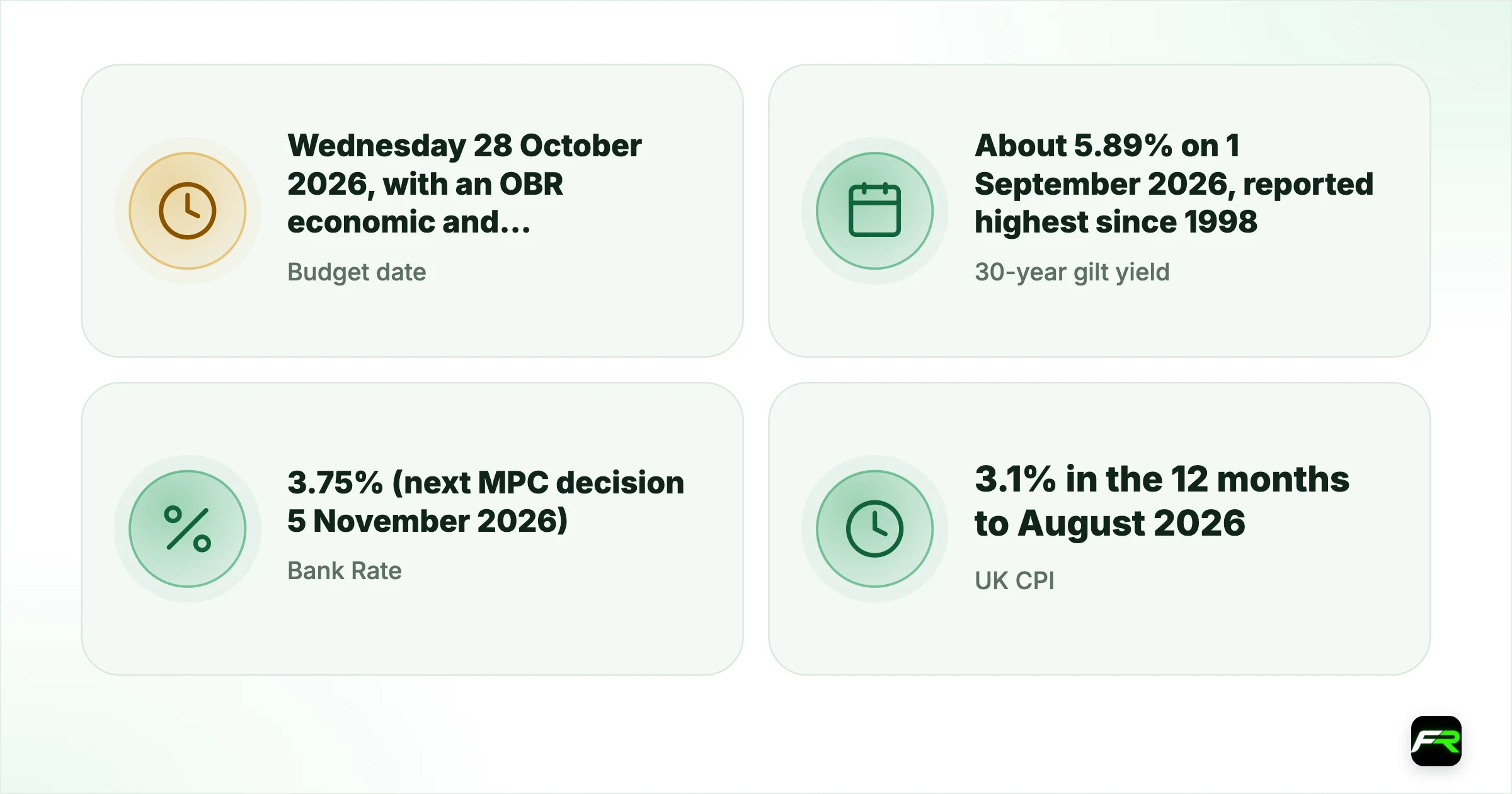
| Budget date | Wednesday 28 October 2026, with an OBR economic and fiscal forecast |
|---|---|
| 30-year gilt yield | About 5.89% on 1 September 2026, reported highest since 1998 |
| Bank Rate | 3.75% (next MPC decision 5 November 2026) |
| UK CPI | 3.1% in the 12 months to August 2026 |
| GBP/USD | Roughly 1.32 to 1.35 in September 2026 (approximate) |
| Historical warning | September 2022 mini-budget and gilt market stress |
Why higher yields have not lifted the pound
Textbook logic says higher interest rates attract foreign money and support a currency. That works well when yields rise because the economy is strong or the central bank is expected to tighten. It breaks down when yields rise because investors are worried about getting paid back in real terms, or about the size of future borrowing.
In that case the higher yield is compensation for risk, not a reward that draws money in. Foreign investors who already hold gilts may be selling, which means selling pounds too. Those who stay ask for a higher return. So yields go up and the currency goes down together, a combination that traders read as a sign of fiscal stress.
In 2026 long-dated gilt yields have been pushed up by several things at once: higher energy prices and inflation linked to the Middle East conflict, a broader global bond sell-off, and questions about how the government will meet its fiscal rules. The Bank of England's own statement in September focused on energy and inflation. Market commentary about the Budget has focused on the fiscal side. Both matter to sterling, and both point the same way when they combine.
| Why yields are rising | Usual effect on sterling | Example |
|---|---|---|
| Stronger growth, BoE expected to hike | Tends to support GBP | A hawkish MPC vote on good data |
| Inflation from an energy shock | Mixed | Rate hike hopes versus weaker real incomes |
| Doubts about public finances | Tends to weaken GBP | Yields and the pound falling together |
| Global bond sell-off | Depends on relative moves | US and European yields rising too |
The 2022 mini-budget as history
September 2022 is the reference point every UK trader should know. On 23 September 2022 the government announced a fiscal statement with large unfunded tax cuts. Gilts sold off hard and sterling fell sharply, reaching a record low against the dollar, reported just above $1.03, in early trading on 26 September. According to the Bank of England, the 30-year gilt yield rose by 130 basis points in three days of trading, a move three times larger than any other over a similar period.
The sell-off exposed pension funds using liability-driven investment (LDI) strategies, which faced collateral calls as gilt prices fell and had to sell more gilts to meet them. On 28 September 2022 the Bank announced temporary purchases of long-dated gilts on financial stability grounds. It bought £19.3 billion of gilts between 28 September and 14 October 2022. Most of the tax measures were later reversed, and the Chancellor who delivered the statement was replaced within weeks.
The lesson for traders is narrower than "every Budget brings a crisis": sterling can gap, gilts can move far more than usual, and correlations that normally hold can break when the market loses confidence in fiscal plans. Partly because of that episode, the Bank of England, the OBR and the fiscal rules exist in their current form, and markets watch them closely.
What to watch on Budget day
Budgets are delivered in the House of Commons, usually starting around 12:30 UK time, and the OBR publishes its forecast when the speech ends. Treat those times as typical, and check them in the week before. The pound often moves during the speech as headlines appear, and again once analysts read the OBR document.
- Borrowing and headroom: how much room the government leaves against its fiscal rules, according to the OBR. Thin headroom tends to worry gilt investors.
- Gilt issuance: the Debt Management Office's financing plan, especially how much long-dated debt it intends to sell. More long gilts at a time of weak demand can push long yields up.
- OBR growth and inflation forecasts: these feed into expectations for the Bank of England eight days later, on 5 November.
- Credibility signals: whether spending and tax plans are funded or rely on hopeful assumptions.
- The 30-year and 10-year gilt yields: watch them live. A sharp rise alongside a falling pound is the pattern to worry about.
Keep a gilt yield chart next to your GBP/USD chart on the day. If yields rise and the pound rises too, the market is probably reading the Budget as positive for growth or rates. Yields up and the pound down suggests the market is pricing fiscal risk.
Tax speculation and what it means for you
Budgets attract rumours. Press reports ahead of the Budget have speculated about aligning capital gains tax with income tax rates. That is speculation, not policy, and we do not treat it as more. The current position is set out in our UK forex tax guide: CFD gains fall under CGT at 18% or 24% above a £3,000 annual exempt amount, and spread betting profits are currently outside CGT for most individuals.
If a change is announced, check when it applies from before acting on it. Tax changes can take effect on the day, from the next tax year or later. A hurried sale of positions to beat a rumoured change that never happens can cost more in spreads and missed moves than the tax it was meant to save.
General information, not tax advice. Tax rules can change at the 28 October 2026 Budget. Speak to an accountant if your gains are large or your position is complicated.
A risk plan for Budget week
- Map the week. The Budget is on Wednesday 28 October, UK clocks go back on 25 October, US clocks on 1 November, and the MPC decides on 5 November.
- Cut position size on sterling pairs going into the day, or be flat through the speech if you cannot watch it.
- Allow for wider spreads and gaps. Stops can fill well away from their level if the pound moves quickly.
- Watch correlation. Long EUR/GBP, short GBP/USD and short GBP/JPY are all the same bet against sterling.
- Check margin. If the pound gaps, a highly leveraged account can hit the 50% close-out level before you react.
- Wait for the OBR document before forming a view, rather than trading the first headline from the speech.
Ellie trades spread bets part time with £12,000 in her account. Ahead of Budget week she holds a long GBP/USD position at £4 per point and a short EUR/GBP at £3 per point, both bets on sterling strength. She works out that a 100-pip move against sterling in both pairs would cost about £700, far more than her 1% rule allows. Two days before the Budget she closes the EUR/GBP trade and halves the cable position, leaving roughly £200 at risk on a 100-pip move. She plans to look again only after the OBR forecast is out and gilt yields have settled.
After the Budget
The first reaction is rarely the last. Gilt investors take days to digest issuance plans, and the Bank of England meets eight days later with its own forecasts, which will include the Budget measures. Sterling often trades the Budget and the MPC together as one story. Our articles on MPC decisions and cable cover what comes next.
Retail loss rates at large UK brokers ran between about 61% and 74% in September 2026, on their own published figures. Budget days add gap risk to that. Keep position sizes small enough that a surprise leaves your account intact.
Frequently asked
When is the UK Budget in 2026?
The Budget is set for Wednesday 28 October 2026, with an economic and fiscal forecast from the Office for Budget Responsibility published the same day. Eight days later, on Thursday 5 November 2026, the Bank of England announces its next rate decision.
Why do gilt yields affect the pound?
Gilt yields show what investors demand to lend to the UK government. When yields rise because the economy is strong, the pound usually benefits. Doubts about the public finances work the other way: foreign money can leave, and the pound may fall alongside gilts.
What happened to sterling in the 2022 mini-budget?
After the 23 September 2022 fiscal statement, gilts sold off and sterling fell to a record low against the dollar, reported just above $1.03, on 26 September. The Bank of England began temporary purchases of long-dated gilts on 28 September to stabilise the market.
Why is the 30-year gilt yield so high in 2026?
It was reported at about 5.89% on 1 September 2026, the highest since 1998. Reported reasons include higher energy prices and inflation, a global bond sell-off and concerns about UK public finances ahead of the Budget. Several forces were acting at once.
Will the Budget change tax on spread betting or CFDs?
Nothing has been announced. Press reports have speculated about aligning capital gains tax with income tax, which would affect CFD gains, but that is speculation only. Wait for the actual Budget documents and check when any change takes effect.
Should I hold sterling positions through the Budget?
That depends on your plan, but reduce size at least. Spreads can widen and prices can gap during the speech and after the OBR forecast. Many part-time traders are better off flat and trading the market once gilts and sterling have settled.
What time does the Budget speech start?
Budget statements usually begin around 12:30 UK time after Prime Minister's Questions, and the OBR releases its forecast when the speech finishes. Confirm the exact time closer to the date, as it is not fixed in law.
Related reading
The team behind this guide
Researched, checked and approved by five forex specialists
Every guide is written, fact-checked and edited before it goes live, and updated when the facts change. Spotted an error? Tell us.