IC Markets





































Leverage 1:500 vs 1:1000: What It Does to Your Risk
Concrete dollar examples showing what changing leverage from 1:500 to 1:1000 actually does, and why it changes nothing about a correctly sized trade but everything about a badly sized one.
 WriterAbir KhanWriterWrites the guides · checks every figure against primary sources View profileAbout Abir →
 Market analysisTanbir Habib RiyadForex & Crypto AnalystForex and crypto analyst · technical and fundamental analysis View profileAbout Tanbir →
 Fact-checking & riskJannatul FerdaushFact-Checker & Risk AnalystFact-checks every figure · risk analysis · Applied Statistics, University of Dhaka View profileAbout Jannatul →
 Trading reviewJowel RanaCo-Founder & Forex TraderCo-founder · forex trader · reviews guides from a trader's view View profileAbout Jowel →
 Final approvalRanjan NiskrityFounder, Owner & Forex TraderFounder and owner · forex trader · signs off every guide View profileAbout Ranjan →
Key takeaways
- Leverage changes the margin a position needs, not its profit or loss: 30 pips on 1 lot of EUR/USD is about $300 at 1:30 or 1:1000.
- High leverage only matters if you size by margin; it removes the ceiling that stops a small account over-sizing.
- If you size every trade by risk (risk amount divided by stop distance), your results are the same at any leverage.
- Regulated brokers under the FCA, ASIC and CySEC cap retail forex at 30:1 because the data links high leverage to faster losses.
Leverage is the most misunderstood number in retail trading. Traders choose brokers based on it, believing 1:1000 lets a small account grow twice as fast as 1:500. It does not. Leverage does not touch your profit or loss on a trade. What it changes is the maximum position size the account can open, which only matters if you are sizing positions by margin instead of by risk. This guide shows the difference with numbers.
What leverage actually is
Leverage is the ratio between your position's notional value and the margin it locks up. At 1:500, a $100,000 position uses $200 of margin. At 1:1000, the same position uses $100. That is the entire mechanical difference. The pip value, the profit, the loss, the stop distance, all identical. If EUR/USD moves 30 pips against a 1-lot position, you lose about $300 whether your leverage is 1:30, 1:500 or 1:1000.
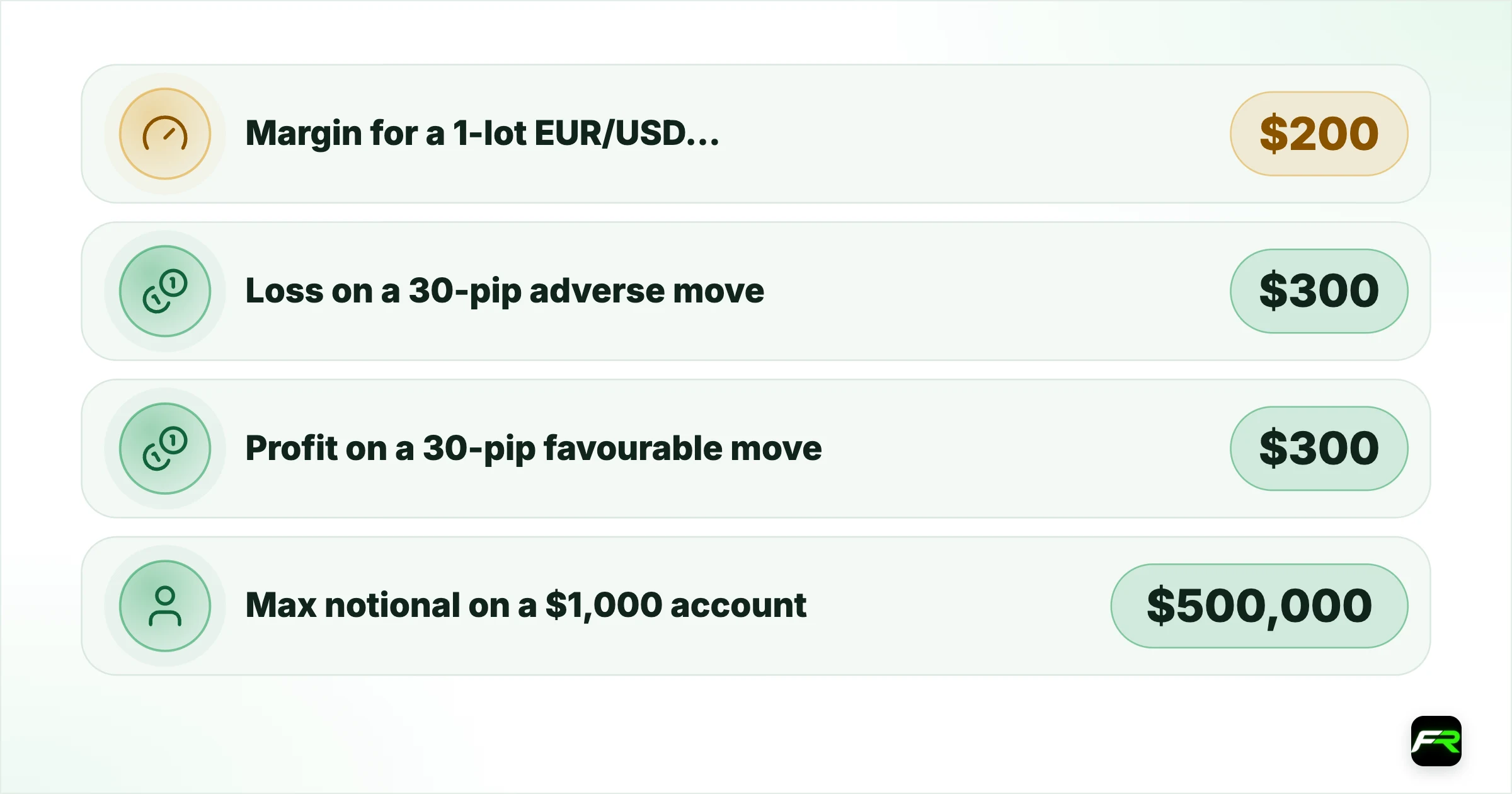
| 1:500 | 1:1000 | |
|---|---|---|
| Margin for a 1-lot EUR/USD position | $200 | $100 |
| Loss on a 30-pip adverse move | $300 | $300 |
| Profit on a 30-pip favourable move | $300 | $300 |
| Max notional on a $1,000 account | $500,000 | $1,000,000 |
| Max lots on a $1,000 account | ~5.0 | ~10.0 |
Where it does change things
On a $1,000 account, 1:500 lets you open up to about 5 lots and 1:1000 lets you open about 10. Neither is a good idea. A single lot of EUR/USD on a $1,000 account is a $10-per-pip position, so a 40-pip move is a $400 loss, 40 per cent of the account. The higher leverage does not make you money faster. It removes the natural ceiling that would otherwise stop a small account taking a catastrophic position, and it delays the point at which a margin call would have forced the position closed at a smaller loss. At 1:100, the account above could not have opened that oversized position in the first place; at 1:1000, it can, and the first warning the trader gets is the margin call arriving much closer to a wiped-out balance than it would at a sane leverage setting.
This is why regulated brokers under the FCA, ASIC and CySEC cap retail forex at 1:30. The FCA's PS19/18 policy statement set that limit after its own data, and a matching EU-wide study by ESMA, showed that higher leverage correlates with faster account losses, because it enables oversizing. An entity offering 1:1000 is doing so from a light-touch jurisdiction, and the number is aimed at traders who have not yet learned why the cap exists.
Hendra switched from a 1:500 broker to a 1:1000 one specifically to 'trade bigger'. His strategy and win rate did not change. What changed was that he started opening 2-lot positions on his $1,500 account instead of 1-lot, because the margin allowed it. His average loss doubled overnight. Three weeks later the account was down 60 per cent. He moved to a broker with 1:100 leverage, not because he had to, but to remove the temptation. His position sizes are now set by a 1 per cent risk rule and the account leverage is irrelevant to him.
The correct-sizing test
Here is how to tell whether leverage matters to you. Take your last ten trades. For each, was the position size calculated as: risk amount divided by (stop in pips times pip value)? If yes, your leverage could be 1:30 or 1:2000 and your results would be identical, because the position size never touched the leverage figure. If instead you sized by 'how many lots can I afford' or 'the margin allows X', then leverage is quietly setting your risk, and higher leverage means higher risk.
If your plan requires more than 1:30 leverage to place the position you want, the position is too large for the account. Cutting the size fixes it. A broker with a higher cap just lets you make the mistake at greater scale.
What to actually look for in a broker
Leverage should not be near the top of your list. A verifiable licence, spreads on the pairs you trade during the hours you trade them, a clean withdrawal record, and local funding matter far more. If two brokers are otherwise equal, more leverage does no harm to a disciplined trader, but it should never be the deciding factor. The leverage limits guide in our broker section covers which regulators cap what.
How leverage caps work differently on a prop firm account
Everything above assumes a retail brokerage account, where leverage is set by whichever regulator licenses the broker. A funded prop firm account is a different structure: you are trading the firm's capital under its own rules, not a retail account subject to FCA, ASIC or ESMA leverage caps, so the firm sets its own leverage figure, commonly somewhere between 1:30 and 1:100 on forex, occasionally higher, and that number can vary by instrument and even by challenge phase.
The more important point is that leverage is almost irrelevant on a prop firm account for a different reason than on a retail one. A funded account is bound by a daily loss limit and a maximum drawdown limit, both fixed in dollars regardless of what leverage the platform technically allows. Whatever leverage the firm sets, the drawdown rule is the real ceiling: breach it and the account is closed, no matter how much margin was still available. The trailing drawdown guide covers exactly how that ceiling is measured, and it is worth understanding before assuming a prop firm's leverage number tells you anything about how much you can safely risk.
Sources and where to check it yourself
- FCA policy statement PS19/18: why the UK capped retail leverage at 30:1 on major pairs
- ESMA: CFD restrictions for retail clients (2018): the EU leverage limits and the loss data behind them
Frequently asked
Does 1:1000 leverage let me profit faster than 1:500?
No. Profit and loss on a trade depend on position size and price movement, not leverage. Leverage only sets how much margin a position uses and the maximum position the account can open.
Is high leverage ever useful?
For a disciplined trader who sizes by risk, higher leverage is harmless and occasionally convenient (less margin tied up). It is dangerous only for traders who size by margin, which is most beginners.
Why do offshore brokers offer such high leverage?
They operate from jurisdictions with light conduct rules and use the leverage number to attract traders, particularly those who do not yet understand that tier-one regulators cap it for a reason.
Can I lower the leverage on my account?
Most brokers let you set a lower maximum leverage in the account settings. It is a reasonable way to enforce discipline, though sizing by risk makes the setting irrelevant.
What leverage do the regulated brokers offer?
FCA, ASIC and CySEC cap retail forex majors at 1:30, with tighter caps on minors, gold, indices and crypto. Professional clients can access higher leverage but must meet strict criteria.
Related reading
The team behind this guide
Researched, checked and approved by five forex specialists
Every guide is written, fact-checked and edited before it goes live, and updated when the facts change. Spotted an error? Tell us.