





























IC Markets Tax UK: Reporting CFD Gains to HMRC
IC Markets profits are CFD gains, so UK residents pay capital gains tax at 18% or 24% above £3,000. Here is how to convert dollar P&L to sterling, what to deduct and when to file.
 WriterAbir KhanWriterWrites the guides · checks every figure against primary sources View profileAbout Abir →
 Market analysisTanbir Habib RiyadForex & Crypto AnalystForex and crypto analyst · technical and fundamental analysis View profileAbout Tanbir →
 Fact-checking & riskJannatul FerdaushFact-Checker & Risk AnalystFact-checks every figure · risk analysis · Applied Statistics, University of Dhaka View profileAbout Jannatul →
 Trading reviewJowel RanaCo-Founder & Forex TraderCo-founder · forex trader · reviews guides from a trader's view View profileAbout Jowel →
 Final approvalRanjan NiskrityFounder, Owner & Forex TraderFounder and owner · forex trader · signs off every guide View profileAbout Ranjan →
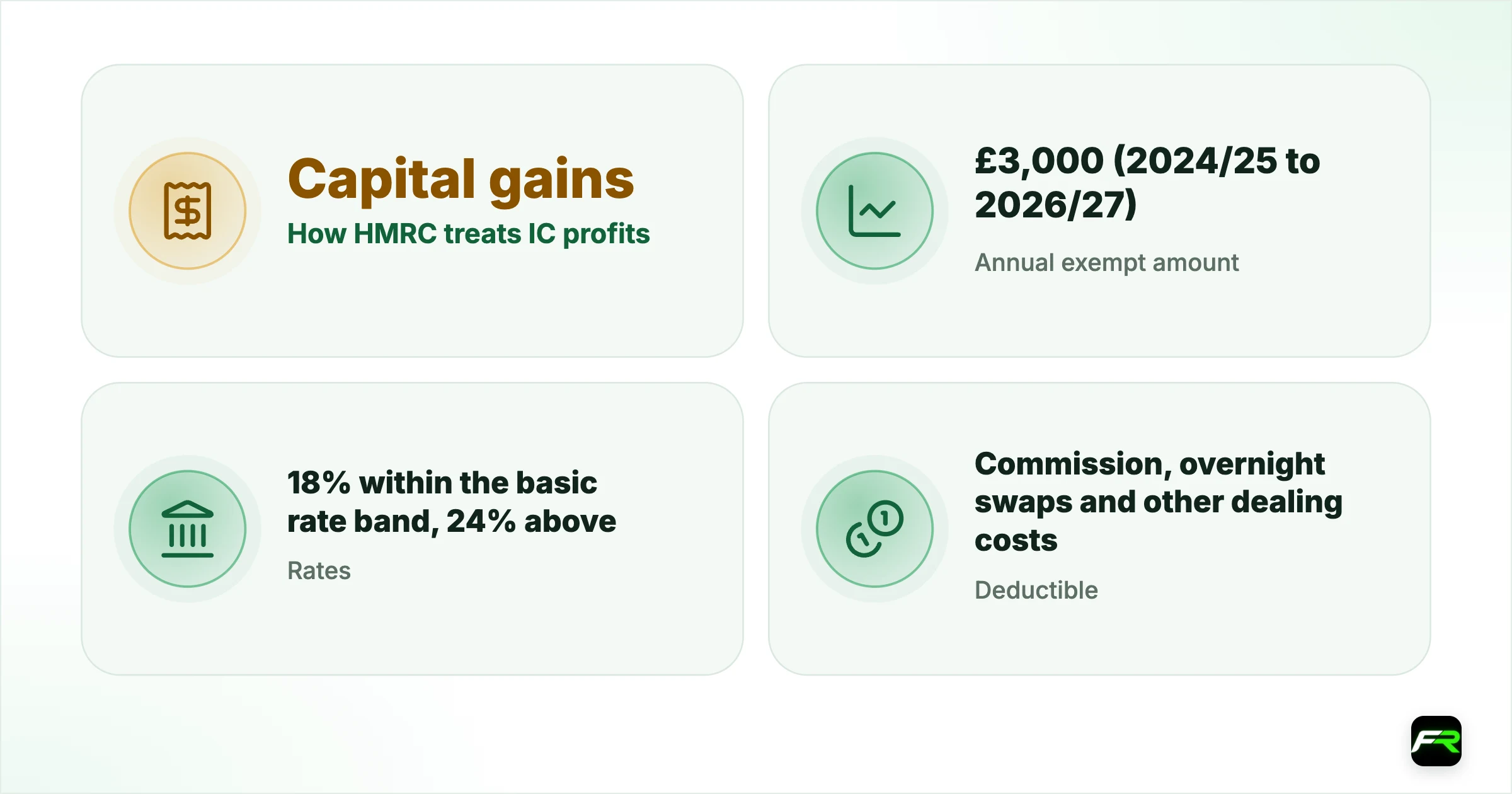
If you live in the UK and make money on IC Markets (now trading as IC), you owe capital gains tax on it. Every IC product is a contract for difference, and HMRC charges CFD outcomes under the capital gains regime in almost every case. You pay 18% on gains within your unused basic rate band and 24% above it, after a £3,000 annual exempt amount. The broker being in the Seychelles makes no difference: UK residents are taxed on their worldwide gains.
The awkward part is the arithmetic. IC reports in whatever base currency you chose, often US dollars, and it does not issue a UK tax statement. You have to turn a year of closed trades into a sterling figure HMRC will accept. Below we set out the rules, the conversion method, the costs you can deduct, and the dates, with a worked example at the end.
General information, not tax advice. Your own position depends on your circumstances, and tax rules can change, including at the 28 October 2026 Budget. An accountant who deals with traders is worth the fee if your gains are large or complicated.
| How HMRC treats IC profits | Capital gains (CFDs are financial futures, CG56100) |
|---|---|
| Annual exempt amount | £3,000 (2024/25 to 2026/27) |
| Rates | 18% within the basic rate band, 24% above (from 30 October 2024) |
| Deductible | Commission, overnight swaps and other dealing costs |
| Losses | Allowable; claim within 4 years of the end of the tax year |
| 2025/26 deadlines | Register by 5 October 2026; online return and payment by 31 January 2027 |
Why IC profits fall under capital gains tax
HMRC's Capital Gains Manual, at CG56100, describes retail contracts for differences as financial futures and says that "unless the profits are taxable as trading income, in almost every case" the outcomes are charged to capital gains tax. Its Business Income Manual (BIM56850) adds a starting presumption that an individual engaged in speculative dealings in securities is not trading. So for a part-time trader with a job, IC gains are capital gains.
HMRC would only treat you as a trader, with profits taxed as income, if your activity looked like a business: full-time, organised, perhaps with borrowed money and staff. In practice that is rare for retail CFD accounts, and our badges of trade explainer covers the tests. The rest of this page assumes the normal capital gains treatment.
Spread betting would be different. HMRC says no chargeable gains or losses arise from spread bets, but IC does not offer them. That gap is covered in does IC Markets offer spread betting, and spread betting vs CFDs compares the two products for a UK taxpayer.
How to convert dollar or pound account P&L into sterling
CGT is computed in pounds. HMRC's manual at CG78310 says amounts in a foreign currency are converted at the sterling value on the date of acquisition and the date of disposal. For a CFD the practical route is to take the realised result of each closed trade, including its commission and any swaps booked to it, and convert that figure to sterling using the exchange rate on the day the trade closed. Use one consistent source for rates, such as the Bank of England's published daily spot rates, and keep a note of which one you used.
With a GBP base account, most of that work disappears. IC offers GBP as one of ten base currencies, and the GBP Raw account charges £2.75 commission per side per lot, so your statement already shows sterling results. Our round-up of forex brokers with GBP accounts shows how FCA firms handle the same question. Be aware that a GBP account trading a dollar-priced market still books the P&L in pounds at IC's conversion rate at the time, which is what you report.
A USD account raises one more point. HMRC treats foreign currency as a chargeable asset in its own right (CG78300), although gains and losses on an individual’s foreign currency bank accounts have been outside CGT since April 2012. Whether a dollar balance held at a broker counts as a bank account for that purpose is not clear-cut. For most retail balances the effect is small, but if you hold tens of thousands of dollars at a broker for years, ask an accountant how to handle it.
What goes into the computation
- Realised profit or loss on each closed CFD: open trades at 5 April are not disposed of yet and belong to the year they close.
- Commission: IC's per-lot commission on Raw accounts is an allowable dealing cost. HMRC's CFD guidance includes it in the computation.
- Overnight swaps and financing: interest and dividend equivalents on CFDs are part of the gain or loss.
- Swap-free holding fees: on Islamic accounts, the flat fee IC charges (for example USD 7 per lot on GBP/USD) is a cost of the position.
- Not deductible: deposits and withdrawals themselves, bank transfer charges on moving money, subscriptions, courses and VPS fees.
Losses, the exempt amount and your rate
CFD losses are allowable, which is one real advantage over spread betting. Losses in the same tax year are set against gains of that year first, even if that wastes part of your £3,000 exempt amount. Anything left over, or a loss from a year with no gains, can be carried forward, but only once you have reported them. HMRC's time limit is four years from the end of the tax year in which the loss arose, so a 2022/23 loss must be claimed by 5 April 2027. Brought-forward losses are only used to bring later gains down to the exempt amount, so they are not wasted.
Your CGT rate depends on your income. Add your taxable gain on top of your taxable income: the slice that fits inside the basic rate band is taxed at 18%, anything above at 24%. A higher rate taxpayer pays 24% on the lot. The rates changed on 30 October 2024 from 10% and 20%, and some older guides still show those numbers.
The 28 October 2026 Budget may change CGT. Press reports since August 2026 have speculated about aligning CGT rates with income tax. Nothing has been announced; treat any figure you read before the Budget as speculation.
Self assessment: who files and when
You must report CFD gains through self assessment if you have tax to pay, which means net gains above £3,000. A return is also needed if your total disposal proceeds for the year exceed £50,000, even when no tax is due. HMRC does not spell out how "proceeds" applies to a CFD, which has no purchase price in the usual sense, so an active IC trader with dozens of positions a month is safest filing a return every year. That return is also how you register losses for later use.
| Step (2025/26 tax year) | Deadline |
|---|---|
| Tax year ends | 5 April 2026 |
| Register for self assessment if you have never filed | 5 October 2026 |
| Paper return | 31 October 2026 |
| Online return and payment of CGT | 31 January 2027 |
Gains go on the capital gains pages (SA108), with a computation attached or described in the notes. Payments on account usually do not apply to capital gains tax. If you realise you should have reported IC gains in an earlier year, HMRC expects you to put it right; the longer you leave it, the more interest and penalties build up.
The offshore broker changes nothing, except your paperwork
A common belief is that gains held at an overseas broker are outside HMRC's reach. They are not. UK residents are taxed on worldwide gains, and HMRC receives account information from many countries under international exchange agreements. The Seychelles appears on HMRC’s list of Common Reporting Standard reportable jurisdictions, the countries the UK swaps financial account data with each year. HMRC uses offshore data of this kind to write to people who may have undeclared income or gains, letters often called nudge letters. Whether IC reports your account or not, the liability is yours.
Anyone who realises they left IC gains off an earlier return can put it right through HMRC’s Worldwide Disclosure Facility, which exists for undeclared offshore income and gains. Coming forward before HMRC asks usually leads to a better outcome than waiting for a letter, and an accountant can help you work out the figures for each year.
Where the offshore status does bite is record-keeping and disputes. IC is not authorised by the FCA, so there is no UK-style annual statement designed for HMRC, and if the firm ever failed or froze an account there is no Financial Ombudsman or FSCS to help you recover records or money. Download monthly statements and a full trade history at least once a year and keep them well beyond the year you file. We suggest at least five years, since loss claims can reach back four. Our step-by-step guide to reporting CFD gains shows how to lay out the working.
Export the full history from your IC client area or MT4/MT5 account history as a spreadsheet each April. Add columns for close date, sterling rate and sterling result, and the tax computation becomes a SUM formula.
Callum earns a salary of £40,000 and trades a USD Raw account at IC. He converts each 2025/26 closed trade, net of commission and swaps, at the rate on the day it closed, then totals the sterling results by month. For illustration, take four monthly totals: a £4,000 gain (USD 5,200 at 1.30), a £1,000 loss (USD 1,350 at 1.35), a £5,000 gain (USD 6,250 at 1.25) and another £1,000 loss (USD 1,300 at 1.30). Gains total £9,000 and losses £2,000, so his net gain is £7,000. After the £3,000 exempt amount, £4,000 is taxable. His taxable income is £27,430 (salary less the £12,570 personal allowance), leaving £10,270 of the £37,700 basic rate band unused, so the whole £4,000 falls at 18%: £720. He files online by 31 January 2027 and pays the £720 the same day. Had he reported his losses a year late, they would still count, because the four-year window runs to 5 April 2030.
Frequently asked
Do I pay tax on IC Markets profits in the UK?
Yes, if you are UK resident. IC products are CFDs, which HMRC charges to capital gains tax in almost every case. You pay 18% or 24% on net gains above the £3,000 annual exempt amount, reported on your self assessment return.
Does IC Markets report to HMRC?
IC issues no UK tax statement. The Seychelles, where Raw Trading Ltd is licensed, is on HMRC’s list of Common Reporting Standard jurisdictions, and HMRC uses offshore account data to send so-called nudge letters to people who may owe tax. Whatever IC does or does not report, declaring your gains is your job, and past omissions can be fixed through the Worldwide Disclosure Facility.
How do I convert a USD IC account to pounds for tax?
Convert the realised result of each closed trade, with its commission and swaps, at the sterling exchange rate on the date it closed. Use one reliable rate source consistently, such as the Bank of England's daily rates, and keep your working with your records.
Can I deduct IC Markets commission and swaps?
Yes. Commission and overnight financing on CFDs are part of the gain or loss computation. Things like bank transfer charges, courses, subscriptions and VPS fees are not deductible against capital gains.
Can I use IC Markets losses against other gains?
Yes. CFD losses are allowable for capital gains tax. They offset gains in the same year first, including gains on shares or property, and any excess can be carried forward if you claim within four years of the end of the tax year.
Do I need to file if my IC profit is under £3,000?
Not usually, if no tax is due and your disposal proceeds are under £50,000. Because proceeds are hard to define for CFDs and filing is how you lock in losses, active traders often file anyway. Ask HMRC or an accountant if unsure.
What are the self assessment deadlines for 2025/26?
Register by 5 October 2026 if you have not filed before. Paper returns are due by 31 October 2026. Online returns, and payment of any capital gains tax, are due by 31 January 2027.
Does using a GBP account at IC help with tax?
It simplifies the paperwork, because your results are already in pounds, which is what HMRC wants. The tax itself stays the same. Commission on the GBP Raw account is £2.75 per side per lot.
Related reading
The team behind this guide
Researched, checked and approved by five forex specialists
Every guide is written, fact-checked and edited before it goes live, and updated when the facts change. Spotted an error? Tell us.