





























Trading UK CPI Releases: What Moves Sterling at 7am
UK CPI moves the pound on the gap between the figure and the forecast, and services and core inflation often matter more than the headline. How the 07:00 release works, and the risks.
 WriterAbir KhanWriterWrites the guides · checks every figure against primary sources View profileAbout Abir →
 Market analysisTanbir Habib RiyadForex & Crypto AnalystForex and crypto analyst · technical and fundamental analysis View profileAbout Tanbir →
 Fact-checking & riskJannatul FerdaushFact-Checker & Risk AnalystFact-checks every figure · risk analysis · Applied Statistics, University of Dhaka View profileAbout Jannatul →
 Trading reviewJowel RanaCo-Founder & Forex TraderCo-founder · forex trader · reviews guides from a trader's view View profileAbout Jowel →
 Final approvalRanjan NiskrityFounder, Owner & Forex TraderFounder and owner · forex trader · signs off every guide View profileAbout Ranjan →
UK consumer price inflation is published by the Office for National Statistics at 07:00 UK time, usually on a Wednesday in the middle of the month, and sterling moves on the difference between the published numbers and what economists expected. Headline CPI was 3.1% in the 12 months to August 2026, up from 2.9%, and the next release is due on 21 October 2026. For trading purposes, services inflation and core inflation often matter as much as the headline, because they tell the Bank of England whether price pressure is spreading beyond energy.
A definition of CPI and a warning to "expect volatility" are not much help at 06:59. Below you will find the current numbers, the parts of the release the market reads first, how surprises have tended to move the pound, why liquidity at 7am is a hazard of its own, and a set of rules to use on the day.
Market education, not investment advice. FX Recap does not give trade signals or price targets. Price levels quoted here are approximate, dated and will have moved by the time you read this. CFDs and spread bets are leveraged and most retail accounts lose money.
| Release time | 07:00 UK time (ONS) |
|---|---|
| CPI, 12 months to August 2026 | 3.1% (July 2.9%) |
| Core CPI | 2.6% (unchanged) |
| Services CPI | 3.4% (unchanged) |
| CPIH | 3.3% |
| Next release | 21 October 2026 (September data) |
The August 2026 figures in context
The ONS August 2026 bulletin, published on 16 September, showed CPI inflation at 3.1%, the highest in five months. Transport made the largest upward contribution, driven by motor fuels: petrol rose 9.1 pence a litre during August and diesel 14.2 pence. Goods inflation climbed from 2.2% to 2.7%. Core CPI, which strips out energy, food, alcohol and tobacco, stayed at 2.6%, and services inflation stayed at 3.4%.
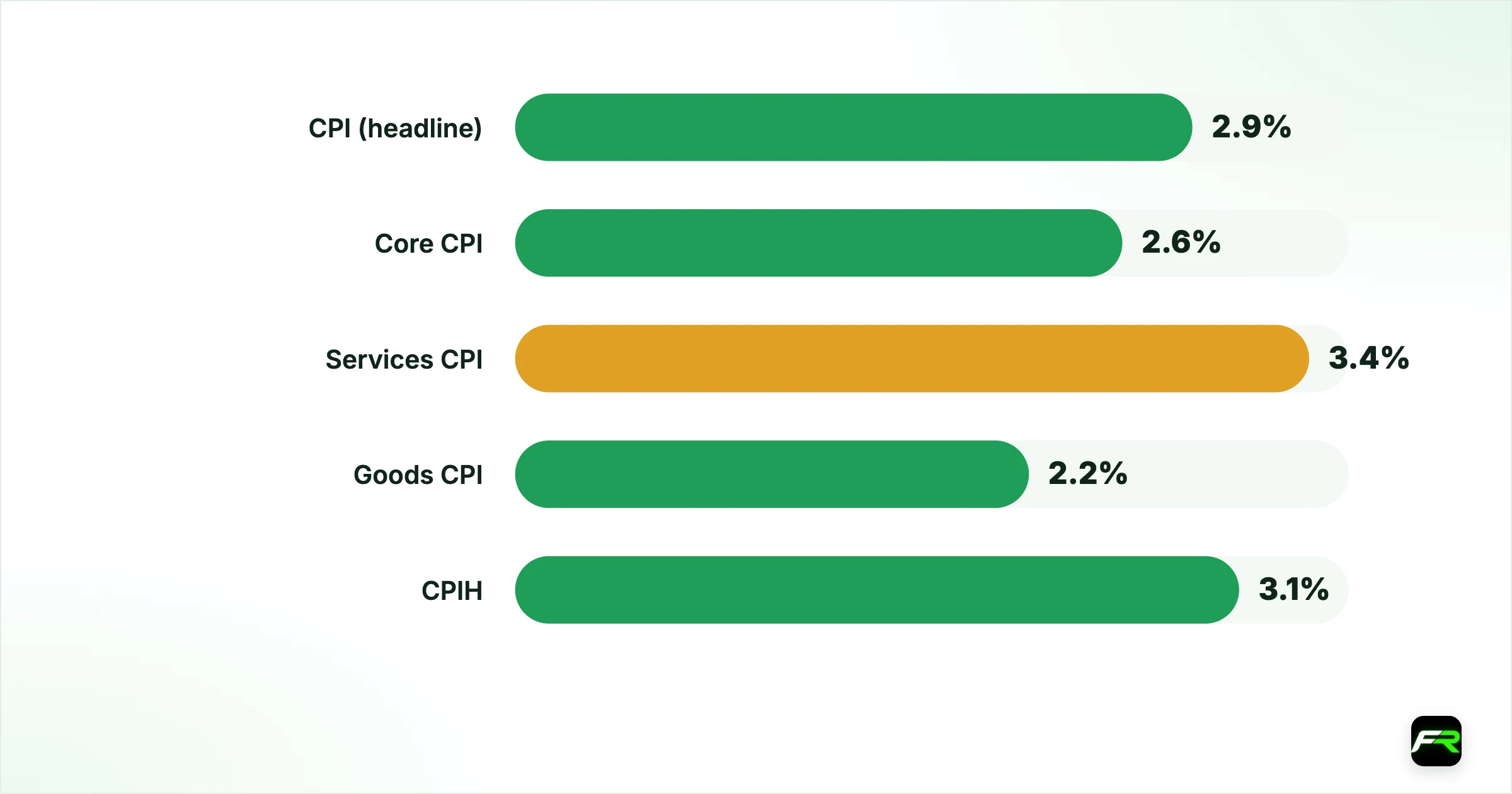
That mix told a specific story: the rise came from fuel, not from a broad acceleration in prices set at home. For the Bank of England, which met the next day, that is the difference between an energy shock it can look through and an inflation problem it has to fight. The MPC held at 3.75% by 6-3, with three members voting to raise. Its projections have CPI reaching around 3¾% in the fourth quarter of 2026 and slightly above 4% in the first quarter of 2027.
| Measure | July 2026 | August 2026 | What traders read into it |
|---|---|---|---|
| CPI (headline) | 2.9% | 3.1% | Energy pass-through, headline for the press |
| Core CPI | 2.6% | 2.6% | Underlying trend, excluding volatile items |
| Services CPI | 3.4% | 3.4% | Domestic price pressure, closely watched by the MPC |
| Goods CPI | 2.2% | 2.7% | Fuel and imported costs |
| CPIH | 3.1% | 3.3% | Includes owner occupiers' housing costs |
Headline, core and services: what the market reads first
Headline CPI is the number in the news, and algorithms react to it first. Within seconds, though, dealers and analysts look at core and services. Services prices are mostly set by domestic wages and demand, so they show whether inflation is becoming embedded in the UK economy. The Bank of England has repeatedly highlighted services inflation as a gauge of persistence, which is why a services surprise can move sterling even when the headline matches forecasts.
Core inflation does a similar job from a different angle. It removes energy and food, which are driven by world prices and can swing sharply month to month. In autumn 2026 the headline is being pushed up by fuel while core is flat. If core and services begin to rise too, markets would likely treat that as a stronger case for a rate increase.
Before the release, write down the consensus for headline, core and services. After it, compare all three. A headline beat with a services miss is a mixed signal, and the first spike in the pound often fades.
Surprise versus consensus
Economists publish forecasts for each CPI release, and the median becomes the consensus shown on the economic calendar. The market prices that consensus before 07:00. So a 3.1% print when 3.1% was expected, as in August, usually produces only a modest move, because nothing new was learnt. A 3.3% or a 2.9% would be a surprise and would change rate expectations.
The size of the reaction depends on how much the surprise changes the outlook for policy. When a rate change at the next meeting is a close call, as it is going into November 2026 with three MPC members already voting to raise, a CPI surprise carries more weight. With policy firmly on hold, the same surprise may move the pound less.
Typical reaction patterns
We describe these carefully because no pattern holds every time. As a tendency, an upside surprise, especially in services or core, makes higher UK rates more likely and tends to lift sterling against the dollar and the euro. A downside surprise tends to do the opposite. The reaction in the first minute is often exaggerated, and part of it can reverse by the London open at 08:00 as more participants arrive and look at the detail.
There is an exception worth knowing in 2026. When inflation rises because of energy costs, markets can worry about growth and public finances as well as rates. In that situation sterling does not always rise on a hot print, because higher inflation may also mean weaker real incomes and more pressure on the government's borrowing. Our article on gilts, the Budget and sterling goes into that link.
A purely British surprise also shows up differently across the sterling pairs. Cable carries whatever the dollar is doing that morning, while EUR/GBP strips the dollar out, so a UK-only inflation shock is often easiest to read in the cross. Remember the direction flips: a hot print that lifts the pound pushes EUR/GBP down.
Liquidity at 7am
The awkward part of UK data is its timing. At 07:00 UK time, London dealing desks are only starting to fill up, Asia is winding down, and New York is asleep. Fewer participants means thinner order books, so a surprise can push the price a long way quickly and spreads widen more than they would at 14:00.
- Spreads: expect the spread on GBP pairs to widen in the seconds either side of 07:00. At some brokers it can be several times the normal level for a short period.
- Slippage: stop orders become market orders when triggered, so they fill at the next available price, which can be well past your level.
- Pending orders: entry orders placed close to the pre-release price can be triggered by a brief spike and then left in a losing position when price snaps back.
- Clock changes: the release is always 07:00 UK local time. After 25 October 2026 that is 07:00 GMT, so nothing changes for UK traders, but overseas platforms showing server time may look different.
Rules for CPI day
- Know the consensus for headline, core and services before 07:00.
- Decide in advance whether you will be flat at 07:00. For most retail traders that is the sensible default.
- If you do hold a position, cut its size so that a stop filled 20 pips worse than planned is still an acceptable loss.
- Wait at least 15 minutes after the release before opening a new trade, so that spreads normalise and the detail has been read.
- Check what else is due that day. US data at 13:30 can overwhelm the CPI move.
- Record the outcome, the consensus, the fill and the result. After a few months you will know how your broker behaves at 07:00.
Guaranteed stops, where offered, are the only way to fix your exit price through a release. Normal stops protect you from holding a losing trade indefinitely, not from a gap.
Sian has £3,000 in a spread betting account and trades before work. On a CPI morning she leaves a buy stop on GBP/USD 10 pips above the 06:55 price, planning to catch a hawkish surprise. The headline comes out slightly above forecast, cable spikes 25 pips, her order fills 6 pips worse than her level, and then price falls back as traders notice services inflation missed. Her stop, 20 pips below entry, fills 4 pips late. That is 24 points against her, so at £2 per point she loses £48 on the trade itself rather than the £40 her stop was meant to cap, plus the wider spread. She now waits until 07:20 and trades only when headline, core and services all point the same way.
Where CPI sits among UK data
CPI is the most market-moving UK release, but it is not alone. Labour market statistics, including pay growth, also come out at 07:00 and feed straight into the Bank's view of services inflation. Monthly GDP and retail sales matter too, usually less. Our best times to trade from the UK article shows how these fit around a normal working week, and trading around a UK job covers the practical side of early releases.
Frequently asked
What time is UK CPI released?
The Office for National Statistics publishes consumer price inflation at 07:00 UK time, and the September 2026 figures are due on 21 October 2026. Releases are usually mid-month, and the exact date is on the ONS release calendar and on most economic calendars.
What was UK inflation in August 2026?
CPI was 3.1% in the 12 months to August 2026, up from 2.9% in July. Core CPI was 2.6% and services 3.4%, both unchanged. CPIH, which includes owner occupiers' housing costs, was 3.3%. Motor fuel was the main driver of the rise.
Why does services inflation matter so much for the pound?
Services prices are driven mainly by UK wages and demand, so they show whether inflation is becoming persistent at home. The Bank of England watches them closely. A services surprise can therefore change rate expectations, and sterling, more than a move in fuel prices.
Does higher inflation always strengthen sterling?
Not always. Higher inflation can mean higher rates, which tends to support the pound. But if it comes from an energy shock that also hurts growth and public finances, investors may sell sterling anyway. The reaction depends on why inflation rose and what it means for policy.
Why are spreads wide at 7am on data days?
Few dealers are active at 07:00 UK time, since London is just opening and New York is closed. With thin order books, market makers widen quotes around the release to protect themselves. Spreads usually narrow within minutes.
Should I place pending orders either side of the price before CPI?
It is a common idea and a risky one. A quick spike can trigger one order with slippage and then reverse, leaving you in a losing trade. Some traders get both orders triggered in quick succession. A short wait for the dust to settle costs a few pips but avoids that.
What is the difference between CPI and CPIH?
CPIH adds owner occupiers' housing costs and council tax to CPI. The ONS treats CPIH as its lead measure, but the Bank of England's 2% target is set on CPI, so CPI is the figure currency markets watch most closely.
Related reading
The team behind this guide
Researched, checked and approved by five forex specialists
Every guide is written, fact-checked and edited before it goes live, and updated when the facts change. Spotted an error? Tell us.