





























Is Spread Betting Tax Free in the UK? What HMRC Says
Yes, for most UK individuals: HMRC treats spread bets as gambling, so there is no CGT and no Income Tax on winnings. The catch is that losses give no relief, and the "main income" rule is a myth.
 WriterAbir KhanWriterWrites the guides · checks every figure against primary sources View profileAbout Abir →
 Market analysisTanbir Habib RiyadForex & Crypto AnalystForex and crypto analyst · technical and fundamental analysis View profileAbout Tanbir →
 Fact-checking & riskJannatul FerdaushFact-Checker & Risk AnalystFact-checks every figure · risk analysis · Applied Statistics, University of Dhaka View profileAbout Jannatul →
 Trading reviewJowel RanaCo-Founder & Forex TraderCo-founder · forex trader · reviews guides from a trader's view View profileAbout Jowel →
 Final approvalRanjan NiskrityFounder, Owner & Forex TraderFounder and owner · forex trader · signs off every guide View profileAbout Ranjan →
Yes. For most individuals in the UK, profits from financial spread betting are free of Capital Gains Tax and Income Tax, and you do not report them on a tax return. HMRC's own manuals say so in plain words: a spread bet is a wager, no asset is bought or sold, and gambling profits sit outside Income Tax for individuals. The exceptions are narrow. They cover spread bets used to hedge a real business risk and the rare case of someone who is running a betting business rather than placing bets. The price of the exemption is symmetry: spread bet losses cannot be set against anything.
That short answer is what most pages give you. What they often get wrong is the reason, and the myth that spread betting becomes taxable once it is your "main income". Below we quote the HMRC manual wording, explain who pays the duty on your bets, and separate genuine Budget risk from speculation.
General information, not tax advice. Your position depends on your own circumstances, and tax rules can change, including at the 28 October 2026 Budget. If your gains are large, your situation is unusual or you are unsure which regime applies, a qualified tax adviser who works with traders is worth the fee.
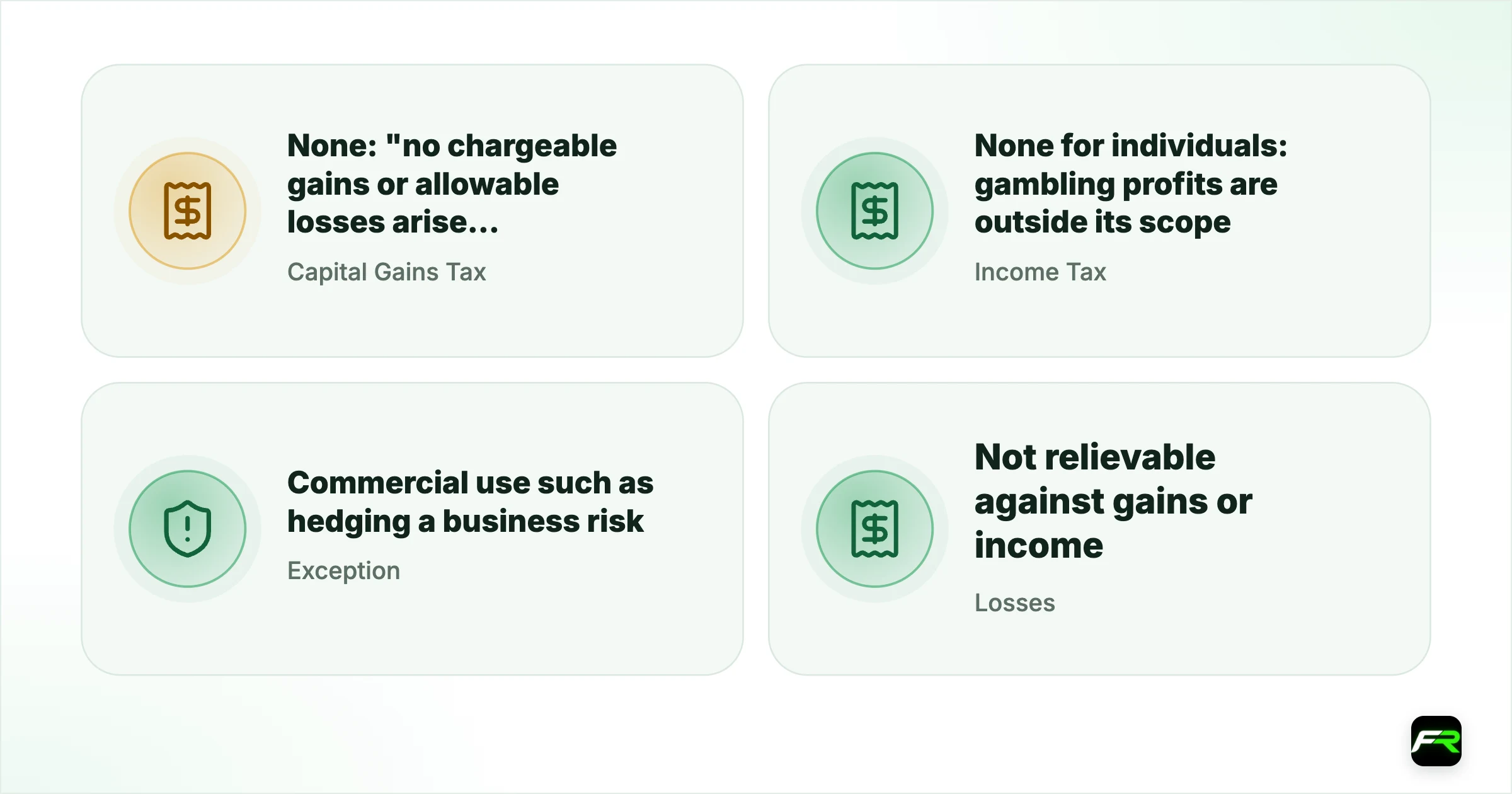
| Capital Gains Tax | None: "no chargeable gains or allowable losses arise from spread betting" (CG56105) |
|---|---|
| Income Tax | None for individuals: gambling profits are outside its scope (BIM56900) |
| Exception | Commercial use such as hedging a business risk (BIM56880) |
| Losses | Not relievable against gains or income |
| Stamp duty | None, as you never own the underlying shares |
| Betting duty | 3%, paid by the operator, not by you |
What the HMRC manuals say, word for word
Three passages settle the question for ordinary traders. The Capital Gains Manual at CG56105 states that with spread betting "no assets are acquired or disposed of and no chargeable gains or allowable losses arise". Because CGT is a tax on disposals of assets, a contract that involves no asset at all cannot produce a chargeable gain, however large the win.
Income Tax is dealt with in the Business Income Manual. BIM56900 says the profits or losses from gambling or wagering contracts are outside the scope of Income Tax, and tells inspectors to examine an individual’s spread bet to see whether it is that kind of contract, which an ordinary private bet usually will be. The same page then gives the exception: the treatment does not apply where the spread bet is used for a commercial purpose such as a hedge, in which case BIM56880 applies instead.
The third passage explains why skill and consistency do not change things. BIM22017 discusses Graham v Green, a 1925 case about a man who lived off his winnings from betting on horses at starting prices. In the court's words, "there is no tax on a habit". HMRC's summary of the case is that betting systematically, studying the form closely or making a living from bets does not by itself turn betting into a trade. The judge did not think the punter could be said to organise his effort in the way a bookmaker organises his.
The "main income" myth
Search for this topic and you will see a claim repeated across broker blogs and comparison pages: spread betting is tax free "unless it is your main source of income", or unless you are a "professional" spread bettor. That is not HMRC's stated position. Nothing in CG56105, BIM56900 or BIM22017 says that the tax treatment flips once winnings exceed your salary, and the Graham v Green passage points the other way: living off bets was exactly what the taxpayer in that case did.
Where the idea comes from is easy to see. Brokers are careful, so their risk wording mentions that tax law can change and depends on circumstances. Some writers have turned that caution into a rule. Others have mixed up spread betting with CFD dealing, where HMRC's separate presumption in BIM56850 can in theory be rebutted by someone who trades like a business. The two regimes are different, and the gambling one is harder to escape.
Full-time spread bettors are still not beyond HMRC's reach, because it can always look at the facts. A person who offers other people a betting service, runs a book, takes the other side of bets or earns fees from a betting operation is doing something different from placing bets, and that income can be taxable. BIM22017 notes, for example, that a professional gambler who receives appearance money from a television company is providing a service for reward, which can be a trade. The winnings from your own bets are the part that stays outside tax.
The narrow exceptions
There are three situations where a spread bet profit, or something close to it, can end up taxed.
- Commercial hedging. If a business uses spread bets to hedge a real commercial exposure, for example an importer protecting against a fall in sterling, HMRC can bring the result into the business's taxable profits under BIM56880. The bet is then part of the trade, and losses become deductible too.
- Companies. The gambling treatment in BIM56900 is framed around individuals. A company that places spread bets is in a different position, and its results can fall into corporation tax. Talk to an accountant before trading through a limited company.
- A genuine betting business. Someone who stops being a bettor and becomes the operator, making a book or selling bets to others, is carrying on a trade. That is a different activity, not a larger version of the same one.
A fourth point is not an exception but a practical warning. If you are self-employed and use a spread betting account for business money, the paperwork gets harder to separate. Keep a personal account for personal bets.
The trade-off: no relief for losses
The exemption works in both directions. A CFD trader who loses £8,000 in a year has an allowable capital loss that can wipe out a gain on shares or a second property, or carry forward to future years. Lose the same £8,000 on spread bets and you get nothing. Given that the FCA's required risk warnings show most retail accounts at UK firms losing money (published figures at the main UK spread betting and CFD firms ranged from 61% to 74% in September 2026), that trade-off matters more than the headline suggests.
For a trader who expects to lose, or who has large gains elsewhere to shelter, CFDs can come out ahead. With consistent net profits and no other gains, spread betting almost always wins. We run the numbers at different profit levels in our spread betting vs CFD comparison. People sometimes ask whether an ISA could shelter CFD profits instead; it cannot, for reasons covered in our explainer on forex and spread betting in an ISA.
Rachel is a nurse who spread bets on EUR/GBP and the FTSE 100 in the evenings through an FCA-authorised firm, at £2 to £5 per point. In 2025/26 she finished £6,800 up after costs. She did not report it and owes nothing: the bets were her own, placed for her own account, with no business purpose. Her colleague Sam traded the same ideas through a CFD account and made a similar £6,800. His net gain above the £3,000 allowance, £3,800, was taxed at 18%, a bill of £684, due by 31 January 2027. The following year both lost £3,500. Sam can set his loss against future gains; Rachel's loss simply disappears.
Who pays the duty, and the 2027 betting changes
Spread bets are not untaxed from the Treasury's point of view. The operator pays general betting duty at 3% on its spread betting business. That cost is baked into the firm's pricing, not charged to you as a separate line, and you never see a tax deduction on your statement.
From April 2027 the government is reforming gambling duties, and remote betting duty rises to 25%. Financial spread bets are excluded from that change: the House of Commons Library briefing CBP-10440 confirms that spread betting duty stays at 3%. Some articles have implied that the reform will hit spread bettors, and it will not, at least on the policy as announced.
Budget 2026: separating risk from rumour
The next Budget is on 28 October 2026. Press reports in late August 2026 speculated about bringing CGT rates closer to Income Tax rates. Even if that happened, it would change the cost of CFD trading, not spread betting, because spread bets are outside CGT altogether. We have seen no official proposal to tax spread betting winnings, and FX Recap would treat any claim to the contrary as speculation until a Budget document says otherwise.
The honest caveat is that no tax treatment is permanent. Spread betting's position rests on the gambling rules and HMRC's long-standing manual guidance, and Parliament could change the law. A policy change would most likely come with a start date, not retrospectively. Keep your statements anyway: if the rules ever change, or HMRC ever asks, you will want a clean record.
Tax-free profits are only useful if you make profits. Spread bets use the same leverage as CFDs (up to 30:1 on major pairs for retail clients), and most retail accounts lose money. Do not let the tax status persuade you to trade larger than you would otherwise.
Frequently asked
Do I need to tell HMRC about spread betting profits?
Not normally. Because spread bet winnings are outside CGT and Income Tax for individuals, there is nothing to report on your self assessment return. Keep your broker statements anyway in case HMRC ever asks about large deposits into your bank account.
Is spread betting still tax free if it is my only income?
HMRC's manuals do not say the treatment changes when spread betting becomes your main income. BIM22017 records that making a living from betting does not by itself create a trade. The exceptions are commercial hedging and running an actual betting business, not simply betting a lot.
Can I claim spread betting losses against my tax?
No. Because no chargeable gains or allowable losses arise from spread betting, losses cannot be offset against capital gains or income. If you expect to use losses, CFDs are taxed under CGT and their losses are allowable.
Is spread betting tax free in Scotland, Wales and Northern Ireland?
Yes. The rules in CG56105 and BIM56900 apply across the whole UK. Scottish Income Tax bands make no difference here, because spread bet winnings are outside Income Tax altogether, and Capital Gains Tax is a UK-wide tax that does not reach them either.
Why do brokers say tax treatment depends on individual circumstances?
It is standard regulatory wording. Tax law can change and a small number of people, such as businesses hedging commercial risk, are treated differently. For an individual placing bets on their own account, HMRC's current position is that winnings are not taxed.
Will the 2027 gambling duty changes affect spread betting?
Not according to the policy announced so far. Remote betting duty rises to 25% from April 2027, but financial spread bets are excluded and their duty stays at 3%, paid by the operator. The House of Commons Library briefing CBP-10440 sets this out.
Can I spread bet through my limited company tax free?
Be careful. The gambling treatment in BIM56900 is aimed at individuals, and a company's spread betting results can fall within corporation tax, which would also make losses relevant. Take advice from an accountant before routing bets through a company, and check the broker will open a corporate spread betting account at all.
Does an offshore broker offer tax-free spread betting?
Spread betting is a UK product, and most offshore brokers only offer CFDs. CFD profits are subject to CGT regardless of where the broker is based, and offshore firms also sit outside the FSCS and the Financial Ombudsman.
Can spread betting money affect Universal Credit or a mortgage application?
Yes, because tax free is not the same as invisible. Universal Credit takes into account all money, savings and investments you hold, in the UK and abroad: below £6,000 has no effect, and above £16,000 you usually cannot claim. Report changes as they happen. Mortgage lenders set their own rules and normally ask where a deposit came from, so keep statements.
Related reading
The team behind this guide
Researched, checked and approved by five forex specialists
Every guide is written, fact-checked and edited before it goes live, and updated when the facts change. Spotted an error? Tell us.