IC Markets






























How Forex Scams Target Asian Traders, and the One Rule That Stops Them
The region is targeted harder than anywhere else, and the scripts barely change. Here are the ones you will encounter, how they work, and the single rule that stops most of them.
 WriterAbir KhanWriterWrites the guides · checks every figure against primary sources View profileAbout Abir →
 Market analysisTanbir Habib RiyadForex & Crypto AnalystForex and crypto analyst · technical and fundamental analysis View profileAbout Tanbir →
 Fact-checking & riskJannatul FerdaushFact-Checker & Risk AnalystFact-checks every figure · risk analysis · Applied Statistics, University of Dhaka View profileAbout Jannatul →
 Trading reviewJowel RanaCo-Founder & Forex TraderCo-founder · forex trader · reviews guides from a trader's view View profileAbout Jowel →
 Final approvalRanjan NiskrityFounder, Owner & Forex TraderFounder and owner · forex trader · signs off every guide View profileAbout Ranjan →
Key takeaways
- Most Telegram and WhatsApp forex scams follow a few scripts: signal groups, account managers, recruitment schemes and pig butchering.
- The money is made from your deposit, through affiliate links, VIP fees or theft, not from trading.
- Never share your login or send money to a personal account, whoever asks.
- Fixed monthly returns plus referral bonuses mean a Ponzi scheme wearing a forex costume.
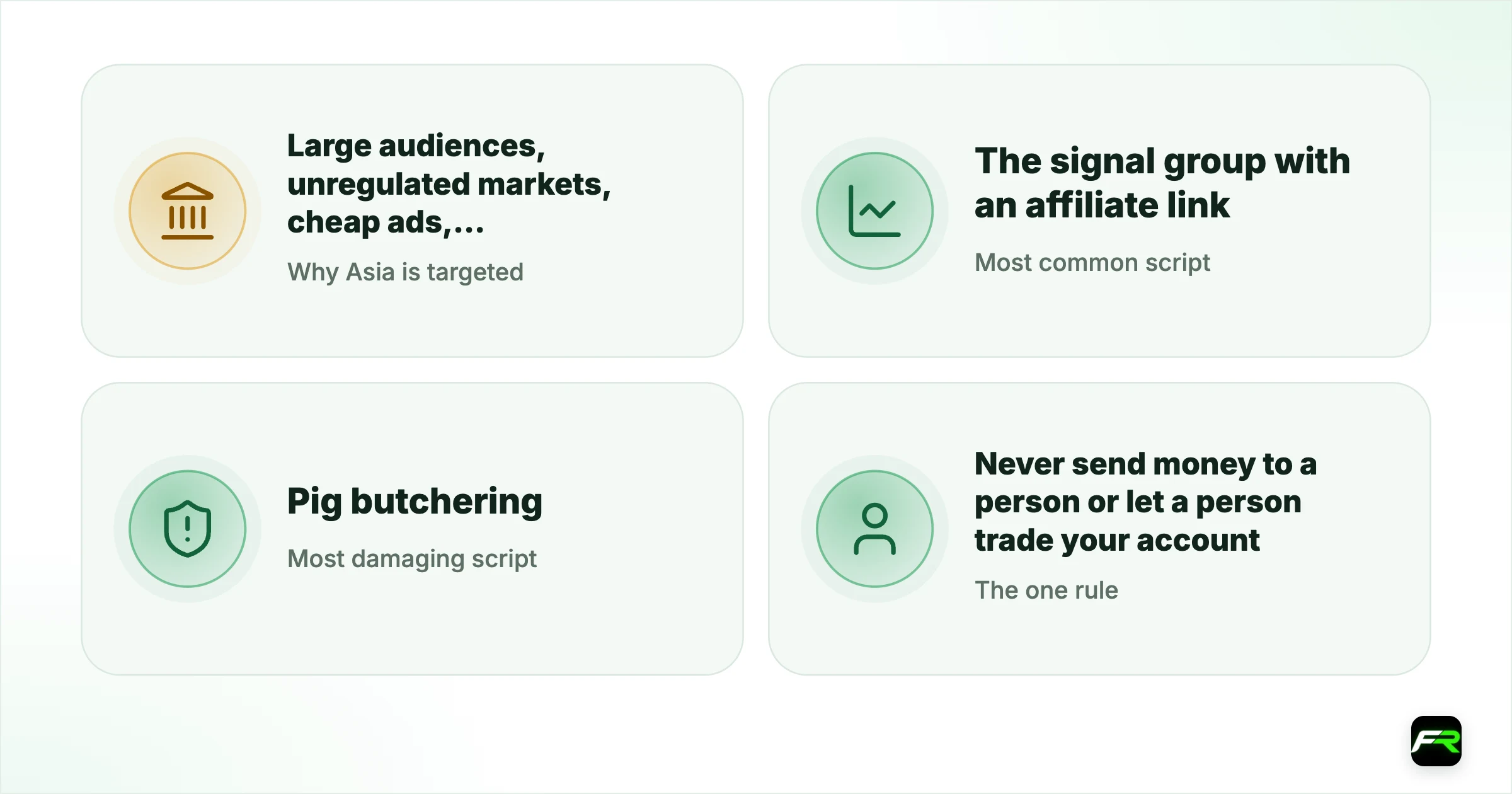
Forex scams concentrate in Asia because the ingredients are all here: large populations of people looking for extra income, unregulated retail markets in most countries, cheap advertising, and Telegram and WhatsApp groups where a stranger can build trust over weeks. The methods themselves are not clever. They are a handful of scripts repeated endlessly, and once you know them they are easy to spot. Our scam broker list tracks the specific operators to avoid.
The scripts you will meet
The signal group
A Telegram or WhatsApp group posts daily “signals” and screenshots of wins. Joining is free or cheap; the money is made when you sign up to the broker through their link (an affiliate commission) or pay for a “VIP” tier. The screenshots are cherry-picked or fake, the signals have no edge, and the group’s incentive is your deposit, not your profit.
The account manager
Someone offers to trade your account for you, for a share of the profit. Sometimes they ask for your login; sometimes they ask you to send money to “their” account to trade. Either way, you have handed control of your money to a stranger with no licence and no obligation. This is the structure regulators across the region warn about most.
The recruitment scheme
A friend or relative introduces you to an “app” with fixed monthly returns and a referral bonus for bringing others in. This is a Ponzi or MLM wearing a forex costume. Early participants may be paid from later deposits, which is what makes it spread, until it collapses.
Pig butchering
A stranger connects on a dating app or via a “wrong number” message, builds a relationship over weeks, then introduces a trading site where you both “invest”. Early small withdrawals work, to build confidence. Then you are encouraged to deposit more, and when you try to withdraw the large balance, there is a “tax” or “fee” to pay first. The whole thing is entirely fake.
The recovery scam
After you have lost money, someone contacts you claiming to be a lawyer, a “fund recovery” service, or even a regulator, offering to get it back for an upfront fee. This targets people already burned once. There is no legitimate service that works this way.
The one rule that stops most of them
Never send money to a person, and never let a person trade your account. A real broker is a company you deal with through its own platform, where the money sits in an account in your name that you can withdraw yourself. The moment a human being is between you and your money, walk away.
Reza was added to a Telegram group by a former classmate. The signals looked good for two weeks, and he made a small profit trading them on his own account. Then the “analyst” offered a managed service: send USD 500 to a specified account and he would double it in a month. Reza sent it. The analyst credited a screenshot showing USD 1,100, then said a USD 300 “withdrawal fee” was needed to release it. Reza recognised the pattern, refused, and lost the USD 500. The classmate, it turned out, was being paid to recruit.
Red flags checklist
- Any guaranteed or fixed return, or screenshots of returns.
- Being asked to pay a person, a personal bank account, or a personal USDT wallet.
- Someone offering to trade for you, or asking for your account login.
- A referral bonus for recruiting other people.
- A platform you can only download as an APK link, not from an app store.
- Pressure to deposit quickly, or to deposit more to “unlock” a withdrawal.
- A relationship that started with a stranger’s message and moved to a trading app.
If you have been scammed
- Stop sending money immediately. Paying a “release fee” or “tax” never works.
- Save every message, transaction record and screenshot.
- Report it to your local cybercrime unit and, if a real regulated broker’s name was misused, to that regulator.
- Warn other people, with the facts. Do not engage anyone who contacts you offering to recover the funds.
| Why Asia is targeted | Large audiences, unregulated markets, cheap ads, messaging apps |
|---|---|
| Most common script | The signal group with an affiliate link |
| Most damaging script | Pig butchering (fake platform, relationship built first) |
| The one rule | Never send money to a person or let a person trade your account |
| Recovery scams | A second scam targeting people already burned |
If a withdrawal requires you to first deposit a fee, a tax, or a “verification amount”, it is not legitimate, without exception. A real broker deducts fees from the payout; it never asks for an incoming payment to send money out.
Where to report financial scams
| Local cybercrime unit | Your country's police cybercrime division is the first stop for any online financial fraud, regardless of amount. |
|---|---|
| Your bank or payment provider | Report the transaction immediately, especially for card payments, where a chargeback may still be possible. |
| The impersonated regulator | If a scam misused a real broker or regulator's name, that regulator usually has its own scam-reporting channel and may issue a public warning naming the fake. |
| The platform itself | Report the Telegram group, WhatsApp number or app listing to Telegram, Meta or the app store, so the specific account can be actioned. |
Sources and where to check it yourself
- Securities Commission Malaysia investor alert list: unauthorised schemes named by Malaysia's regulator
- FCA warning list of unauthorised firms: a searchable list of known scam firms
Frequently asked
How do forex scams in Asia usually work?
The common ones are signal groups that make money from your broker sign-up, people offering to trade your account, recruitment schemes with fixed returns, and ‘pig butchering’ where a stranger builds a relationship then steers you to a fake platform. Recovery scams then target people who have already lost money.
How can I tell if a forex opportunity is a scam?
Guaranteed returns, being asked to pay a person rather than a company platform, someone offering to trade for you, referral bonuses for recruiting others, APK-only apps, and pressure to deposit fast are all reliable signs. Any one of them is enough to walk away.
Is it safe to follow a forex signals group?
Most free and cheap signal groups exist to earn an affiliate commission on your broker deposit. The signals rarely have any edge and the screenshots are selective or fake. Paying for ‘VIP’ signals does not change this.
Someone offered to recover money I lost. Should I pay?
No. There is no legitimate service that recovers lost forex funds for an upfront fee. Recovery offers are a second trap aimed at people already burned. Report the original incident to the police instead.
What should I do if I have been scammed?
Stop sending money, save all records, report it to your local cybercrime unit and to any real regulator whose name was misused, and warn other people, with the facts, without engaging ‘recovery’ contacts.
Why does forex get advertised so aggressively in my country?
Affiliate marketing pays per funded account, and audiences in South and Southeast Asia are inexpensive to reach. The promoter earns a commission whether or not you profit, which is why the pitches are so confident.
The team behind this guide
Researched, checked and approved by five forex specialists
Every guide is written, fact-checked and edited before it goes live, and updated when the facts change. Spotted an error? Tell us.