





























Forex Finfluencers and Telegram Signals: What UK Law Says
Social media promotion of forex trading without FCA approval is a criminal offence in the UK. Seven influencers were sentenced in February 2026. Here is the law, the cases and the red flags.
 WriterAbir KhanWriterWrites the guides · checks every figure against primary sources View profileAbout Abir →
 Market analysisTanbir Habib RiyadForex & Crypto AnalystForex and crypto analyst · technical and fundamental analysis View profileAbout Tanbir →
 Fact-checking & riskJannatul FerdaushFact-Checker & Risk AnalystFact-checks every figure · risk analysis · Applied Statistics, University of Dhaka View profileAbout Jannatul →
 Trading reviewJowel RanaCo-Founder & Forex TraderCo-founder · forex trader · reviews guides from a trader's view View profileAbout Jowel →
 Final approvalRanjan NiskrityFounder, Owner & Forex TraderFounder and owner · forex trader · signs off every guide View profileAbout Ranjan →
In the UK, it is a criminal offence for anyone who is not authorised by the FCA to promote investments such as forex CFDs or spread bets, unless an authorised firm has approved the promotion. That applies to Instagram posts, TikTok videos, YouTube links and paid Telegram groups alike. The penalty can be up to two years in prison and an unlimited fine. On 20 February 2026 seven social media influencers, several known from reality TV, were sentenced at Southwark Crown Court for promoting an unauthorised forex trading scheme, and further finfluencers have been charged and are awaiting trial.
For you as a follower, the practical point is simple. Most forex content that pushes a specific broker, a referral link, a "VIP" signal group or a mentoring package on social media is either illegal, unregulated or both. Below is what the law says, what has happened in court, the red flags to watch for, and what genuine forex education looks like.
General information about UK law, not legal advice. Cases described as charged are allegations that have not been proven.
The law: section 21 of FSMA
Section 21 of the Financial Services and Markets Act 2000 (FSMA) sets out the financial promotion restriction. In plain terms, a person must not, in the course of business, communicate an invitation or inducement to engage in investment activity unless they are an authorised person or the content has been approved by one. A breach is a criminal offence under section 25, and the FCA can prosecute. Contracts or deals made as a result can also be unenforceable against the customer.
The FCA's social media guidance, FG24/1, published on 26 March 2024, spells out how this applies online. Any communication can be a financial promotion if it invites or induces someone to invest, whatever the format. The guidance specifically mentions private and invite-only channels such as Discord and Telegram, posts on public forums, and even memes. An influencer who is paid, or receives affiliate commission, for pointing followers to a trading product is acting in the course of business.
| What an influencer does | How UK law usually sees it |
|---|---|
| Posts a referral link to an offshore CFD broker and earns commission per sign-up | Likely an unauthorised financial promotion |
| Promotes a broker that is FCA-authorised, but without the firm approving the content | Still a problem: the promotion itself needs approval |
| Runs a paid Telegram or WhatsApp group sending "buy EUR/USD now" calls | Can be a financial promotion, and personalised calls may stray into regulated advice |
| Explains how leverage or a stop-loss works, with no product or broker pushed | Generally education, not a promotion |
| Shares their own trades with no link, no fee and no call to action | Less likely to be a promotion, though context matters |
Retail forex is also heavily restricted in the UK in its own right. FCA-authorised firms must cap leverage at 30:1 on major pairs, close positions at 50% of margin, protect retail clients from negative balances and cannot offer bonuses. When an influencer promotes 1:500 leverage or a "100% deposit bonus", you can be fairly sure the firm behind it is not following UK rules. Our UK leverage limits guide has the full table.
The cases so far
On 20 February 2026 the FCA announced that seven influencers had been sentenced at Southwark Crown Court after pleading guilty to one count each of issuing unauthorised financial promotions for a foreign exchange trading scheme. Their combined Instagram following was about 4.5 million. The sentences, as published by the FCA:
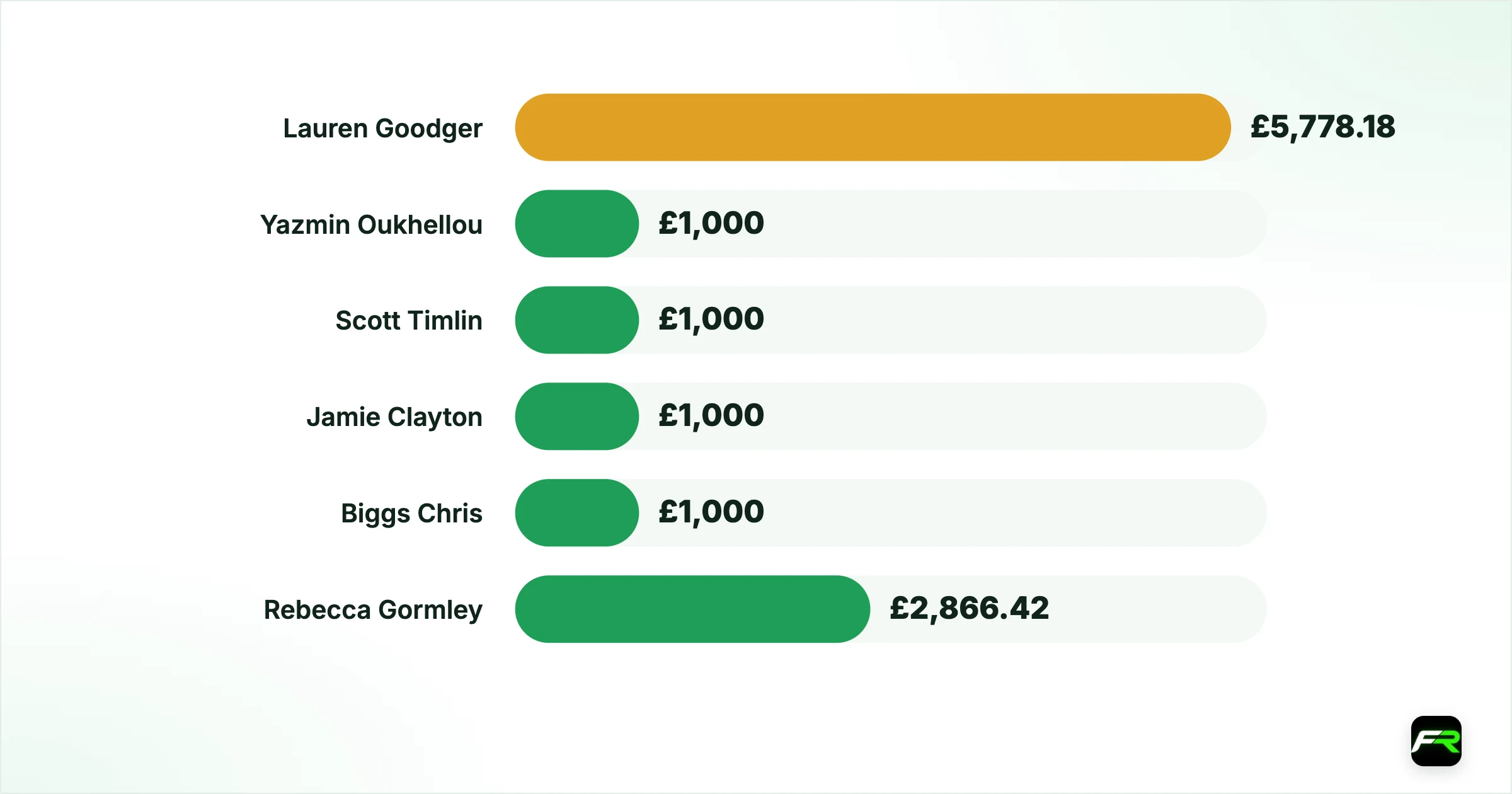
| Influencer | Sentence | Costs |
|---|---|---|
| Lauren Goodger | £3,750 fine | £5,778.18 |
| Yazmin Oukhellou | £974 fine | £1,000 |
| Scott Timlin | £938 fine | £1,000 |
| Jamie Clayton | £820 fine | £1,000 |
| Biggs Chris | £600 fine | £1,000 |
| Rebecca Gormley | Conditional discharge | £2,866.42 |
| Eva Zapico | Absolute discharge | £1,770.44 |
The fines were small, yet the convictions matter: they are criminal, they are public, and they confirm that posting a trading scheme to your followers is not a grey area. Steve Smart, an executive director at the FCA, said the influencers had "betrayed the trust of those who followed them".
Separately, three finfluencers, Charles Hunter, Kayan Kalipha and Luke Desmaris, have each been charged with one count of communicating an invitation to engage in investment activity contrary to section 21(1) of FSMA. The FCA alleges they encouraged followers to trade forex through contracts for difference without authorisation to promote it. All three pleaded not guilty at Southwark Crown Court on 8 October 2025, and their trials are listed for September to November 2027. These are allegations only; none of the three has been convicted, and each is entitled to the presumption of innocence.
Case status checked 26 September 2026: all three deny the charge and no trial has yet taken place. The FCA says their trials are listed for between September and November 2027. We will update this page when the cases conclude.
The June 2025 week of action and the wider crackdown
The charges came out of an internationally coordinated week of action against illegal finfluencer promotions, led by the FCA in June 2025. In the UK it produced three arrests, 50 warning alerts and more than 650 requests to social media platforms to take down content. Regulators in several other countries ran parallel action in the same week.
The FCA has also highlighted how much money is at stake. On 30 October 2025 it warned about firms pressuring clients to opt up to professional status, and said that over four years more than 90,000 people had lost about £75 million at one firm through schemes promoted by finfluencers. It published 2,329 warnings about unauthorised firms in 2025. For how these regulatory moves fit together, see our piece on the 2026 FCA crackdown on CFD firms.
Red flags in finfluencer and Telegram trading content
Followers who lose money to finfluencer schemes rarely lose it to one dramatic lie. The damage builds gradually, through a sequence of small nudges that each seem reasonable. Watch for these:
- A referral link to an offshore broker. Check the FCA Register; if the firm is not authorised for UK clients, you have no Financial Ombudsman or FSCS if it goes wrong.
- Screenshots of profits. They are easy to fake on demo accounts, and nobody posts the losing months.
- Lifestyle marketing: cars, holidays, watches, "quit your job" stories.
- "VIP" tiers with monthly fees for "premium signals", often upsold from a free group.
- Guaranteed or fixed returns, such as "10% a month" or "copy my trades, can't lose".
- Pressure to opt up to professional status or to use a higher-leverage offshore account.
- An "account manager" who messages you privately, or anyone asking to trade your account for you.
- Deleted history. Channels that wipe old messages so losing calls vanish.
If you are asked to pay to join a signal group, then asked to open an account with a specific broker, the influencer is probably being paid twice: once by you and once by the broker when you deposit. Their income depends on your deposits, not on your results.
What legitimate forex education looks like
There is plenty of honest forex content online, and it has a recognisable shape. It explains concepts rather than calling trades, is open about risk, and does not depend on you signing up with a particular firm.
| Legitimate education | Likely promotion or scheme |
|---|---|
| Explains spreads, leverage, margin, position sizing | Sells "secret" strategies or indicators |
| Shows losing trades and drawdowns | Only shows wins and screenshots |
| Points you to the FCA Register and risk warnings | Discourages checks, pushes an offshore broker |
| Free or clearly priced, with no broker link attached | Free group that funnels into paid tiers and referral links |
| If promoting an FCA-authorised firm, carries the firm's approval and the standard risk warning showing the share of retail accounts that lose money | No risk warning, or a buried one |
If a creator you follow promotes a broker, check two things: that the broker is on the FCA Register with UK permission, and that the post carries the standard CFD risk warning. At the time of writing (September 2026), the larger UK CFD providers report that roughly 61% to 74% of retail accounts lose money. Anyone who does not mention that figure is not telling you the whole story.
Forex courses and mentorships: what "accredited" and "CPD" really mean
Look for a forex course in the UK and you will see "accredited", "CPD certified" and "FCA compliant" everywhere. None of those labels means a regulator has checked that the course works. No FCA approval is needed to sell most trading courses: the FCA's perimeter guidance (PERG 8) treats training in trading techniques as usually too remote from any actual deal to count as an inducement to invest. The same guidance carries a caveat. A course sold as almost certain to produce trading profits can become a financial promotion, and then the section 21 restriction applies.
CPD, short for continuing professional development, is a system for recording structured learning, used mainly by professionals who must log training hours. A "CPD accredited" badge means an accreditation body has reviewed the course's structure, learning objectives and delivery. Accreditation bodies themselves say this is not an endorsement of the techniques taught, so a CPD-accredited forex course can still teach a strategy that loses money. "Accredited" on its own, with no named body behind it, tells you nothing.
- Who is teaching? If the tutor claims to be regulated, find them on the FCA Register yourself.
- Does it end in a broker link or a signal group? Then the education is a sales funnel.
- Are results full statements over a long period, or a handful of screenshots?
- Is the price fixed and stated up front, or does a free taster lead into rising monthly tiers?
- What does it promise? An income, a guaranteed prop firm pass or a set monthly return are marketing, not teaching.
Our view: a paid course is worth considering only if it teaches skills you can check, such as reading an economic calendar, sizing a position or keeping a trade journal, at a fixed price with no broker attached. The free risk management guide on FX Recap and the beginners' broker guide cover the basics for free. Fake "mentors" sometimes pose as staff of real brokers too, a pattern our article on IC Markets clone scams describes.
If you have already lost money
Report the influencer and any firm involved to the FCA on 0800 111 6768, and report the fraud to Report Fraud (reportfraud.police.uk, 0300 123 2040) or, in Scotland, to Police Scotland on 101. If you paid by bank transfer, contact your bank immediately by calling 159, because APP reimbursement claims must be made within 13 months of the last payment. Report the account to the platform too. Our guide to reporting forex scams has the full step-by-step.
Harvey followed a trading influencer on Instagram who posted daily profit screenshots. He paid £49 a month for a Telegram "VIP" group and, on the group's advice, opened an account with an offshore broker via a referral link, depositing £1,500. The broker offered 1:500 leverage and a 50% deposit bonus. At the suggested sizes, the signals cost him £1,120 in five weeks. He then found that the bonus terms blocked withdrawals until he had traded 30 times the bonus amount. After cancelling the subscription he checked the FCA Register: the broker had no UK authorisation, so the Financial Ombudsman could not help. He reported the influencer to the FCA, withdrew the remaining £380 after two weeks of document requests, and moved to a demo account on an FCA-authorised platform while he learnt the basics.
Frequently asked
Is it illegal for influencers to promote forex trading in the UK?
It is a criminal offence under section 21 of FSMA for someone who is not FCA-authorised to promote investments such as forex CFDs in the course of business, unless an authorised firm has approved the promotion. The maximum penalty is two years in prison and an unlimited fine.
Which influencers were sentenced in February 2026?
On 20 February 2026 Lauren Goodger, Yazmin Oukhellou, Scott Timlin, Jamie Clayton, Biggs Chris, Rebecca Gormley and Eva Zapico were sentenced at Southwark Crown Court after pleading guilty to issuing unauthorised financial promotions for a forex trading scheme. Sentences ranged from an absolute discharge to a £3,750 fine, plus costs.
Are Telegram forex signal groups legal in the UK?
Not automatically. The FCA's social media guidance says private channels such as Telegram and Discord can carry financial promotions. A paid group that pushes followers towards a broker or investment without FCA authorisation or approval is likely to breach the law. Personalised trade calls may also amount to regulated advice.
Can I get my money back from a forex influencer?
It is difficult. If you paid by UK bank transfer due to fraud, ask your bank about APP reimbursement within 13 months. Card payments may qualify for a chargeback. Losses at an unauthorised offshore broker are not covered by the Financial Ombudsman or FSCS.
How do I report a finfluencer to the FCA?
Use the FCA's online reporting form or call its consumer helpline on 0800 111 6768. Include screenshots, links, usernames and any payment records. If you have lost money, also report the fraud to Report Fraud or, in Scotland, Police Scotland.
Can an influencer promote an FCA-authorised broker?
Yes, but the promotion must be approved by an authorised firm and follow the FCA's rules, including the standard risk warning showing the share of retail CFD accounts that lose money. Authorisation alone does not make an unapproved post legal.
Are CPD-accredited forex courses regulated?
No. CPD accreditation means a body has reviewed how a course is structured and delivered, not whether its trading methods work, and it is not FCA regulation. Most trading courses need no FCA approval at all, unless they are marketed as near-certain to produce profits, which can turn them into financial promotions.
What happened in the FCA's June 2025 finfluencer week of action?
The FCA led a coordinated international week of action against illegal finfluencer promotions. In the UK it produced three arrests, 50 warning alerts and more than 650 requests to social media platforms to remove content, and charges against three finfluencers followed.
Related reading
The team behind this guide
Researched, checked and approved by five forex specialists
Every guide is written, fact-checked and edited before it goes live, and updated when the facts change. Spotted an error? Tell us.