





























Best Time to Trade Forex in the UK (BST and GMT, 2026)
For most UK traders the best window is 13:00 to 17:00 UK time, when London and New York are both open. Here is the full session table for summer and winter, plus the data times that move sterling.
 WriterAbir KhanWriterWrites the guides · checks every figure against primary sources View profileAbout Abir →
 Market analysisTanbir Habib RiyadForex & Crypto AnalystForex and crypto analyst · technical and fundamental analysis View profileAbout Tanbir →
 Fact-checking & riskJannatul FerdaushFact-Checker & Risk AnalystFact-checks every figure · risk analysis · Applied Statistics, University of Dhaka View profileAbout Jannatul →
 Trading reviewJowel RanaCo-Founder & Forex TraderCo-founder · forex trader · reviews guides from a trader's view View profileAbout Jowel →
 Final approvalRanjan NiskrityFounder, Owner & Forex TraderFounder and owner · forex trader · signs off every guide View profileAbout Ranjan →
The best time to trade forex from the UK is usually between 13:00 and 17:00 UK time on a weekday, when the London and New York sessions overlap. Spreads on the major pairs are tightest then, volume is highest, and most US economic data lands inside that window at 13:30. The second busiest stretch is the London open, from about 08:00 to 10:00. Late evening and the small hours are the quietest and, for most pairs, the most expensive to trade.
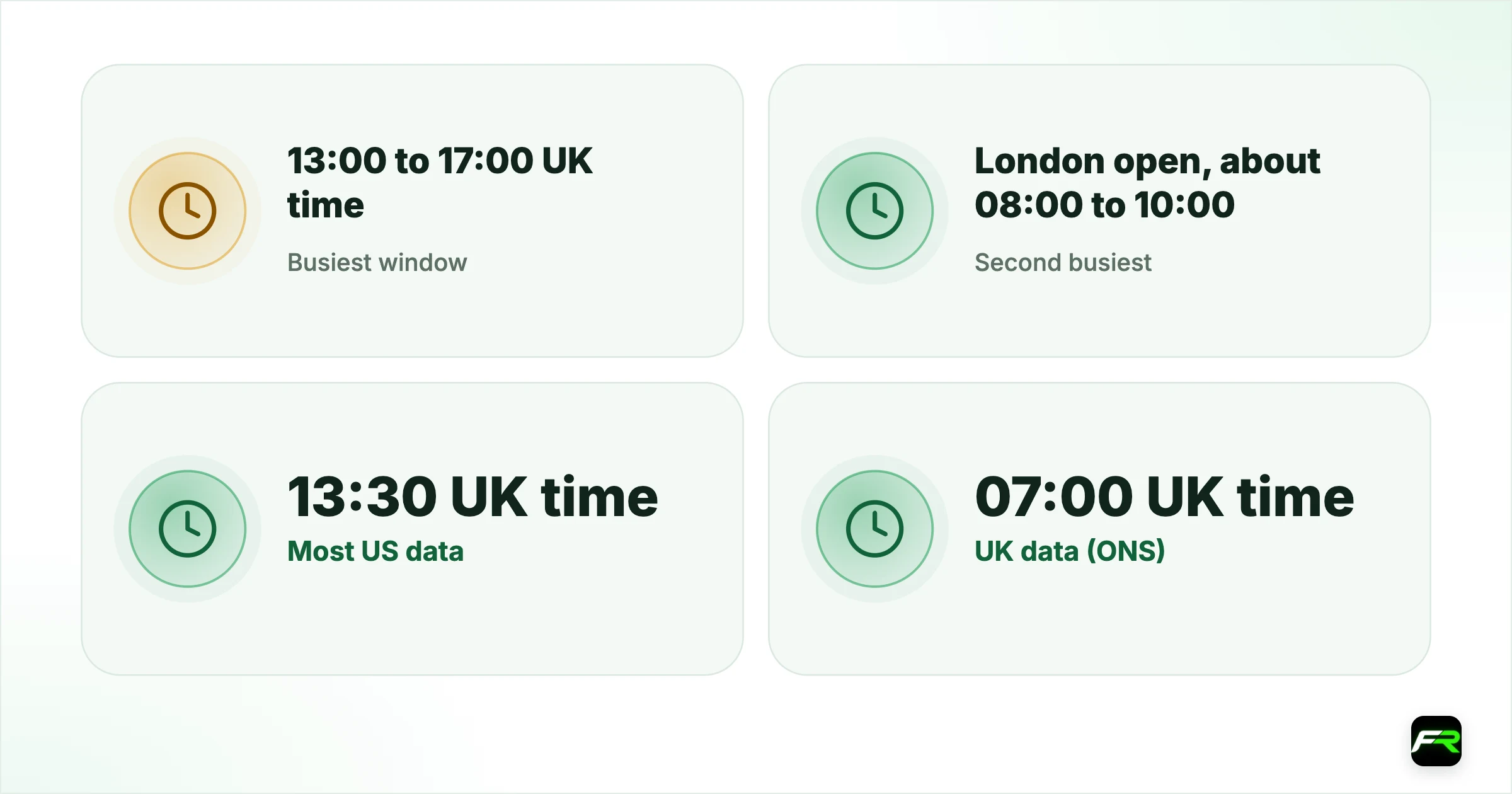
Those times hold in both summer and winter, because London and New York shift their clocks together. The awkward exception is a handful of days each year when the UK and US change clocks on different weekends. In 2026 that happens between 25 October and 1 November, and it moves the New York session and every US data release one hour earlier on UK clocks. The details are below, with a data timetable and a guide to which pairs suit which part of the day.
| Busiest window | 13:00 to 17:00 UK time (London/New York overlap) |
|---|---|
| Second busiest | London open, about 08:00 to 10:00 |
| Most US data | 13:30 UK time (12:30 during mismatch weeks) |
| UK data (ONS) | 07:00 UK time |
| Bank of England decisions | 12:00 UK time |
| Mismatch week, autumn 2026 | 25 October to 1 November |
Forex sessions in UK time, summer and winter
The forex market has no central exchange, so "sessions" are conventions based on when the big dealing centres are at their desks. Different brokers and textbooks quote slightly different hours. The table below uses the most common convention and converts it to the clock on your wall, so you do not have to think in GMT while the UK is on British Summer Time (BST).
| Session | UK summer (BST, late March to late October) | UK winter (GMT, late October to late March) | Notes |
|---|---|---|---|
| Sydney | about 23:00 to 08:00 | about 21:00 to 06:00 | Australia changes clocks in the opposite direction, so this one moves by two hours across the year |
| Tokyo | about 01:00 to 10:00 | about 00:00 to 09:00 | Japan has no daylight saving, so only the UK side moves |
| London | about 08:00 to 17:00 | about 08:00 to 17:00 | Stays the same on UK clocks; in GMT terms it is 07:00 to 16:00 in summer |
| New York | about 13:00 to 22:00 | about 13:00 to 22:00 | Moves to 12:00 to 21:00 during mismatch weeks |
| London/New York overlap | about 13:00 to 17:00 | about 13:00 to 17:00 | The deepest liquidity of the day |
London is the largest forex centre in the world, so UK traders get a genuine home advantage: the busiest part of the global day falls during normal waking hours. Someone trading from Sydney or Singapore has to stay up late to catch it. You do not.
The trading week opens on Sunday evening, around 22:00 UK time, when Wellington and Sydney come online, and closes on Friday at around 22:00 UK time when New York shuts. Your broker's own hours may differ by a few minutes, so check its contract specifications for the exact open and close. Our forex market hours explainer covers the general session logic in more depth.
Why the London/New York overlap matters
Between 13:00 and 17:00 both of the two largest dealing centres are active at once. More banks, funds and corporates are quoting prices, which means more competition for your order. For a retail trader that shows up in three places: tighter spreads, less slippage on stop orders, and price moves that are big enough to be worth trading.
The overlap also contains most of the scheduled volatility. US data such as non-farm payrolls, CPI and retail sales comes out at 08:30 New York time, which is 13:30 in the UK for most of the year. At 16:00 UK time the WM/Reuters benchmark rates are set in London (the "London fix"), and large fund flows around that moment can push prices around in the final hour of the London day. After 17:00 London traders go home, volume thins, and the rest of the New York afternoon is usually quieter.
There is a catch. The same volume that makes the overlap cheap to trade also makes it fast. A GBP/USD position can move 40 or 50 pips in the minutes after a US jobs number. If you are new, trading the overlap on a quiet day is sensible; trading the first minute after a big release is not.
The mismatch week: 25 October to 1 November 2026
UK clocks go back at 02:00 on Sunday 25 October 2026. US clocks do not change until Sunday 1 November 2026, the first Sunday of November. For the five trading days in between, the usual five-hour gap between London and New York shrinks to four hours. Everything American arrives an hour earlier on your UK clock.
| Event | Normal UK time | UK time, 26 to 30 October 2026 |
|---|---|---|
| New York session opens | 13:00 | 12:00 |
| US data at 08:30 New York time | 13:30 | 12:30 |
| US data at 10:00 New York time | 15:00 | 14:00 |
| US Federal Reserve decision (14:00 New York) | 19:00 | 18:00 (the Fed announces on Wednesday 28 October 2026) |
| Daily rollover (17:00 New York) | 22:00 | 21:00 |
The Federal Reserve's rate decision falls inside that week this year, so anyone with alerts set for 19:00 will be an hour late. Pending orders, overnight financing and the weekly close all shift too. The same thing happens in spring, in reverse: in 2027 the US moves its clocks forward on 14 March and the UK on 28 March, so for two weeks US data again comes out at 12:30 UK time. If you use an economic calendar, set it to display London time rather than a fixed GMT offset so it handles this for you. Our economic calendar is one option.
The UK data and Bank of England timetable
Sterling reacts most to UK data and Bank of England decisions, and both follow fixed times. The Office for National Statistics (ONS) publishes its market-moving releases, including CPI inflation, GDP and the labour market figures, at 07:00 UK time. That is before the London session is properly open, when liquidity is still thin, so the first move can be jumpy and spreads can be wide. Many experienced traders wait for 08:00 to see whether the move holds.
Bank of England Monetary Policy Committee announcements come at 12:00 UK time. At the time of writing Bank Rate is 3.75%, held on 17 September 2026 by a 6-3 vote with three members wanting a rise to 4%. The next decisions are Thursday 5 November 2026, with the Monetary Policy Report, and Thursday 17 December 2026, followed in 2027 by 4 February, 18 March, 29 April, 17 June, 29 July, 16 September, 4 November and 16 December. See our Bank of England decisions guide for how cable and EUR/GBP tend to behave around them.
| Release | UK time | What usually moves |
|---|---|---|
| ONS: CPI, GDP, labour market, retail sales | 07:00 | GBP pairs, sharply but on thin volume |
| Eurozone flash PMIs and data | about 08:00 to 10:00 | EUR/GBP, EUR/USD |
| Bank of England rate decision | 12:00 | All sterling pairs, gilts |
| US data: payrolls, CPI, retail sales | 13:30 (12:30 in mismatch weeks) | USD pairs including GBP/USD |
| US data: ISM, consumer confidence | 15:00 (14:00 in mismatch weeks) | USD pairs |
| Federal Reserve decision | 19:00 (18:00 in mismatch weeks) | USD pairs, often a second move at the press conference |
UK CPI was 3.1% in the 12 months to August 2026, up from 2.9% in July, and the Bank expects inflation to rise to somewhat over 4% in early 2027. That keeps each CPI morning a live event for sterling. Our UK CPI trading guide covers the 07:00 release in detail.
Which pairs suit which window
Pairs are liveliest when the centres behind their two currencies are awake. A rough map for a UK trader looks like this:
- 08:00 to 12:00 (London morning): GBP/USD, EUR/GBP, EUR/USD and GBP/JPY. European and UK news drives the move, and cable often sets its range for the day here.
- 13:00 to 17:00 (overlap): GBP/USD, EUR/USD, USD/JPY, USD/CAD and gold. US data dominates; this is the best time for the dollar majors.
- 17:00 to 22:00 (New York afternoon): USD/CAD and USD pairs generally, but with thinner volume and fewer clean moves. Sterling tends to drift.
- 00:00 to 08:00 (Asia): USD/JPY, AUD/USD, NZD/USD and AUD/JPY. Sterling pairs are quiet and spreads on crosses such as GBP/NZD can be wide.
EUR/GBP deserves a special mention. Both currencies are European, so it does most of its moving between 07:00 and 12:00 UK time and often goes sideways for the rest of the day; our EUR/GBP guide explains why. GBP/JPY is the opposite: it is thin and volatile in the Asian morning and can gap on Japanese news, so it rewards care more than enthusiasm, and the GBP/JPY sizing guide shows how far the stake has to come down. Our cable guide goes deeper on GBP/USD specifically.
Quiet periods and times to avoid
Some parts of the week cost more to trade than they are worth, especially for short-term strategies. Spreads widen when liquidity drains away, and a stop-loss placed a sensible distance from price can be triggered by a spike that has nothing to do with the market's direction.
- Around 22:00 UK time daily: the rollover, when many brokers settle overnight financing and spreads can briefly jump to several times normal.
- Sunday evening open: prices can gap from Friday's close, so weekend stops may fill well away from where you set them.
- Friday after about 20:00: volume fades as New York winds down for the weekend.
- The first seconds after major data: spreads widen and slippage is common, even on the majors.
- UK and US bank holidays, and the period between Christmas and New Year: fewer participants, thinner prices and occasional erratic moves. The dates for this winter are in the next section.
If you trade with UK leverage limits of up to 30:1 on the majors, a spread that briefly widens from 1 pip to 10 pips can still close a tight position. Build in room, or simply stay flat through the rollover and big releases. Our UK leverage limits guide explains the margin maths.
Forex market holidays: Christmas, New Year and UK bank holidays
Forex never formally shuts for a UK bank holiday, because there is no central exchange and other centres keep dealing. What changes is who turns up. On an English bank holiday London's banks are largely absent, so sterling pairs trade on thinner books with wider spreads, and a large order can push price further than usual. US holidays do the same to the dollar in the UK afternoon: on Thanksgiving, Thursday 26 November 2026, US exchanges are closed and New York trading is light, and the Friday after is often thin as well.
The festive fortnight is the thinnest stretch of the year. Christmas Day falls on Friday 25 December 2026, and because Boxing Day is a Saturday, the UK bank holiday moves to Monday 28 December. New Year's Day is Friday 1 January 2027, and Scotland adds a substitute day for 2 January on Monday 4 January. Many brokers close forex on Christmas Day and New Year's Day, or quote it for only part of the day, and some shorten trading on Christmas Eve and New Year's Eve. Hours differ from firm to firm, so read your broker's holiday notice rather than assuming last year's times.
| Date | Holiday | What to expect |
|---|---|---|
| Thursday 26 November 2026 | US Thanksgiving | US exchanges closed, light dollar trading in the UK afternoon |
| Monday 30 November 2026 | St Andrew's Day (Scotland only) | London open, little effect |
| Thursday 24 December 2026 | Christmas Eve (not a bank holiday) | Early closes at some brokers, thin afternoon |
| Friday 25 December 2026 | Christmas Day | Forex closed or near-closed at many brokers |
| Monday 28 December 2026 | Boxing Day (substitute day) | London shut, thin sterling trading |
| Thursday 31 December 2026 | New Year's Eve (not a bank holiday) | Early closes at some brokers |
| Friday 1 January 2027 | New Year's Day | Forex closed or near-closed at many brokers |
| Monday 4 January 2027 | Substitute day for 2 January (Scotland only) | London open, liquidity returning |
The days in between that are open still carry holiday-market risks: spreads several times their normal width, gaps when a centre reopens, and sharp moves on little news. Financing can bite too, because some brokers apply extra days of overnight funding around holidays in the same way they do for weekends. For most retail traders the sensible plan is to close short-term positions before 24 December, cut the size of anything held through the period, and restart once London is fully back, which in 2027 means Monday 4 January.
A window that fits your life
The theoretical best time is irrelevant if you are at work, on the school run or asleep. What matters is picking one window that you can trade consistently, and matching your strategy to it. A trader who can only look at charts from 19:00 is better served by swing trades on the daily chart than by trying to scalp a quiet evening market.
Our view is that most part-time UK traders do best focusing on one of two windows: 07:00 to 09:00 before work, or 13:00 to 14:00 at lunch, which catches the 13:30 US data. Anything outside those times is usually better handled with pending orders and alerts rather than live screen time. Our guide to trading around a 9 to 5 job covers that in detail. If you have not opened an account yet, test your chosen window on a demo first; our guide to UK brokers for beginners is a sensible place to start.
Rhiannon traded GBP/USD in the evenings after work, usually between 20:00 and 22:30, with a £3,000 account and a £30 risk per trade. Over three months she noticed that her average spread cost was about 1.8 pips on the evening trades, against roughly 0.9 pips when she occasionally traded at lunch, and that several stops had been hit during the 22:00 rollover spike. She switched to placing limit orders at 07:30 with a stop and target set, and checking them at lunch. Her trade count halved, from about 40 a month to 20, and her spread cost per trade roughly halved too. The results were still modest, but she stopped losing money to the time of day.
Session times are conventions, not official hours, and brokers set their own trading hours and rollover times. Check your platform's contract specifications, and use an economic calendar set to London time so clock changes are handled for you.
Frequently asked
What is the best time of day to trade forex in the UK?
For most traders it is 13:00 to 17:00 UK time, when London and New York overlap. Spreads on the majors are tightest, volume is highest and most US data lands at 13:30. The London open, about 08:00 to 10:00, is the second-best window, especially for sterling pairs.
What time does the forex market open in the UK?
The trading week opens on Sunday at around 22:00 UK time, when the Sydney and Wellington centres come online, and it closes on Friday at around 22:00 UK time. Individual brokers may open or close a few minutes differently, so check your platform's trading hours.
Do forex session times change between BST and GMT?
London and New York stay at about 08:00 and 13:00 on UK clocks all year, because both countries change their clocks. Tokyo and Sydney shift on UK clocks. The exception is mismatch weeks, such as 25 October to 1 November 2026, when New York opens at 12:00 UK time.
What time is US non-farm payrolls in the UK?
Payrolls come out at 08:30 New York time, which is 13:30 UK time for most of the year. During the short periods when the UK and US clocks are out of step, such as late October and mid to late March, it arrives at 12:30 UK time.
What time do UK data and Bank of England decisions come out?
The ONS publishes CPI, GDP and the labour market figures at 07:00 UK time, before London is fully open, so sterling can jump on thin volume. Bank of England rate decisions follow at 12:00 on MPC days, the next being Thursday 5 November 2026. Our BoE article has the full 2026 and 2027 dates.
Is the forex market open on UK bank holidays?
Usually, yes. Forex has no central exchange, so dealing carries on through an English bank holiday while Asia, Europe and New York are open. London's banks are largely absent, though, so spreads on sterling pairs tend to widen and moves can be erratic. Christmas Day and New Year's Day are the exceptions, when many brokers close forex.
When should I avoid trading forex?
Around 22:00 UK time, when the daily rollover widens spreads; the Sunday evening open, when prices can gap; late Friday; the first seconds after major data; and holiday periods such as late December. Short-term traders feel these costs most.
Which is the best day of the week to trade forex?
Tuesday to Thursday tend to be the most active, with Monday often slow until London opens and Friday afternoons fading. Data days matter more than weekdays, though. A Friday with US payrolls can be the busiest day of the month.
Related reading
The team behind this guide
Researched, checked and approved by five forex specialists
Every guide is written, fact-checked and edited before it goes live, and updated when the facts change. Spotted an error? Tell us.