





























GBP/JPY Trading Guide: Sizing for a Volatile Cross (UK, 2026)
GBP/JPY trading means bigger swings than cable, so position size matters more than entry. What drives "the Beast", how the carry trade and the BoJ fit in, and how to size it in pounds.
 WriterAbir KhanWriterWrites the guides · checks every figure against primary sources View profileAbout Abir →
 Market analysisTanbir Habib RiyadForex & Crypto AnalystForex and crypto analyst · technical and fundamental analysis View profileAbout Tanbir →
 Fact-checking & riskJannatul FerdaushFact-Checker & Risk AnalystFact-checks every figure · risk analysis · Applied Statistics, University of Dhaka View profileAbout Jannatul →
 Trading reviewJowel RanaCo-Founder & Forex TraderCo-founder · forex trader · reviews guides from a trader's view View profileAbout Jowel →
 Final approvalRanjan NiskrityFounder, Owner & Forex TraderFounder and owner · forex trader · signs off every guide View profileAbout Ranjan →
GBP/JPY, nicknamed "the Beast" by traders, is the price of one pound in Japanese yen, and it is one of the most volatile pairs that UK traders commonly deal. It combines sterling's sensitivity to UK rates and fiscal news with the yen's role as a funding and safe-haven currency, so its daily swings are usually much larger in pip terms than GBP/USD. That makes position sizing the single most important decision. Between mid-August and mid-September 2026 the pair was reported trading between roughly 207 and 217.5, a spread of about 1,000 pips in a month.
Much of what is written about this pair dwells on how exciting it is. Fewer of them do the sums for a UK account: what a pip is worth in pounds, what margin FCA rules require, and how large a stake fits a 1% risk rule when normal stops need to be wide. Those sums are the core of this article.
Market education, not investment advice. FX Recap does not give trade signals or price targets. Price levels quoted here are approximate, dated and will have moved by the time you read this. CFDs and spread bets are leveraged and most retail accounts lose money.
| Nickname | The Beast |
|---|---|
| Reported range, 14 Aug to 14 Sep 2026 | About 207 to 217.5 (secondary sources) |
| Bank of Japan policy rate | 1.25% after a rise on 18 September 2026 (reported) |
| Bank Rate | 3.75% |
| UK retail leverage | 30:1 (both currencies are majors under the FCA rule) |
| Pip value, 1 CFD lot at 208 | ¥1,000, about £4.81 |
Why it is called the Beast
Traders use the nickname for a pair that can move hundreds of pips in a session and reverse just as quickly. There are structural reasons. Sterling is a relatively volatile major, sensitive to UK inflation, the Bank of England and public finances. The yen reacts strongly to global risk mood and to Bank of Japan policy. When both move at once, in opposite directions, the cross moves a long way.
A pip on GBP/JPY is also the second decimal place, 0.01, with the pair priced around 208. Moves look large in pips partly because of that quoting convention, but in pounds the swings are still bigger than cable's for the same stake. We have not found a trustworthy primary source for an "average daily range" figure, so we would rather tell you to measure it: put ATR(14) on a daily chart and you will see what normal looks like right now.
The Bank of Japan and the carry trade
For many years Japanese rates sat close to zero while UK rates were higher. Investors borrowed in yen, which cost almost nothing, and bought higher-yielding assets such as sterling. That is the carry trade, and it pushed GBP/JPY higher for long stretches. When markets panic, carry trades are unwound quickly: investors sell the higher-yielding currency and buy back yen, and the pair can fall sharply.
The Bank of Japan has been raising rates since March 2024. It lifted its policy rate to 1.25% on 18 September 2026, reported as the highest in 31 years, in a 7-2 vote. Coverage at the time reported that the yen weakened after the decision because two members dissented and no promise of further rises was made. That is a good example of the surprise principle: the hike was expected, so the guidance moved the currency.
With Bank Rate at 3.75% and the BoJ at 1.25%, the rate gap still favours sterling, which is why a long GBP/JPY position can earn positive overnight interest at some brokers. Do not count on it. Broker funding charges include a margin on top of the interbank rate, and the net figure can be small or negative. Check the swap table before holding the pair for weeks on the basis of carry.
What else drives the cross
- Global risk mood: equity sell-offs usually push the yen higher and GBP/JPY lower.
- Japanese government intervention: Japan's Ministry of Finance has sold dollars to support the yen at times of rapid weakness, and the risk of such action can cause sharp yen rallies.
- UK events: CPI, MPC decisions and fiscal news, including the 28 October 2026 Budget.
- Energy prices: both the UK and Japan import energy, so oil and gas shocks feed into both currencies and their inflation.
UK retail margin on GBP/JPY
Under the FCA's retail CFD rules, which also cover spread bets and rolling spot forex, a major currency pair gets 30:1 leverage, meaning a 3.33% margin. The rules follow the ESMA convention, which treats a pair as major when both currencies are among the US dollar, euro, Japanese yen, pound, Canadian dollar and Swiss franc. Sterling and the yen are both on that list, so GBP/JPY gets the same 30:1 as cable, even though it is technically a cross.
Brokers may set lower leverage than the maximum, and some do on volatile crosses or around events, so check your own account. The limit is a ceiling, not a recommendation. With a pair that can move 1,000 pips in a month, 30:1 is more than enough to lose an account quickly. The UK leverage limits article lists the full FCA table.
Sizing maths in pounds
Because the pip is 0.01 and the quote currency is the yen, the pound value of a pip on a CFD depends on the GBP/JPY rate itself. At 208, one pip on a 100,000-pound lot is ¥1,000, which converts to about £4.81. A spread bet removes the conversion: at £1 per point, each 0.01 move is £1.
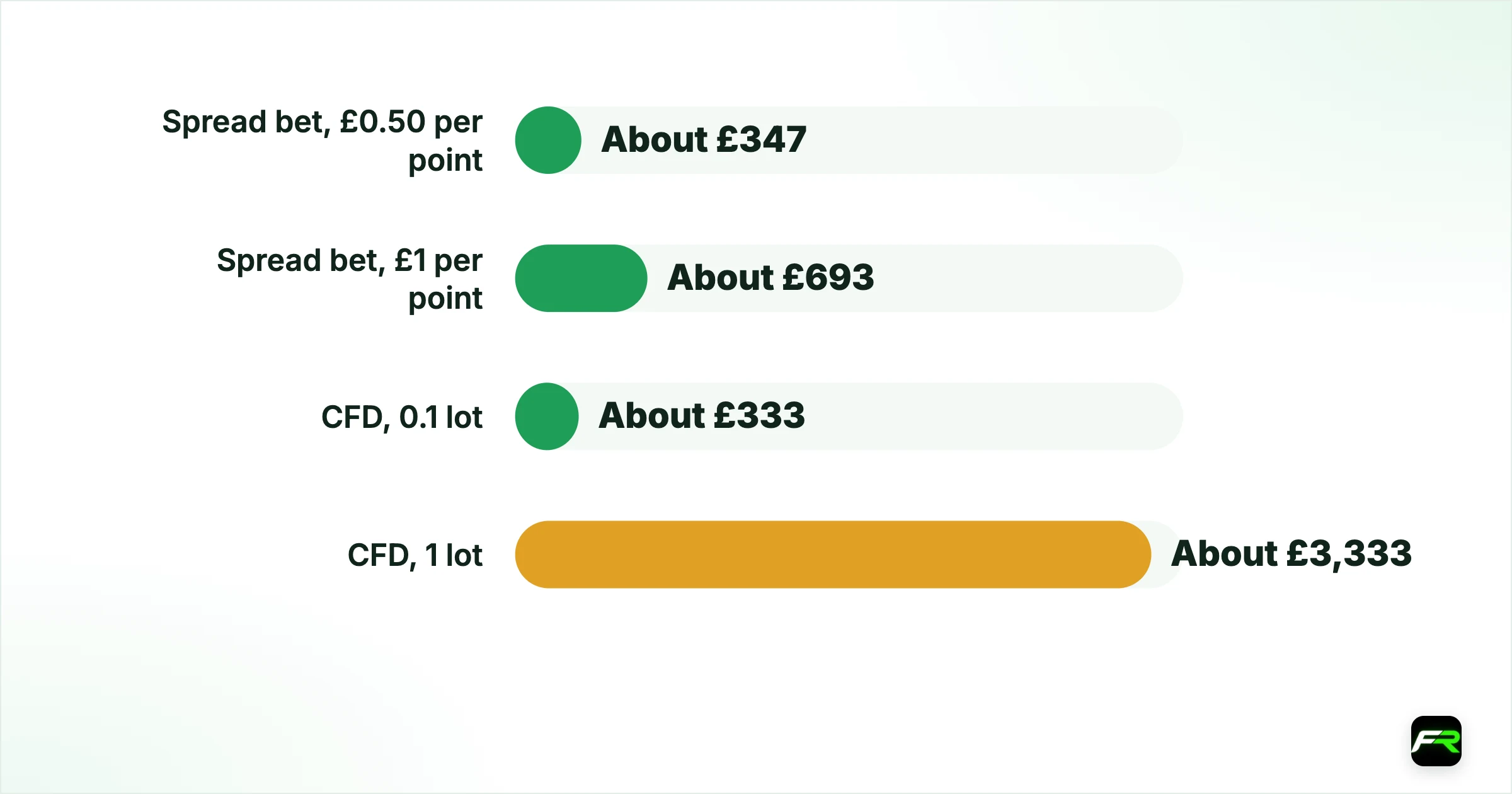
| Product and size | Value of one pip | Margin at 208.00 (3.33%) |
|---|---|---|
| Spread bet, £0.50 per point | £0.50 | About £347 |
| Spread bet, £1 per point | £1 | About £693 |
| CFD, 0.1 lot (10,000 GBP) | ¥100, about £0.48 | About £333 |
| CFD, 1 lot (100,000 GBP) | ¥1,000, about £4.81 | About £3,333 |
Stops on this pair need to be wider to sit outside normal noise, so the stake has to be smaller to keep the same risk in pounds. Here is the method.
- Set your risk per trade, for example 1% of a £5,000 account, £50.
- Place the stop where the chart says the idea is wrong. On GBP/JPY that is often further away than on cable, say 80 pips.
- Spread bet stake: £50 ÷ 80 = £0.625 per point, so round down to £0.60.
- CFD size: £50 ÷ (80 × £4.81) ≈ 0.13 lots.
- Leave room for slippage. On event days the fill can be many pips worse than the stop on this pair.
Compare that with cable, where a 40-pip stop on the same account would allow about £1.25 per point. The trade size roughly halves because the stop doubles. Our position size calculator and pip calculator handle the conversion at live rates.
Vikram has £5,000 in a spread betting account and moves from cable to GBP/JPY because it moves more. On his first week he keeps his usual £2 per point stake and a 40-pip stop. Three trades are stopped out by ordinary swings before moving in his direction, costing £240 plus spreads, nearly 5% of the account. He changes approach: stops at about 90 pips based on the daily ATR, and a stake of £0.50 per point to keep risk near £45. His next losses are around £45 each, and the wider stops mean fewer trades are closed by noise. He also stops holding the pair over the Tokyo open on BoJ weeks.
Tokyo and London timing
GBP/JPY is traded around the clock, but two windows stand out for UK traders. The Tokyo session runs through the UK night and early morning, roughly midnight to 09:00 UK time depending on the season. Bank of Japan decisions and Japanese data arrive then, so a UK trader can wake to find the pair has moved a long way. The London open at about 08:00 UK time, which overlaps with the end of the Tokyo session, often brings the next burst of movement.
From 25 October 2026 the UK is on GMT, while Japan does not change its clocks, so the Tokyo session shifts an hour earlier in UK terms relative to the summer. If you hold positions overnight, check the economic calendar for Japanese events in UK time before you go to bed.
Holding GBP/JPY through a BoJ decision or a weekend exposes you to gaps you cannot manage while asleep. Negative balance protection limits a retail loss to your account balance at an FCA-authorised broker, but it does nothing to protect that balance.
Who the pair suits
Our view is that GBP/JPY suits traders who already size by risk, have a written plan and can tolerate large swings without widening stops or doubling up. It is a poor first pair. Beginners are usually better served by cable or EUR/GBP, where the same mistakes cost less. If you trade it, trade it small, and treat every rule in our risk management basics as a minimum.
Frequently asked
Why is GBP/JPY called the Beast?
Because it regularly moves hundreds of pips in a session and can reverse sharply. The pair combines sterling's sensitivity to UK data with the yen's reaction to global risk and Bank of Japan policy, so its swings are usually larger than those of major pairs such as GBP/USD.
What leverage do UK retail traders get on GBP/JPY?
Up to 30:1, a margin of 3.33%. The FCA rules follow the ESMA convention that a pair made of two of the US dollar, euro, yen, pound, Canadian dollar and Swiss franc counts as major. Both sterling and the yen are on that list. Brokers may offer less.
How much is one pip worth on GBP/JPY?
A spread bet pip is worth your stake, so £1 per point means £1 per 0.01 move. On a CFD, one lot of 100,000 pounds makes ¥1,000 per pip, which is about £4.81 at a rate of 208. The pound value changes as the rate changes.
What is the carry trade on GBP/JPY?
It means borrowing in the lower-yielding yen and holding the higher-yielding pound to earn the interest difference. With Bank Rate at 3.75% and the Bank of Japan at 1.25%, the gap still favours sterling, but broker funding margins can shrink or erase it for retail traders.
When does GBP/JPY move in UK time?
During the Tokyo session, roughly midnight to 09:00 UK time, when Japanese data and BoJ decisions come out, and again from the London open at about 08:00. UK data at 07:00 and MPC decisions at 12:00 also move it.
Is GBP/JPY good for beginners?
We do not think so. The swings are large, stops need to be wide and the stake must be small to keep risk the same. Mistakes that cost little on EUR/GBP cost a lot here. Learn on a calmer pair first.
Can Japan intervene to move the yen, and what happens to GBP/JPY?
Yes. Japan's Minister of Finance decides on currency intervention and the Bank of Japan carries out the trades as its agent, typically buying yen when it is weakening too fast. The yen can then jump within minutes, and GBP/JPY can fall hundreds of pips with it. Official intervention figures are published by the Ministry afterwards, so confirmation often comes later.
How big should my stop be on GBP/JPY?
Large enough to sit outside normal daily noise, which you can gauge with the 14-day ATR on a daily chart. Then work the stake backwards from your maximum loss in pounds. A wider stop with a smaller stake is usually safer than a tight stop that gets hit by routine swings.
Related reading
The team behind this guide
Researched, checked and approved by five forex specialists
Every guide is written, fact-checked and edited before it goes live, and updated when the facts change. Spotted an error? Tell us.