





























Is Copy Trading Legal in the UK? FCA Rules, Risks and Tax
Yes, but a service that copies trades into your account automatically counts as portfolio management and needs FCA permission. What that means for you, plus the risks and the tax.
 WriterAbir KhanWriterWrites the guides · checks every figure against primary sources View profileAbout Abir →
 Market analysisTanbir Habib RiyadForex & Crypto AnalystForex and crypto analyst · technical and fundamental analysis View profileAbout Tanbir →
 Fact-checking & riskJannatul FerdaushFact-Checker & Risk AnalystFact-checks every figure · risk analysis · Applied Statistics, University of Dhaka View profileAbout Jannatul →
 Trading reviewJowel RanaCo-Founder & Forex TraderCo-founder · forex trader · reviews guides from a trader's view View profileAbout Jowel →
 Final approvalRanjan NiskrityFounder, Owner & Forex TraderFounder and owner · forex trader · signs off every guide View profileAbout Ranjan →
Copy trading is legal in the UK. You can copy another trader's positions, by hand or automatically, as long as the service doing the copying is authorised by the FCA for what it does. The FCA's own guidance, last updated on 27 July 2026, is clear on the key point: where trades are copied into your account automatically, with no manual input from you, it treats the service as portfolio management, which needs specific permission. A platform or signal seller running that service in the UK without permission is acting unlawfully, and you would have little or no protection if it went wrong.
Most pages answering this question stop at "yes, if the platform is regulated". That skips the parts that cost people money: offshore copy services that UK residents can still sign up to, finfluencers promoting copy schemes without approval, leaderboards that hide the traders who blew up, and the tax on dozens of closed positions you never clicked. We cover each below.
General information, not tax or legal advice. Your own position depends on your circumstances, and tax rules can change, including at the 28 October 2026 Budget.
What the FCA says about copy trading
The FCA's copy trading page, first published on 12 May 2015 and updated on 27 July 2026, sets out how it classifies these services. Its central line is: "We classify copy trading as portfolio or investment management where no manual input is clear from the account holder." It describes copy and mirror trading as services where investment decisions "are implemented with no intervention by the client other than an agreement ('mandate') between the service provider and the client", and says that where the service involves MiFID financial instruments, "it requires portfolio management authorisation from us."
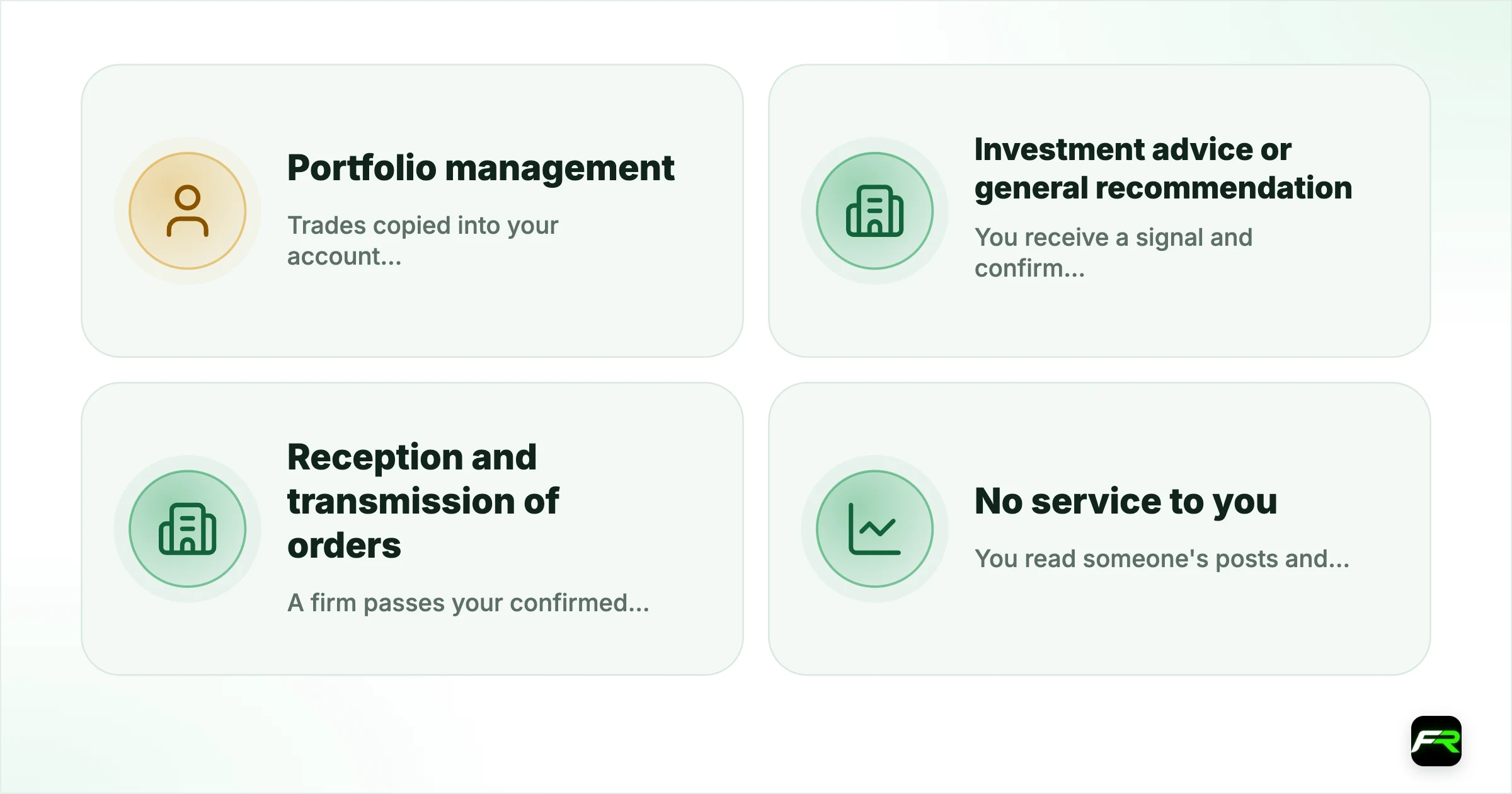
CFDs, spread bets and rolling spot forex are all financial instruments for this purpose. So a platform that places trades in your CFD or spread betting account because someone else traded is, in the FCA's view, managing your portfolio. The FCA also says that setting your own parameters, such as how much you invest or are prepared to lose, does not change that classification. A loss limit is not the same as deciding each trade.
Things change when you stay in control. In the FCA's words: "Where no automatic order execution occurs because client action is required before executing each transaction, the activity performed will not amount to portfolio management." A service that sends you a trade idea which you must confirm is giving investment advice or a general recommendation instead, and routing your confirmed orders can be reception and transmission of orders. Both are still regulated activities when done by way of business, just different ones.
| How the copying works | How the FCA classifies it | Who needs permission |
|---|---|---|
| Trades copied into your account automatically | Portfolio management | The copy service provider |
| You receive a signal and confirm each trade yourself | Investment advice or general recommendation | The firm giving personal advice, by way of business |
| A firm passes your confirmed orders to a broker | Reception and transmission of orders | The firm transmitting the orders |
| You read someone's posts and place your own trades | No service to you | Nobody, though promotions are still caught by s21 FSMA |
Signal providers, leaders and the finfluencer link
The trader you copy is usually called a leader, strategy provider or signal provider. On an FCA-authorised platform, the platform holds the permission and sets the rules for who can be copied and how they are paid. Outside that setting, an individual who sells trade signals or "account management" to UK customers as a business may be carrying on a regulated activity without permission, which is a criminal offence under the general prohibition in FSMA. The FCA's Warning List includes signal sellers, for example entries for "Profit Forex Signals" and "FX Signal".
Promotion is a separate trap. Section 21 of the Financial Services and Markets Act 2000 bans anyone from communicating an invitation or inducement to engage in investment activity in the course of business unless an authorised firm made or approved it. The FCA's finalised guidance FG24/1 (March 2024) confirms this applies to social media, including influencers. A TikTok clip saying "copy my trades, link in bio" can fall squarely within it.
That is how copy trading and finfluencer cases meet. On 20 February 2026 seven reality-TV influencers were sentenced at Southwark Crown Court for promoting an unauthorised FX trading scheme, and other finfluencers have been charged, with their cases still ongoing. Our guide to finfluencer and Telegram signal scams shows the scripts they use, which often end with "let me trade your account for you".
FCA copy trading vs offshore copy services
The protection you get depends on the firm holding your account, not on the copy tool. With an FCA-authorised platform, the usual retail rules apply to copied trades: 30:1 leverage on major pairs, a 50% margin close-out, negative balance protection, segregated client money, access to the Financial Ombudsman Service and FSCS cover up to £85,000 if the firm fails. eToro (UK) Ltd, FRN 583263, is the best-known FCA-authorised firm running a copy service for UK clients; check its current permissions on the Register yourself.
Offshore copy services are a different product. IC Markets (now trading as IC) offers IC Social, ZuluTrade and Signal Start, but a UK resident signing up today is in practice onboarded by Raw Trading Ltd in the Seychelles, which the FCA's Warning List names. An account there means no FCA conduct rules, no Ombudsman, no FSCS, leverage far above UK limits and no guaranteed negative balance protection. A leader running 1:500 on an offshore account can lose a follower's balance in an afternoon. Our page on using an offshore broker as a UK resident explains the trade-off in full.
Some experienced traders accept that risk for the tools, and we do not pretend otherwise. For anyone copying because they do not yet know how to trade, it is the worst combination: someone else's decisions, high leverage and no one to complain to. If IC is on your list for its copy tools, compare the FCA options in our IC Markets alternatives guide first.
The risks that leaderboards hide
- Drawdown. A leader showing +120% over a year may have been down 40% along the way. Look at the maximum drawdown, not the headline return, and assume you will join near a peak.
- Leverage mismatch. Your account copies the leader's positions in proportion to your allocation. A small allocation can still carry large exposure if the leader trades big relative to their balance.
- Slippage between leader and follower. Your trade opens after theirs, at a slightly different price, and fills diverge further in fast markets. On short-term strategies that gap can turn a winning leader into a losing follower.
- Survivorship bias. Leaderboards show the traders still standing. Those who blew up have dropped off, so the list looks far better than the average leader's record.
- Incentives. Leaders are often paid by copier numbers or assets, which rewards a strong recent run more than steady risk control.
- Costs. Spreads, overnight funding and any copy fees apply to every copied trade, and a leader who trades 30 times a week passes all of that on.
None of these risks goes away because the platform is authorised. FCA status protects your money if the firm fails and gives you somewhere to complain about the firm. It does not protect you from a leader's bad trades.
Declan allocated £2,000 to a leader ranked third on an FCA-authorised platform's leaderboard, with a 12-month return of 140%. He set a copy stop at 40% of the allocation. Three weeks later the leader took a large position in GBP/JPY before a Bank of England decision. The leader's account fell 35%; Declan's copy fell 38% because his fills around the announcement were worse, and he closed the copy at £1,240, a £760 loss. Across 84 copied positions, all CFDs, his realised net loss was £760. He recorded it on his self assessment return so he can set it against future capital gains.
Tax on copied trades
HMRC does not have a special regime for copy trading. A copied trade is your own trade: when the leader closes a position and your copy closes too, that is your disposal, on your numbers, on that date. The tax follows the product, so CFD profits fall under capital gains tax in almost every case (HMRC's CG56100), while spread bet profits are normally outside capital gains tax and income tax for individuals (CG56105).
For CFD copying, gains above the £3,000 annual exempt amount are taxed at 18% within the basic rate band and 24% above it. Commissions and funding costs go into the computation, and losses are allowable against other gains if you claim within four years of the end of the tax year. Many copiers are surprised by the admin: an active leader can generate hundreds of disposals, each of which needs a sterling value on its disposal date if your account runs in dollars. Our forex trading tax guide covers the reporting thresholds and deadlines.
A checklist before you copy anyone
- Search the exact company named on your agreement on the FCA Register and confirm it is authorised, with contact details that match the website.
- Make sure the firm has permission for the service: automatic copying is portfolio management.
- Walk away from anyone on social media, Telegram or WhatsApp offering to trade your account or selling a copy link. Check them on the FCA Warning List.
- Read the leader's maximum drawdown, average leverage and how long they have traded, not just the return.
- Allocate only money you could lose, and set a copy stop you would honour.
- Decide between a CFD and a spread betting account with tax in mind, and keep records of every copied close.
- If something goes wrong with an FCA firm, complain to the firm first, then the Financial Ombudsman. Report suspected scams to Report Fraud on 0300 123 2040.
Manual copying, where you read a trader's analysis and place your own trades, needs no permission from anyone and keeps every decision with you. It is slower, and that is often its main benefit.
Frequently asked
Is copy trading legal in the UK?
Yes. You can copy trades by hand freely. A service that copies trades into your account automatically is portfolio management under the FCA's guidance and needs FCA permission, so use an authorised firm with the right permissions.
When did the FCA last update its copy trading guidance?
The FCA's copy trading page shows it was first published on 12 May 2015 and last updated on 27 July 2026. It says automatic copying with no manual input from the account holder is portfolio or investment management and requires portfolio management authorisation.
Do forex signal providers need FCA authorisation?
That depends on what they do. Personal trade recommendations or account management sold as a business are regulated activities, and promoting investments on social media is caught by section 21 FSMA. The FCA's Warning List includes several signal sellers. General market commentary is a different matter.
Can I use ZuluTrade or IC Social from the UK?
You can sign up, but through IC's offshore arm. IC Markets offers IC Social, ZuluTrade and Signal Start, and UK residents are in practice onboarded by Raw Trading Ltd in the Seychelles, which is named on the FCA Warning List. That means no Ombudsman, no FSCS and no UK leverage limits.
Do I pay tax on copy trading profits in the UK?
Yes, if you copy on a CFD account: each copied close is your own disposal for capital gains tax, with a £3,000 annual exempt amount and rates of 18% or 24%. Copied spread bets are normally tax-free for individuals, and their losses cannot be offset.
Is copy trading safe for beginners?
It is not safe in the sense of low risk. Leaders can suffer deep drawdowns, your fills can differ from theirs, and leaderboards hide traders who failed. An FCA firm protects your money if the firm collapses, not from losses. Start with a small allocation and a copy stop.
Can a friend or influencer trade my account for me?
Not legally as a business without FCA permission, and it breaks most brokers' terms. Sharing your login also leaves you with little recourse if money disappears. Offers to manage your account are a common route into finfluencer and Telegram scams.
Related reading
The team behind this guide
Researched, checked and approved by five forex specialists
Every guide is written, fact-checked and edited before it goes live, and updated when the facts change. Spotted an error? Tell us.