





























FCA CFD Firms Closing in 2026: What It Means for Your Broker
On 25 September 2026 the FCA said 24 CFD firms have closed or are closing for using UK authorisation as a badge for offshore affiliates. Here is what changed and what to check today.
 WriterAbir KhanWriterWrites the guides · checks every figure against primary sources View profileAbout Abir →
 Market analysisTanbir Habib RiyadForex & Crypto AnalystForex and crypto analyst · technical and fundamental analysis View profileAbout Tanbir →
 Fact-checking & riskJannatul FerdaushFact-Checker & Risk AnalystFact-checks every figure · risk analysis · Applied Statistics, University of Dhaka View profileAbout Jannatul →
 Trading reviewJowel RanaCo-Founder & Forex TraderCo-founder · forex trader · reviews guides from a trader's view View profileAbout Jowel →
 Final approvalRanjan NiskrityFounder, Owner & Forex TraderFounder and owner · forex trader · signs off every guide View profileAbout Ranjan →
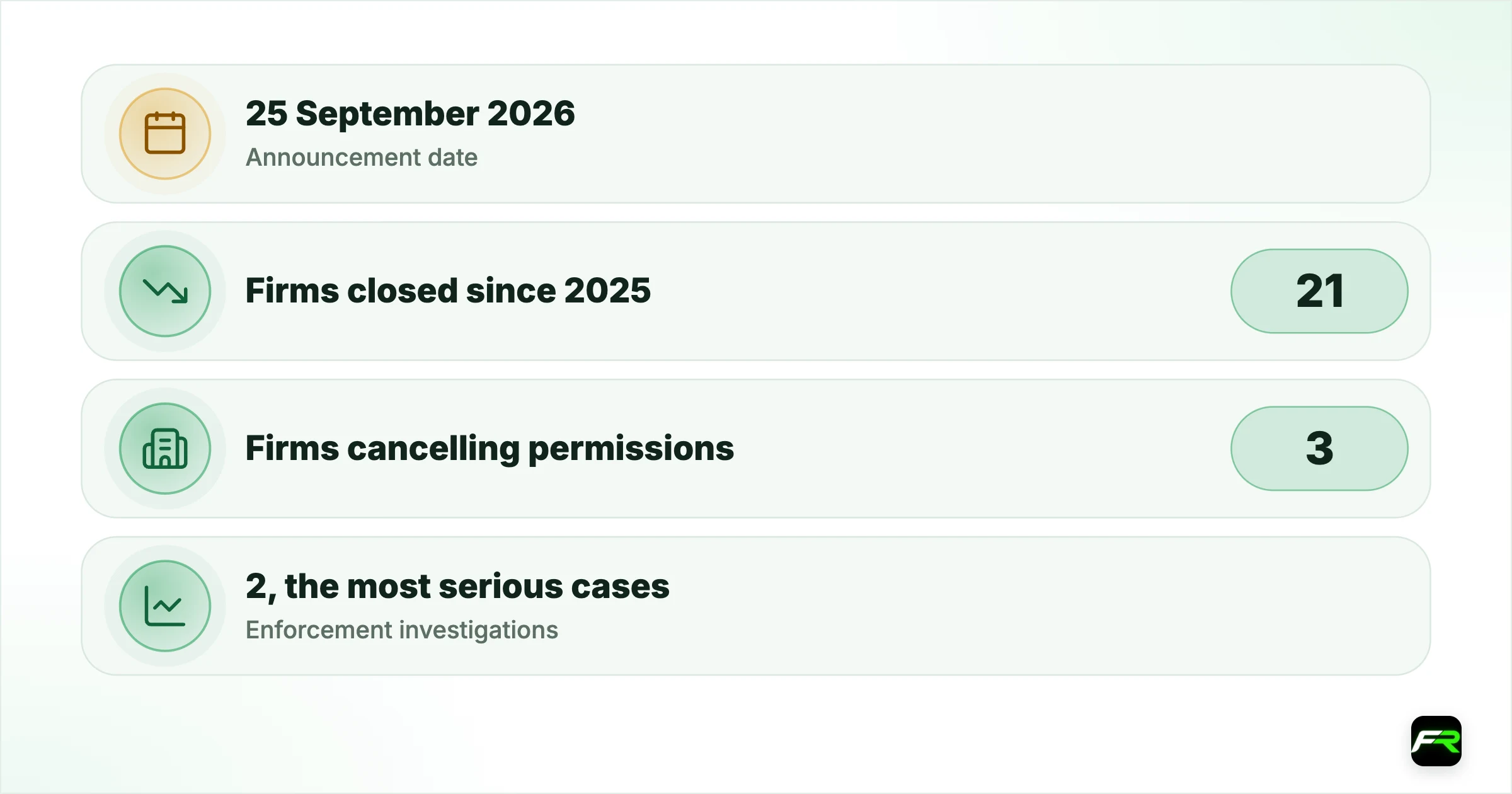
On 25 September 2026 the Financial Conduct Authority said 21 CFD firms have closed since 2025 after it challenged them, and three more are cancelling their permissions: 24 in total. Its target was firms that, in the FCA’s words, "carry out little UK business but use their authorisation as a badge to make linked overseas companies look more trustworthy than they really are." If your account is with a genuinely UK-authorised firm and your client agreement names that firm, nothing changes for you. If you signed up through a UK-looking brand but your contract sits with an offshore sister company, this announcement is about exactly your situation.
The FCA did not name the firms in its press release, and FX Recap will not guess. What follows is what the regulator said, how it fits with its two warnings from late 2025, and a short list of checks worth doing this week.
| Announcement date | 25 September 2026 |
|---|---|
| Firms closed since 2025 | 21 |
| Firms cancelling permissions | 3 |
| Enforcement investigations | 2, the most serious cases |
| FCA spokesperson | Dominic Holland, director of sell-side supervision |
| Firms named | None in the press release |
What the FCA announced
The press release, titled "Twenty-four CFD firms closing in crackdown on misuse of UK authorisation", describes a supervisory push that has led to 21 closures since 2025. Its concern was a business model rather than a single scam. A group holds a UK authorisation but does little business through it. The UK licence then appears on the group’s marketing, and customers are onboarded by a related company in another country with lighter rules.
According to the FCA, this "creates the misleading impression that consumers are dealing directly with a UK-regulated firm and benefit from UK protections when they do not." Firms faced "a range of actions, including restricting their trading abilities, requiring independent reviews of their business and opening enforcement investigations in the 2 most serious cases."
Dominic Holland, the FCA’s director of sell-side supervision, said: "Consumers need to know exactly who they’re dealing with and what protections they have. When firms blur the lines between their UK-regulated activities and overseas businesses, we will step in." The release ends its consumer advice by urging people to use the FCA’s Firm Checker to make sure you are dealing with a UK-authorised firm, "and not an overseas firm with a very similar name to a UK firm."
Why the badge model hurts traders
UK retail CFD rules are strict. Leverage is capped at 30:1 on major currency pairs, your broker must close positions at 50% of required margin, you cannot lose more than your account balance, bonuses are banned, and your money must be segregated under the FCA’s client money rules. Complaints go to the Financial Ombudsman, and if an authorised firm fails with a shortfall in client money, the FSCS can pay up to £85,000 per person.
An offshore affiliate owes you none of that. Its leverage can run to 500:1, it can offer a deposit bonus with withdrawal conditions attached, and disputes go to courts in its home country. The customer who picked the brand because of an FCA logo on the website ends up with a Seychelles, Vanuatu or St Vincent contract. Nothing about the trading platform looks different, which is why the FCA calls the impression misleading.
| UK-authorised entity | Offshore affiliate of the same brand | |
|---|---|---|
| Max leverage on EUR/USD (retail) | 30:1 | Often 500:1 or more |
| Negative balance protection | Required by FCA rules | Depends on the firm’s terms |
| Deposit bonuses | Banned | Often offered |
| Financial Ombudsman | Yes | No |
| FSCS if the firm fails | Up to £85,000 | No |
| Governing law | UK | Offshore jurisdiction |
The two 2025 warnings that led here
September’s announcement did not come out of nowhere. On 30 October 2025 the FCA warned that CFD investors were at risk of losing UK protections. It said some firms were pushing retail clients to become elective professional clients, and others were "redirecting retail clients to associated CFD providers in third country jurisdictions without equivalent consumer protections." The regulator estimated that retail protections benefit nearly 400,000 people a year and are worth £267 million to £451 million a year. The FCA added that more than 90,000 people had lost about £75 million over four years at one firm through finfluencer-promoted schemes.
Two weeks later, on 13 November 2025, the FCA published a multi-firm review of how CFD providers deliver price and value under the Consumer Duty. It found wide variation in the effective interest rates built into overnight funding charges, with firms unable to justify the differences and not disclosing them well. Some firms charged funding on both legs of a hedged position, so a client holding a long and a short in the same market paid twice. Complaints data was not feeding into fair value assessments at many firms, and some firms’ responses suggested poor controls for vulnerable clients. Only a small number of firms paid interest on retail clients’ margin deposits.
Taken together, the three publications point one way. The FCA is squeezing the routes by which UK customers end up outside UK rules (opt-ups and offshore redirection), and it is pressing the firms that stay inside the rules on cost and value.
What to check on your own account now
- Find your contracting entity. Open your client agreement or account terms and write down the exact company name and country.
- Look that company up on the FCA Register. A UK brand on the website means nothing if your contract is with another entity. Our FCA Register walkthrough shows how.
- Check your leverage. If you can trade GBP/USD at more than 30:1 and you have not opted up to professional status, you are almost certainly outside UK retail rules.
- Confirm your client category. Look for a professional client confirmation email or a change in your account classification. You may be able to reverse it.
- Review your funding costs. Pull a month of statements and add up the overnight financing. If you hold hedged positions, see whether you are charged on both.
- Watch for transfer requests. A message asking you to move to a "global" or "international" account for better conditions is the exact pattern the FCA described.
- If your firm is closing, follow its official instructions, withdraw to the original payment method and keep copies of every statement.
A closing firm must return client money in an orderly way. If you receive a message about a closure from an unfamiliar email address, or one that asks for a fee to release funds, assume it is a scam and contact the firm using the details on the FCA Register.
Kerry opened a CFD account in 2024 with a brand whose homepage carried an FCA logo. A pop-up offered "professional conditions" and 1:200 leverage, and she clicked through. After reading about the September 2026 announcement she downloaded her agreement: the contracting company was registered in St Vincent and the Grenadines, not the UK firm. Her balance was £6,200. She withdrew £500 as a test, which arrived by card in five working days, then took out the remaining £5,700 in two further requests. With the money out, she reopened with an FCA-authorised spread betting provider, where her margin on a £5 per point GBP/USD position was noticeably higher, and she cut her position size to match.
What happens if your broker is one of the 24
A firm cancelling its FCA permissions does not mean your money has gone. If the UK entity holds client money, it must return it under the FCA’s CASS rules, which keep client money segregated from the firm’s own funds. Positions are usually closed or you are asked to close them by a set date. If a firm fails and client money turns out to be short, the FSCS can step in up to £85,000 per person, as it did for customers of FIXI plc, declared in default on 30 August 2019.
For an account held with an offshore affiliate, the position is weaker. The FSCS and the Ombudsman do not cover it, and you would have to pursue any shortfall under the affiliate’s own law. That is the practical reason the FCA keeps repeating its advice to check who you are dealing with before you deposit. For the protections themselves, see our guides to FSCS cover for trading accounts and complaints to the Financial Ombudsman.
Our view: the crackdown is good news for UK traders who use properly authorised firms, and a clear warning for anyone who assumed an FCA logo protected an offshore account. It is unlikely to be the last announcement of its kind.
Last checked on 26 September 2026 against the FCA’s press release of 25 September 2026. Trade press will keep reporting on this story; FX Recap will update the page if the FCA names firms or publishes the outcome of its two enforcement investigations.
Frequently asked
Which CFD firms did the FCA close in 2026?
The FCA’s 25 September 2026 press release did not name the firms. It said 21 had closed since 2025 and three were cancelling permissions. If you are unsure about your broker, look up its entry on the FCA Register and check its current status and any notices.
Is my money safe if my CFD broker is closing?
If your account is with the UK-authorised entity, client money should be segregated and returned. Should the firm fail with a shortfall, the FSCS may pay up to £85,000 per person. Accounts held with an offshore affiliate have no FSCS or Ombudsman cover.
What does "using authorisation as a badge" mean?
It describes firms that hold UK authorisation but do little UK business through it. The licence is used in marketing, while customers are signed up by a related overseas company, giving the impression of UK protection that does not apply to those accounts.
How do I know if I am with the UK entity or an offshore one?
Read your client agreement for the company name and governing law, then search that exact company on the FCA Register. Leverage above 30:1 on major pairs without professional status, or a deposit bonus, strongly suggests an offshore entity.
Did the FCA fine any firms in this crackdown?
The release describes restrictions on trading, required independent reviews and enforcement investigations in the two most serious cases. It did not announce fines. Any outcomes of those investigations would be published separately.
What did the FCA’s November 2025 CFD review find?
It found wide, unjustified variation in overnight funding charges, poor disclosure of those costs, funding charged on both legs of hedged positions, complaints not used in fair value assessments and signs of poor controls for vulnerable clients at some firms. Few firms paid interest on margin deposits.
Should I move to a different broker?
Only if your checks show you are outside UK rules or unhappy with costs. A UK-authorised firm that names itself in your agreement, caps retail leverage and shows its loss percentage is not affected by this announcement. It takes time to switch, and you may have to close open positions.
Related reading
The team behind this guide
Researched, checked and approved by five forex specialists
Every guide is written, fact-checked and edited before it goes live, and updated when the facts change. Spotted an error? Tell us.