




























When Does HMRC Treat Forex Trading as a Business? Badges of Trade
Rarely. HMRC presumes an individual's dealing in financial instruments is not a trade (BIM56850), so most forex traders pay CGT on CFDs. Here are the badges of trade, what changes if you pass, and why spread betting differs.
 WriterAbir KhanWriterWrites the guides · checks every figure against primary sources View profileAbout Abir →
 Market analysisTanbir Habib RiyadForex & Crypto AnalystForex and crypto analyst · technical and fundamental analysis View profileAbout Tanbir →
 Fact-checking & riskJannatul FerdaushFact-Checker & Risk AnalystFact-checks every figure · risk analysis · Applied Statistics, University of Dhaka View profileAbout Jannatul →
 Trading reviewJowel RanaCo-Founder & Forex TraderCo-founder · forex trader · reviews guides from a trader's view View profileAbout Jowel →
 Final approvalRanjan NiskrityFounder, Owner & Forex TraderFounder and owner · forex trader · signs off every guide View profileAbout Ranjan →
HMRC treats an individual's forex trading as a business only in exceptional cases. Its Business Income Manual at BIM56850 adopts the "prima facie presumption", from the Salt v Chamberlain judgment, that a private person's speculative dealing in shares, derivatives and similar instruments is not a trade, and the courts have backed that view for decades. So most people who trade CFDs from home, even full time and with real skill, are taxed under Capital Gains Tax rather than Income Tax. Spread betting sits further away still: winnings are treated as gambling, and BIM22017 says making a living from bets does not by itself create a trade.
The answer matters because it decides whether profits face CGT at 18% or 24% or Income Tax at up to 45% plus National Insurance, and whether losses can reduce your salary's tax bill. Below we go through HMRC's badges of trade in a forex setting, the cases that shaped the presumption, and what would change if you were treated as trading.
General information, not tax advice. Your position depends on your own circumstances, and tax rules can change, including at the 28 October 2026 Budget. If your gains are large, your situation is unusual or you are unsure which regime applies, a qualified tax adviser who works with traders is worth the fee.
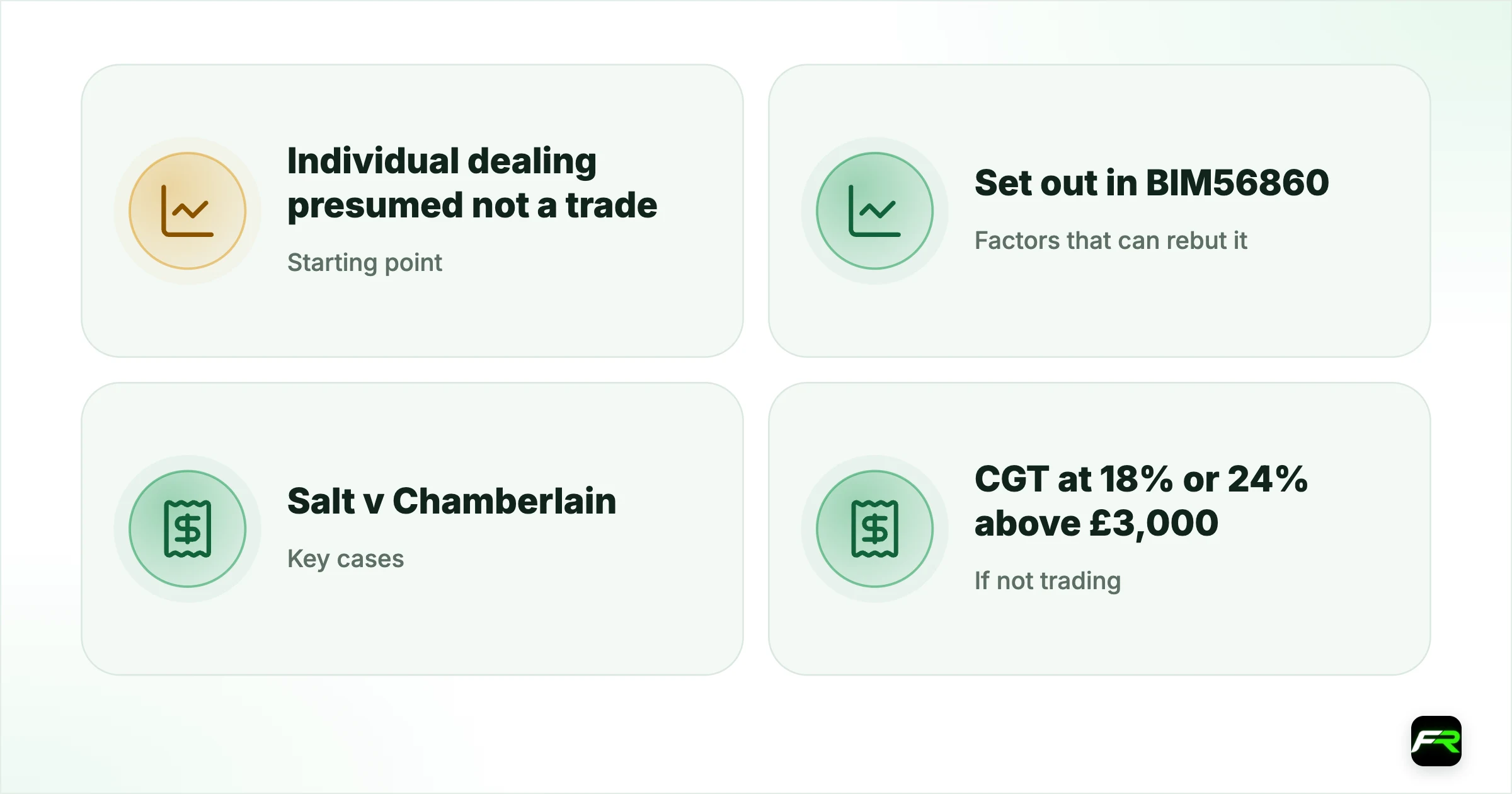
| Starting point | Individual dealing presumed not a trade (BIM56850) |
|---|---|
| Factors that can rebut it | Set out in BIM56860 |
| Key cases | Salt v Chamberlain (1979), Wannell v Rothwell (1996), Manzur v HMRC (2010) |
| If not trading (CFDs) | CGT at 18% or 24% above £3,000 |
| If trading | Income Tax 20%, 40%, 45% plus Class 4 NI |
| Spread betting | Gambling: "there is no tax on a habit" (BIM22017) |
The presumption in BIM56850
HMRC's guidance describes three possible categories for an individual's dealings in financial instruments: investment, trading, or speculation that falls short of trading. The manual adds that speculation is not an accurate opposite of either "trade" or "investment", because a private person can carry out all sorts of transactions that are neither. For a forex trader that middle category is where almost everyone ends up. Profits on CFDs and rolling spot FX are then charged under the capital gains rules, as CG56100 explains.
The presumption is "prima facie", meaning it is the default unless the facts take the case "out of the norm". Companies are treated differently: the manual notes it is much harder for a company to argue that dealing within its objects is anything other than trading. That is one reason the individual and company positions should never be mixed up.
Three tribunal and court decisions sit behind the guidance and are listed in BIM56860. In Salt v Chamberlain (1979), a mathematics graduate who used computer forecasts for about 200 share and option deals was held not to be trading. Wannell v Rothwell (1996) concerned a former commodity futures dealer trading shares and futures from home: the High Court accepted he was trading, but found the activity was not carried on commercially, so his losses could not be set against his general income. In Manzur v HMRC (2010), a retired surgeon making 240 to 300 share trades a year through an online broker was found to be managing an investment portfolio rather than trading. Activity, knowledge and effort did not produce usable trading losses in any of them.
The badges of trade, applied to forex
HMRC's general test for whether any activity is a trade is the set of "badges of trade" in BIM20205. They were developed mostly for buying and selling goods, and fit forex awkwardly, but they are still the framework an inspector or tribunal starts from. Here is how each one reads for a currency trader.
| Badge of trade | What it asks | How it looks for a forex trader |
|---|---|---|
| Profit-seeking motive | Was the activity aimed at profit? | Always yes, so it rarely helps either side |
| Number of transactions | Frequent, repeated dealing? | Often high, but frequency alone is not decisive for financial instruments |
| Nature of the asset | Is it something bought for resale rather than enjoyment or income? | Currency derivatives give no income or enjoyment, which points towards trading in theory |
| Similar trading interests | Is it linked to an existing trade? | Only if you work in a related business, such as an FX desk |
| Changes to the asset | Was work done to make it saleable? | Not applicable to CFDs |
| Way the sale was carried out | Sold in a trader-like way? | Positions closed on a platform like any retail client |
| Source of finance | Borrowed to buy? | Broker leverage is standard retail margin, not business finance |
| Interval of time | Short holding periods? | Usually short, but the courts treat speculators the same way |
| Method of acquisition | Bought deliberately rather than inherited? | Always deliberate, so it rarely separates cases |
Look at the table and you can see the problem. Most badges point the same way for every retail trader, so they do not distinguish a hobby speculator from a business. That is why, for financial instruments, the cases and HMRC's guidance focus on a different question: is the dealing organised and conducted in the way a professional dealer's business would be?
What can take a case "out of the norm"
The cases in BIM56860 point to the sort of factors that can rebut the presumption, and HMRC stresses that no single one is decisive. In a forex context they look like this:
- Professional expertise beyond a keen amateur's, such as working or having worked as a dealer, with formal training in markets.
- Organisation like a business: premises, systems, staff or contractors, proper books, business banking and a commercial plan, not a home laptop and a broker login.
- Scale and time: large volumes and many hours, though heavy activity on its own did not help in the reported cases.
- Commercial features that a private speculator does not have, such as dealing with or for customers, or access to markets on professional terms.
A retail account at an FCA-authorised broker, however busy, rarely checks these boxes, and nor does an evening routine fitted in around a UK job. Your classification as a retail client is at least consistent with dealing as a consumer rather than as a market professional. Even electing to be treated as a professional client for FCA purposes does not decide your tax status, although the evidence you gave to qualify (such as experience in the financial sector) could still be weighed alongside everything else.
What changes if you are trading
If HMRC or a tribunal accepted that your forex dealing was a trade, profits would be taxed as trading income. That means Income Tax at 20%, 40% or 45% (Scottish bands differ) plus Class 4 National Insurance at 6% on profits between £12,570 and £50,270 and 2% above, reported on the self-employment pages. Compare a £30,000 profit for a higher rate taxpayer: under CGT the bill would be £6,480 (24% of £27,000), while as trading income it would be £12,000 of Income Tax at 40% plus £1,045.80 of Class 4 NI on the profit above £12,570, a total of £13,045.80.
Losses are where trading status becomes attractive, and why most arguments about badges of trade are started by taxpayers rather than HMRC. A trading loss can, in principle, be set against your other income, including salary, in the same or previous year, or carried forward against future profits of the same trade. Strict conditions apply. The trade must be carried on on a commercial basis with a view to profit. Relief against other income is capped, generally at the greater of £50,000 or 25% of your adjusted total income, and a "non-active" trader who spends on average less than 10 hours a week on the trade is limited to £25,000 of such relief a year. Those rules exist precisely to stop people converting hobby losses into tax refunds.
Gareth took early retirement from an engineering firm and spent his days trading forex and index CFDs from a spare room. In 2024/25 he lost £31,000. His brother-in-law suggested describing himself as a self-employed trader so the loss could be set against his £38,000 pension income, producing a large refund. The accountant he consulted explained the presumption in BIM56850 and the outcome in cases like Manzur, and pointed out that Gareth had no professional background in dealing, a single retail account and no business structure. They reported the £31,000 as a capital loss instead. It cannot reduce Income Tax on his pension, but it carries forward indefinitely against future capital gains, including a planned sale of a buy-to-let flat. A claim to trading status would very likely have led to an HMRC enquiry, the loss claim being refused and interest on the tax.
Why spread betting is a different question
Spread bets are not assessed under BIM56850 at all. HMRC treats them as bets: CG56105 says no chargeable gains or allowable losses arise, and BIM56900 puts gambling profits outside Income Tax for individuals. The trading question for a bettor is governed by BIM22017, which discusses Graham v Green (1925). Its judgment includes the line "there is no tax on a habit", and HMRC's commentary is that being systematic, studying the form closely or making a living from betting does not by itself create a trade.
In practice that makes a spread bettor's position even more settled than a CFD trader's. The narrow exceptions are commercial hedging by a business (BIM56880) and someone who is effectively running a betting operation rather than placing bets. Our explainer is spread betting tax free? covers the myths that surround this.
Our view
For nearly every UK retail forex trader, the right working assumption is: CFDs are taxed under CGT, spread bets are not taxed, and trading status is not available. Payouts from prop firms are a separate case, taxed as income because you are paid for a service, which we cover in how prop firm payouts are taxed. If you believe your dealing is organised like a genuine business, take specialist advice before filing on that basis, and expect HMRC to test it. The 28 October 2026 Budget could change CGT rates, but it would take a change in the law, not a rate change, to alter the presumption itself.
Frequently asked
Is forex trading classed as self-employment in the UK?
Almost never for an individual trading their own money. HMRC's BIM56850 presumes that private dealing in financial instruments is not a trade. CFD profits are normally taxed under Capital Gains Tax and spread bets are outside tax. Prop firm payouts are different and are usually treated as self-employment income.
What are HMRC's badges of trade?
They are the factors in BIM20205 used to decide if an activity is a trade: profit motive, number of transactions, nature of the asset, related trading, changes to the asset, how sales happen, finance, holding period and how the asset was acquired. For financial instruments, organisation and expertise matter most.
Can I set forex trading losses against my salary?
Only if your dealing is accepted as a trade carried on commercially, which is rare. Even then, relief against other income is capped, and non-active traders are limited to £25,000 a year. Most traders instead claim CFD losses as capital losses against future gains.
Does trading full time make me a trader for tax?
Not by itself. In Salt v Chamberlain and Manzur, heavy activity and knowledge were not enough, and in Wannell v Rothwell a former dealer found to be trading still could not set his losses against other income because the activity was not commercial. The question is whether the dealing is organised and conducted like a professional dealer's business, and a retail account rarely meets that test.
Would being a trader for tax cost me more?
Usually yes in a profitable year. Trading income faces Income Tax at up to 45% plus Class 4 National Insurance, compared with CGT at 18% or 24% on CFD gains above £3,000. The advantage lies only in using losses against other income, subject to caps.
Can a spread bettor be taxed as a professional?
Very rarely. BIM22017 records Graham v Green: "there is no tax on a habit". Betting systematically or making a living from bets does not by itself create a trade. Exceptions involve commercial hedging or running a betting business, not simply betting a lot.
Does trading through a limited company change this?
Yes. The presumption in BIM56850 applies to individuals. HMRC notes it is much harder for a company to argue that its dealing is not trading, so a company's results are normally within corporation tax. Take advice before setting one up for trading.
Related reading
The team behind this guide
Researched, checked and approved by five forex specialists
Every guide is written, fact-checked and edited before it goes live, and updated when the facts change. Spotted an error? Tell us.