IC Markets



































Forex Brokers With a $5 to $50 Minimum Deposit
A low minimum is genuinely useful for starting small and testing a broker. It is not a licence to trade tiny capital as if it were large. Here is how to use one properly.
 WriterAbir KhanWriterWrites the guides · checks every figure against primary sources View profileAbout Abir →
 Market analysisTanbir Habib RiyadForex & Crypto AnalystForex and crypto analyst · technical and fundamental analysis View profileAbout Tanbir →
 Fact-checking & riskJannatul FerdaushFact-Checker & Risk AnalystFact-checks every figure · risk analysis · Applied Statistics, University of Dhaka View profileAbout Jannatul →
 Trading reviewJowel RanaCo-Founder & Forex TraderCo-founder · forex trader · reviews guides from a trader's view View profileAbout Jowel →
 Final approvalRanjan NiskrityFounder, Owner & Forex TraderFounder and owner · forex trader · signs off every guide View profileAbout Ranjan →
Plenty of well-known brokers open a live account from USD 5 to 50, and for a beginner in Asia that is a real advantage. It lets you put actual money on the platform, which changes how you behave, without risking a meaningful amount, and it lets you test a broker’s deposit and withdrawal process before you trust it with more. The mistake is treating the low minimum as permission to trade a USD 10 account as though it can grow into an income.
Why a small first deposit is the right move
A demo account teaches you the platform and the mechanics, but it cannot teach you how you behave when real money is moving, because part of your brain knows it is not real. A small live account closes most of that gap. USD 20 is enough to feel a loss and notice your own reaction to it, whether that is the urge to “win it back” or the temptation to move a stop, while the amount at stake is genuinely trivial. That is the point of it.
It also lets you run the full test of a broker: deposit the minimum, place one trade, withdraw what is left. You learn the real deposit speed, the real withdrawal speed, and whether the withdrawal triggers verification you had not completed. Doing that with USD 10 is much better than discovering a broker’s withdrawal problems with USD 500 in the account.
What a $10 account cannot do
It cannot compound into a living, and any content suggesting otherwise is selling you something. On a USD 10 account, even a strong 10% month is one dollar, and a run of two or three would still leave you with pocket change. The spread on a single micro-lot trade can be a meaningful fraction of the balance. Position sizing that keeps risk to 1–2% per trade means risking 10 to 20 cents, which is not a serious trade and will not teach you anything about managing a position that matters. A very small account is a training tool for behaviour, not a path to income, and treating it as the latter is how people end up over-leveraged.
It also cannot survive normal variance if you trade it at sizes that feel worthwhile. The temptation with USD 10 is to open a position big enough to “matter”, which on that balance means over-leveraged, which means one bad trade ends it. The account that lasts is the one traded at sizes that look almost pointless.
Lan opened a standard account with USD 15, tested a deposit and withdrawal successfully, then spent two months trading 0.01-lot positions and journalling every one. The account bounced between USD 8 and USD 22 and taught her more about her own impatience than any course had. When she funded it properly with USD 200, she already knew her worst habit was entering before her setup was complete, and she had a rule written down for it.
How to choose one
- Verify the licence. A low minimum does not make a broker safe, and some scams use it to lower the barrier to a first deposit. Take the specific entity name from the terms you accept, not just the brand, and check it on the regulator’s own public register (FCA, ASIC or CySEC) before you fund it, see our full routine in how to spot a fake forex broker.
- Check it supports a local funding method (bank transfer, GCash, FPX) so USD 10 is not eaten by card fees.
- Confirm withdrawals are also possible at small amounts, since some brokers set a higher withdrawal minimum than deposit minimum.
- Prefer a broker that also offers a cent account, so you can trade live at tiny size without over-leveraging a standard account.
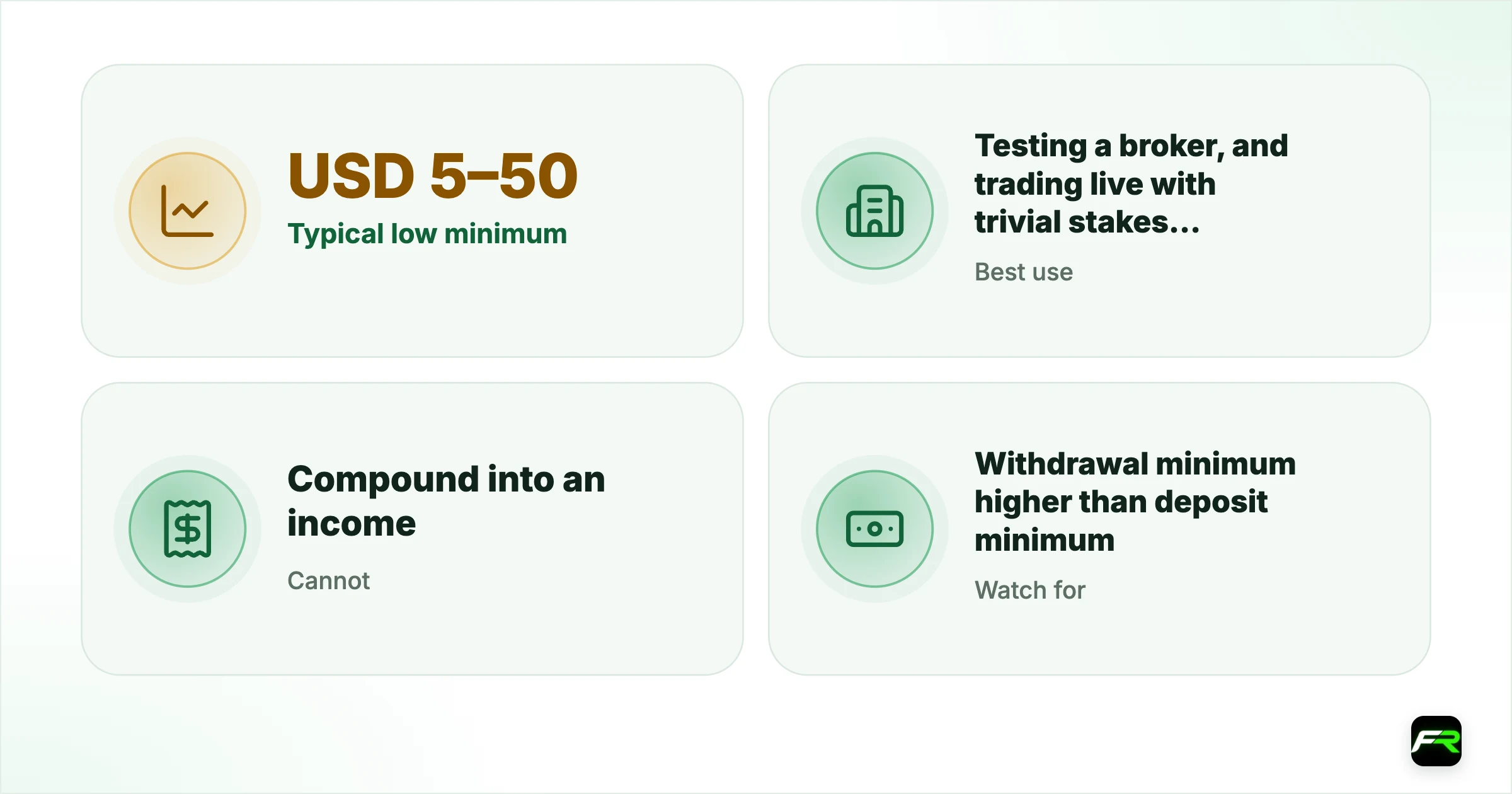
| Typical low minimum | USD 5–50 |
|---|---|
| Best use | Testing a broker, and trading live with trivial stakes while learning |
| Cannot | Compound into an income; survive if traded at ‘meaningful’ size |
| Watch for | Withdrawal minimum higher than deposit minimum |
| Better for tiny live trading | A cent account |
Ignore any video or ‘mentor’ showing a small account turned into thousands. Those results are survivorship, luck, or fabricated, and the strategy behind them is almost always over-leverage that works until it does not.
Frequently asked
Which forex brokers have a $10 minimum deposit?
Several well-known brokers open a live account from USD 5 to 50, often including a cent account option. Rather than pick from a list, verify the broker’s licence and local funding support first, then check the exact minimum for the entity you are signing up with.
Is $10 enough to start forex trading?
It is enough to test a broker and to trade live at trivial size while you learn how you behave with real money. It is not enough to grow into an income, and treating it as if it were leads to over-leverage.
Can I withdraw from a small forex account?
Usually, but check the withdrawal minimum, which some brokers set higher than the deposit minimum. Test a small withdrawal early so you know the process works.
Should I use a cent account or a standard account with $10?
A cent account is better for trading live at tiny size, because it makes small positions natural rather than forcing you to over-leverage a standard account to open a trade that feels meaningful.
Why do brokers offer such low minimums?
It lowers the barrier to a first deposit, which is good for the broker’s conversion. Used well by the trader, it is also genuinely useful for testing and learning. Scams use it for the same reason, so verify the licence.
How much should I deposit as a beginner?
Start with the minimum to test the broker, then fund the account with an amount you can afford to lose entirely while learning. For most people that is a few hundred dollars, not a few thousand.
Is a low minimum a sign of a good broker?
Neither good nor bad on its own. Solid regulated brokers offer low minimums to widen access, and so do scams, for the same reason. The minimum tells you nothing about safety; the licence and withdrawal record do.
Can I keep adding small amounts to a $10 account?
Yes, and drip-funding an account you are actively trading is fine. Just be aware that each deposit and withdrawal usually costs a currency-conversion spread both ways, so infrequent larger top-ups are cheaper than constant small ones.
The team behind this guide
Researched, checked and approved by five forex specialists
Every guide is written, fact-checked and edited before it goes live, and updated when the facts change. Spotted an error? Tell us.