





























Best Forex Demo Accounts in the UK
IG and CMC Markets give £10,000 spread betting and CFD demos, Pepperstone offers an unlimited balance on five platforms, and Capital.com and XTB demos do not expire. Here is how they compare.
 WriterAbir KhanWriterWrites the guides · checks every figure against primary sources View profileAbout Abir →
 Market analysisTanbir Habib RiyadForex & Crypto AnalystForex and crypto analyst · technical and fundamental analysis View profileAbout Tanbir →
 Fact-checking & riskJannatul FerdaushFact-Checker & Risk AnalystFact-checks every figure · risk analysis · Applied Statistics, University of Dhaka View profileAbout Jannatul →
 Trading reviewJowel RanaCo-Founder & Forex TraderCo-founder · forex trader · reviews guides from a trader's view View profileAbout Jowel →
 Final approvalRanjan NiskrityFounder, Owner & Forex TraderFounder and owner · forex trader · signs off every guide View profileAbout Ranjan →
The best forex demo accounts in the UK come from FCA-authorised brokers that let you practise the same product and platform you will use live. For spread betting, IG and CMC Markets stand out: each gives £10,000 of virtual funds and both spread bets and CFDs in one demo. Pepperstone suits anyone who wants to test platforms, with demos on its own platform, MT4, MT5, cTrader and TradingView and an unlimited virtual balance, although they expire after 60 or 90 days without activity. Capital.com says its demo has no expiry, and XTB's help centre says a demo stays open for as long as your agreement with it runs.
A demo is free, so the real cost is time spent learning habits that will not survive contact with real money. This page compares the demos on what matters, then shows how to use one properly and when to stop. For the wider question of which broker suits a beginner, see our best forex broker for beginners shortlist.
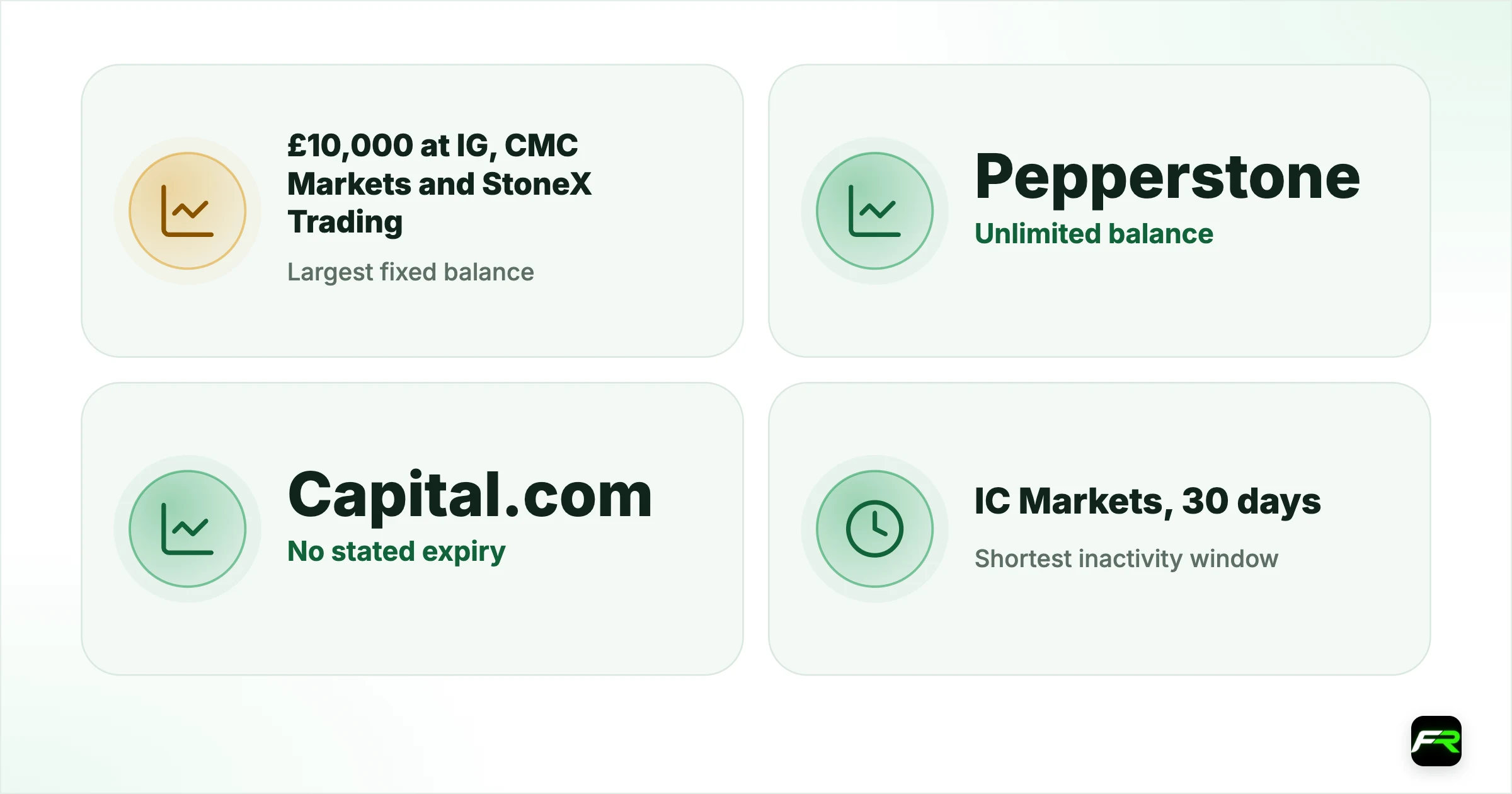
| Largest fixed balance | £10,000 at IG, CMC Markets and StoneX Trading |
|---|---|
| Unlimited balance | Pepperstone |
| No stated expiry | Capital.com; XTB (while your agreement runs) |
| Shortest inactivity window | IC Markets, 30 days (offshore, no FCA cover) |
| Spread bet and CFD in one demo | IG, CMC Markets |
| Cost | Free at every firm listed |
UK forex demo accounts compared
We checked each firm's own UK demo page or help centre in September 2026. Where a firm does not publish a detail, the table says so rather than repeating third-party claims, several of which contradict each other.
| Broker | FRN | Virtual funds | Expiry | Spread bet demo | Platforms on demo |
|---|---|---|---|---|---|
| IG | 195355 / 114059 | £10,000 | None stated on IG's demo page | Yes, with CFDs | IG web platform; separate MT4 demo |
| CMC Markets | 173730 | £10,000 | None stated on CMC's demo page | Yes, with CFDs | CMC web and apps; MT4 |
| Pepperstone | 684312 | Unlimited | 60 days inactive (own platform, MT4, MT5); 90 days (cTrader, TradingView) | Ask on sign-up | Pepperstone, MT4, MT5, cTrader, TradingView |
| Capital.com | 793714 | Not stated | No expiry | Not stated | Web and app |
| StoneX Trading (formerly City Index) | 446717 | £10,000 | Not stated | Not stated | Web, app, MT4, TradingView (live account) |
| XTB | 522157 | Adjustable in Client Office | Active while your agreement runs | No (CFDs only) | xStation web and app |
| IC Markets (offshore) | Not FCA authorised | Adjustable in Client Area | 30 days of inactivity | No (CFDs only) | MT4, MT5, cTrader |
Broker by broker
IG: best for spread betting practice
IG's demo loads £10,000 and lets you practise spread betting and CFD trading on its web platform. That matters because the spread bet ticket, with its £ per point stake and guaranteed stop option, is exactly what most UK beginners will use live. MT4 needs a separate demo. IG's own demo page does not name an expiry period, and third-party sites disagree, so treat any claim either way with care.
CMC Markets: best for chart-heavy practice
CMC also gives £10,000 of virtual funds covering spread bets and CFDs, with live charts on its web platform and apps. It runs MT4 as a separate option. Keep in mind that the live account carries a £10 monthly inactivity fee after a year without trading, which does not apply to the demo but does apply if you fund an account and then drift away.
Pepperstone: best for testing platforms
Pepperstone offers demos on all five of its platforms with an unlimited virtual balance and live prices across FX, indices, shares and commodities. That makes it the obvious place to compare MT5 with cTrader, or to connect TradingView before paying for anything. The catch is expiry: its own platform, MT4 and MT5 demos lapse after 60 days of inactivity, and cTrader and TradingView after 90. Log in at least monthly if you want to keep your history.
Capital.com, XTB and StoneX Trading
Capital.com describes its demo as "live prices, virtual funds, no expiry", which suits a slow learner who dips in and out. XTB demos are opened through its mobile app and, according to its help centre, stay active for the duration of your agreement; you can add virtual funds from the Client Office. Remember that XTB offers CFDs only, so its demo cannot teach spread betting. StoneX Trading, the renamed City Index, gives £10,000 in virtual funds.
IC Markets' demo and the offshore caveat
IC Markets (now trading as IC) is popular in forums for its raw pricing, and its demo is easy to open. IC's Help Centre says "demo accounts will only expire after 30 days of inactivity", that they run on MT4, MT5 and cTrader, and that you can add virtual funds from the Client Area. It also says demos are for familiarisation and education and that IC does not guarantee demo results will match a live account. That is a fair statement, and more candid than many.
The caveat is about what comes after the demo. IC has no FCA authorisation and no UK entity, and the FCA Warning List carries an entry against IC Markets Global saying UK customers will not have access to the Financial Ombudsman or the FSCS. A UK resident who opens a live account is, in practice, onboarded by the Seychelles company. IC offers no spread betting, so profits fall under capital gains tax, and leverage well above 30:1 is available. A demo there is harmless, but practising on a platform you should not then use live is wasted effort for a beginner. Our page on whether UK residents can use IC Markets sets out who might still choose it.
Does a demo mirror live trading?
Prices on a good demo are live, but the trading experience is not. Fills on a demo are usually instant at the quoted price, with no requotes and little slippage around news. Liquidity is infinite, so a large virtual order never moves the market or waits. Spreads may match the live feed, but you never test how your broker handles a fast Bank of England announcement with real orders queuing. None of these gaps favour you when you go live.
The bigger gap is you. A £200 virtual loser costs nothing to close, so demo traders cut losses cleanly and let winners run in a way they rarely manage with their own savings. A University of Bristol-led study published in Behavioural Public Policy in 2025 audited demo modes of 14 popular UK CFD trading apps and found that nearly a third of risk warnings did not meet the regulator's standards, and that app education tended to stress practice and strategy rather than the role of chance. Treat a demo as a flight simulator for the controls, not evidence that you can fly.
How to use a demo properly
- Match the balance to your real deposit. Reduce the virtual funds if the broker allows it, or keep a note of your notional balance and ignore the rest.
- Use your live stake and stop. If you will trade £0.50 a point with a 40-point stop, do exactly that. Our position size calculator sets the stake from the stop.
- Practise the same product. A spread betting demo for a spread betting account. Practise on a CFD demo and you learn lot sizes you will never use.
- Trade at your real hours. A commuter who can only trade at 07:30 and 21:00 should demo then, spreads and all.
- Log every trade. Entry, stop, target, reason, result and whether you followed your rules.
- Rehearse the awkward tasks. Try a stop moved to breakeven, a partial close and a guaranteed stop, and find where the platform shows margin and overnight funding.
Two demos side by side for a fortnight is a sensible way to compare brokers before funding one. Place the same trades on both and note the spread at the moment of entry, how clear the margin display is and how quickly you can find the close button on your phone. For the tax implications of product choice, see our spread betting vs CFD comparison.
Nathan opened demos with IG and Pepperstone, set a notional £1,000 balance and traded EUR/GBP and GBP/USD at £0.25 a point with 40-point stops, risking £10 a trade. Over seven weeks he logged 36 trades and finished £46 up on paper, but his log showed he had moved a stop further away six times. He spent two more weeks trading with a rule that stops could only tighten, broke it once in 14 trades, and then funded a live spread betting account with £1,000 at the same £0.25 stake.
When to move from demo to live
There is no fixed number of weeks. Move when three things are true: you have logged at least 30 to 50 trades with the stake and stop you plan to use live, you followed your own rules on nearly all of them, and you can operate the platform without hunting for buttons. A profitable demo is not one of the conditions. Plenty of people are profitable on demo and lose live; a rule-following demo that broke even is a better sign.
When you do move, start smaller than the demo, not larger. Expect your first month live to look worse than your demo record, and treat that as normal rather than a reason to raise stakes to catch up. Check the broker's entry on the FCA Register before depositing, keep your demo open for testing new ideas, and follow the funding and sizing steps in our step-by-step plan for starting forex trading.
A "demo" or "training account" offered by someone who contacts you on social media, promising you can switch to real profits with their help, is a common scam route. Genuine broker demos never need a third party. See forex scams and reporting fraud.
Frequently asked
Which UK broker has the best forex demo account?
For spread betting practice, IG and CMC Markets, each with £10,000 of virtual funds and spread bets plus CFDs in one demo. Pepperstone is the better pick for testing platforms, with demos on MT4, MT5, cTrader, TradingView and its own platform and an unlimited balance.
Do forex demo accounts expire?
It depends on the firm. Pepperstone's MT4, MT5 and own-platform demos expire after 60 days of inactivity and its cTrader and TradingView demos after 90. IC Markets demos lapse after 30 days of inactivity. Capital.com says its demo has no expiry.
Are demo accounts free?
Yes. Every broker in our comparison offers its demo free and without a deposit. You will normally need to give an email address and some basic details, and the broker may contact you about opening a live account.
Can I practise spread betting on a demo?
Yes, at firms that offer spread betting on demo, such as IG and CMC Markets, whose demos cover both spread bets and CFDs. XTB and IC Markets offer CFDs only, so their demos cannot teach £ per point staking.
Do demo accounts use real prices?
Good ones do. Pepperstone and Capital.com both state their demos use live prices, and CMC offers live charts. Execution is still smoother than live, with fewer slippage and requote issues, so results tend to flatter you.
How long should I use a demo before going live?
Until you have logged 30 to 50 trades at your planned stake, followed your rules on nearly all of them and can use the platform confidently. For most part-time traders that means four to eight weeks, not a fixed date.
Can I reset or top up my demo balance?
At some firms. XTB lets you add virtual funds in its Client Office, and IC Markets lets you add funds from its Client Area. Pepperstone's balance is unlimited. Check the settings, and consider setting the balance to your real deposit.
Related reading
The team behind this guide
Researched, checked and approved by five forex specialists
Every guide is written, fact-checked and edited before it goes live, and updated when the facts change. Spotted an error? Tell us.