IC Markets



































Why Gold Prices Spike Around Diwali and Chinese New Year
Diwali and Chinese New Year drive big physical gold demand months apart. How it shows up in the price, and how reliable the pattern is.
 WriterAbir KhanWriterWrites the guides · checks every figure against primary sources View profileAbout Abir →
 Market analysisTanbir Habib RiyadForex & Crypto AnalystForex and crypto analyst · technical and fundamental analysis View profileAbout Tanbir →
 Fact-checking & riskJannatul FerdaushFact-Checker & Risk AnalystFact-checks every figure · risk analysis · Applied Statistics, University of Dhaka View profileAbout Jannatul →
 Trading reviewJowel RanaCo-Founder & Forex TraderCo-founder · forex trader · reviews guides from a trader's view View profileAbout Jowel →
 Final approvalRanjan NiskrityFounder, Owner & Forex TraderFounder and owner · forex trader · signs off every guide View profileAbout Ranjan →
Key takeaways
- India's Dhanteras and Diwali (October or November) and China's pre-New Year buying (December to January) concentrate physical gold demand.
- The season is a mild tailwind, strongest when prices are moderate and weakest after a big rally.
- A large Indian discount to the world price signals a soft festival season.
- The dollar, real yields and central-bank buying usually decide gold's trend regardless of the calendar.
India and China together account for a large share of the world’s physical gold demand, mostly as jewellery and, in India, as a traditional store of household wealth. Both cultures concentrate their buying around specific festivals: Dhanteras and Diwali in India (October or November), and the run-up to Chinese New Year (late January or February). When two of the biggest buyers step up purchases within a few months of each other, it leaves a mark on the price, though the pattern is noisier than the folklore suggests.
The Indian season
Buying gold on Dhanteras, two days before Diwali, is considered auspicious, and the festival period drives a surge in jewellery and coin demand across India. Jewellers stock up in the weeks before, which means importers and refiners are buying on the global market from around September. In years when the domestic rupee price is not too high, the season adds real physical demand. In years when prices have already run hard, Indian buyers pull back and the seasonal support is weaker, because gold in India is price-sensitive at the household level.
The Chinese season
Chinese New Year gifting, particularly gold jewellery and small gold items given at weddings and to children, concentrates demand in December and January as retailers build inventory. The People’s Bank of China and Chinese commercial banks also tend to be active gold buyers, and while that is a year-round story now, the retail season adds a seasonal layer. The record central-bank buying guide covers the bigger structural demand.
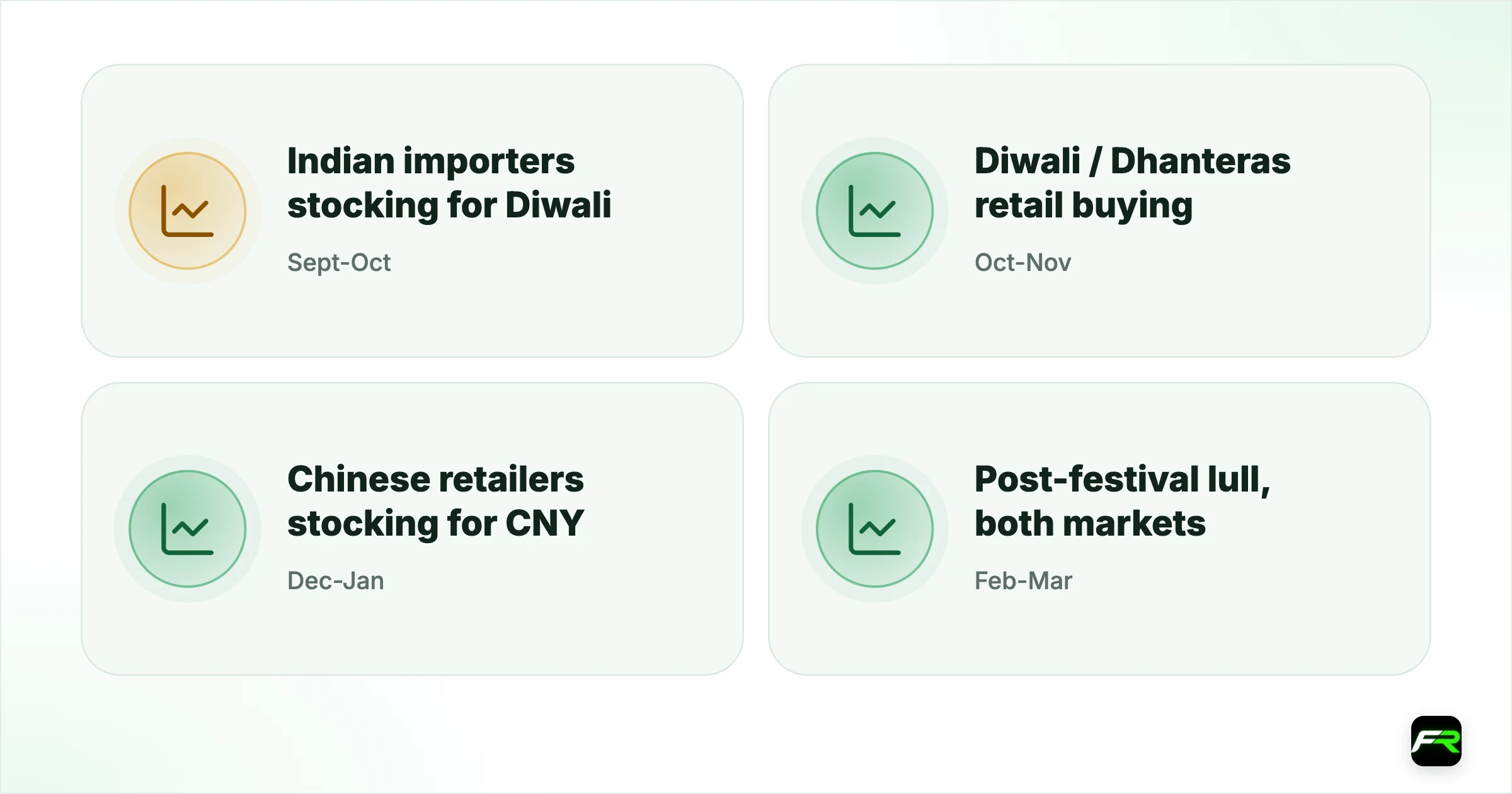
| Period | Demand driver | Typical effect |
|---|---|---|
| Sept-Oct | Indian importers stocking for Diwali | Mild upward pressure |
| Oct-Nov | Diwali/Dhanteras retail buying | Support, weaker in high-price years |
| Dec-Jan | Chinese retailers stocking for CNY | Mild upward pressure |
| Feb-Mar | Post-festival lull, both markets | Seasonal demand fades |
How reliable is it?
Moderately. Studies of long-run gold seasonality do show a tendency for firmer prices in the autumn and around year-end, consistent with the festival demand, and a softer patch in the spring. But it is a tendency, not a rule. In any given year, macro forces (the dollar, real interest rates, geopolitical risk, central-bank buying) can completely swamp the seasonal effect. 2026, with gold at records driven mainly by central-bank demand and rate expectations, is a case where the seasonal signal was a minor factor next to the macro story.
Anil used to buy gold CFDs every September expecting the Diwali bounce. Some years it worked; the year gold had already risen 30 per cent, Indian physical demand collapsed and the price fell through the festival. He now treats the season as a mild tailwind to factor in, not a trade on its own. If the macro picture is bullish and it is also festival season, he weights that. If the macro picture is bearish, the season does not save it.
Trading implications
- Treat festival seasonality as a secondary factor, not a standalone trade.
- It is more likely to matter in a year when the gold price is moderate and Indian household demand is intact.
- Watch the Indian domestic premium or discount: a large discount to the world price signals weak local demand and a soft season.
- The dollar, US real yields and central-bank buying will usually determine the trend regardless of the calendar.
Physical demand and paper (futures and CFD) prices are linked but not identical. Festival buying is physical; a lot of what moves the screen price day to day is speculative flow and macro positioning.
Sources and where to check it yourself
- World Gold Council: Gold Demand Trends: quarterly jewellery demand for India and China, to see each season's real size
Frequently asked
Does gold always rise before Diwali?
No. There is a mild historical tendency for firmer autumn gold prices, consistent with Indian festival demand, but it is easily overwhelmed by macro factors in any given year, and Indian demand itself weakens when prices are already high.
When is the Chinese New Year gold demand?
Retailers build inventory in December and January ahead of the holiday, so the demand pull is concentrated in that window, fading through February and March.
How much of world gold demand is India and China?
Together they have historically accounted for roughly half of global consumer gold demand (jewellery, bars and coins), though central-bank buying has become a larger share of total demand recently.
What is the Indian gold premium?
The difference between the price of gold in India and the world price, driven by import duty and local demand. A large premium signals strong local demand; a discount signals weak demand, which is a soft signal for the festival season.
Should I trade gold on the festival calendar?
Only as one input among several. The trend is set by the dollar, real yields and central-bank flows. Seasonality is a minor tailwind at best and unreliable in high-price years.
Related reading
The team behind this guide
Researched, checked and approved by five forex specialists
Every guide is written, fact-checked and edited before it goes live, and updated when the facts change. Spotted an error? Tell us.