



























IC Markets FCA Warning: What It Means If You Already Trade There
The FCA warning says IC Markets Global is not authorised for the UK, so you have no Ombudsman or FSCS. It is not a fraud finding. Here is what existing UK account holders should do.
 WriterAbir KhanWriterWrites the guides · checks every figure against primary sources View profileAbout Abir →
 Market analysisTanbir Habib RiyadForex & Crypto AnalystForex and crypto analyst · technical and fundamental analysis View profileAbout Tanbir →
 Fact-checking & riskJannatul FerdaushFact-Checker & Risk AnalystFact-checks every figure · risk analysis · Applied Statistics, University of Dhaka View profileAbout Jannatul →
 Trading reviewJowel RanaCo-Founder & Forex TraderCo-founder · forex trader · reviews guides from a trader's view View profileAbout Jowel →
 Final approvalRanjan NiskrityFounder, Owner & Forex TraderFounder and owner · forex trader · signs off every guide View profileAbout Ranjan →
The FCA warning on IC Markets Global means one thing: the offshore company behind IC Markets (now trading as IC) is not authorised to do business with people in the UK, so UK clients have no access to the Financial Ombudsman and no FSCS cover. It is not a finding of fraud, it does not freeze your account and it does not make your trading illegal. If you already hold an account, the sensible response is to confirm which company you are with, plan how you would get money out, keep good records and carry on paying tax on any gains.
Below is what the warning says word for word, what it does and does not mean, and a practical checklist for UK account holders.
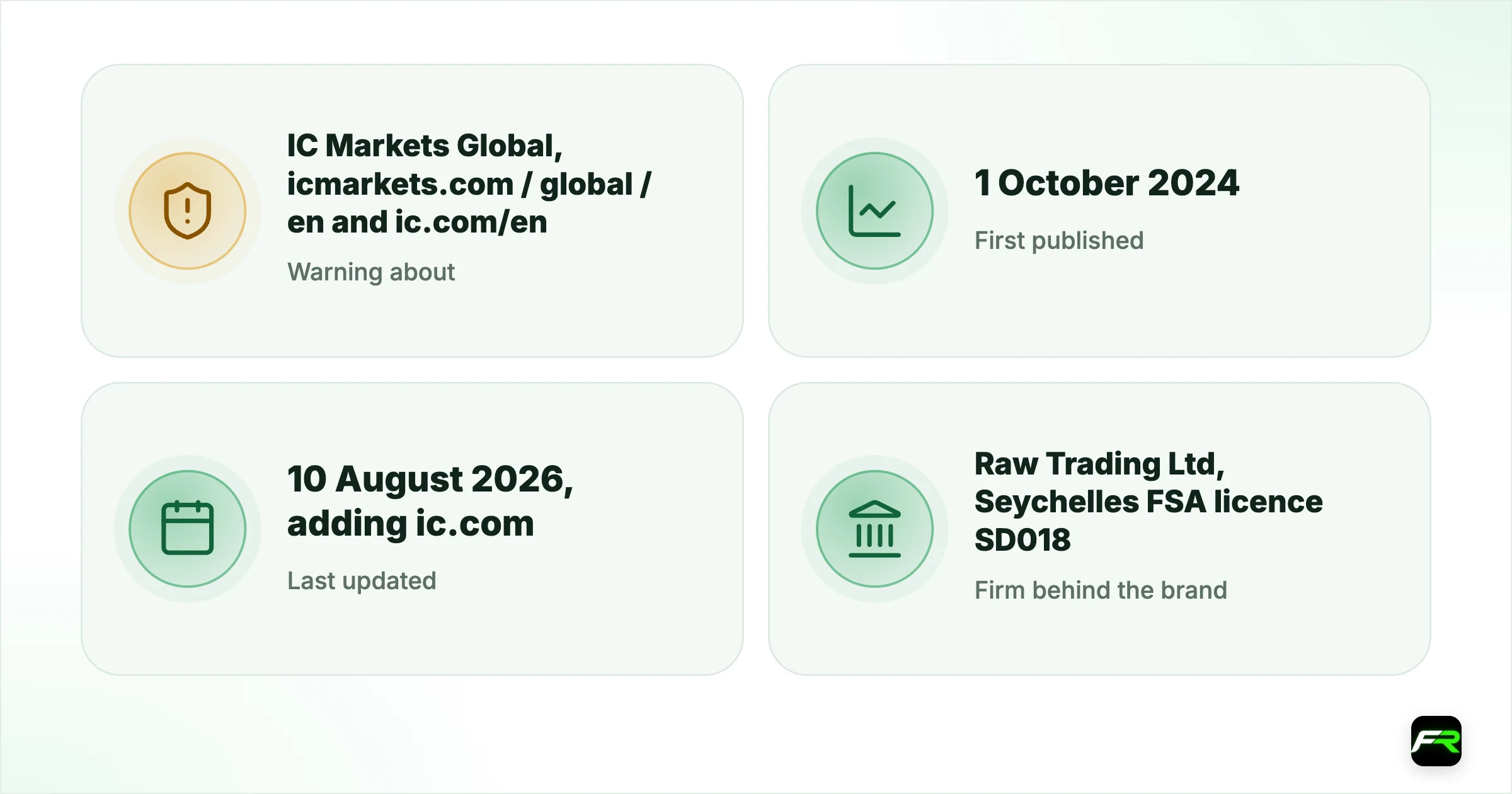
| Warning about | IC Markets Global, icmarkets.com/global/en and ic.com/en |
|---|---|
| First published | 1 October 2024 |
| Last updated | 10 August 2026, adding ic.com |
| Firm behind the brand | Raw Trading Ltd, Seychelles FSA licence SD018 |
| Genuine firm or clone? | Genuine. The phone number matches IC’s own Seychelles support line |
| Effect on you | No Ombudsman, no FSCS, no FCA conduct rules |
What the warning says
The entry sits on the FCA Warning List under the title "IC Markets Global (https://www.icmarkets.com/global/en/ and https://www.ic.com/en/)". First published on 1 October 2024, it was updated on 10 August 2026, shortly after the brand moved from icmarkets.com to ic.com (our piece on the ic.com rebrand covers what changed on the day). The core text reads: "This firm may be providing or promoting financial services or products without our permission. You should avoid dealing with this firm and beware of scams." You can read the full entry on the FCA website.
Further down, the FCA states that the firm "is not authorised by us and may be targeting people in the UK". It adds that anyone who deals with it won’t have access to the Financial Ombudsman Service and won’t be protected by the FSCS, so they are unlikely to get money back if the firm goes out of business.
Several phone numbers and email addresses appear on the entry. The first number, 4671976, matches IC’s Seychelles support line (+248 467 19 76), others match toll-free numbers IC publishes for individual countries, and every email address listed ends in @icmarkets.com. That detail matters: this is the FCA describing the real offshore business, not a fake operation borrowing the IC name. Clones have a separate warning, covered in our piece on IC Markets clone sites.
What it does and does not mean
| The warning means | The warning does not mean |
|---|---|
| IC’s offshore company has no FCA permission | The FCA has found IC guilty of fraud |
| The FCA thinks it may be targeting UK residents | Your account is frozen or will be closed |
| No Ombudsman route for UK complaints | You broke the law by opening an account |
| No FSCS compensation if the firm fails | Your money has disappeared |
| UK rules on leverage, bonuses and negative balances don’t apply | IC is unlicensed everywhere |
The Warning List mixes very different kinds of firm. Outright frauds, clones and licensed overseas brokers that the FCA thinks are reaching into the UK all appear on it, under the same heading about unauthorised business. The FCA published 2,240 warnings about unauthorised firms in 2024 and 2,329 in 2025, so a listing is common. Readers often assume every entry is a scam. That is the wrong conclusion for IC, which holds licences from ASIC, CySEC, the Seychelles FSA, the Bahamas SCB and Kenya’s CMA.
Equally wrong is shrugging it off. A listing is the UK regulator saying, in public, that it does not want UK consumers dealing with this firm, and spelling out the protections you lose. Any dispute with IC is settled under Seychelles law and courts, per clause 28 of the terms. There is no negative balance guarantee, and IC’s Help Centre says that if you lose more than your balance "you will bear the negative consequences". Is IC Markets FCA regulated? sets out all three FCA records side by side, and checking a broker on the FCA Register shows how to read an entry like this for any firm.
Practical steps for existing UK account holders
Nothing here requires panic. It does call for a bit of housekeeping, most of which a careful trader should do with any broker:
- Confirm your entity. Download your client agreement and search for the contracting party. For a UK resident it is, in practice, Raw Trading Ltd. Our article on UK residents and IC Markets shows where to look.
- Export your history now. Save statements and a full trade history for every tax year, as PDF and CSV. Records you hold yourself don’t depend on a portal staying available.
- Test a withdrawal. Request a small amount and time it. Card withdrawals usually take 3–5 business days, international wires up to 14.
- Learn the withdrawal rules. Card withdrawals are capped at what you deposited on that card, e-wallet money goes back to the same wallet, Rapidpay and Klarna deposits come back by wire, and IC may require withdrawals to previous deposit methods in a sequence it decides.
- Right-size the balance. Keep only the margin you need plus a buffer. Surplus cash sitting offshore earns you nothing and carries broker risk.
- Cut your leverage. With up to 1:5000 available and no negative balance guarantee, a weekend gap can leave you owing money. Setting a lower leverage yourself is sensible.
- Keep a paper trail. Save KYC documents, emails and the date of every withdrawal request. Should a dispute arise, dates and copies are your evidence.
IC’s withdrawal cut-off is 12:00 Australian Eastern time, which falls in the early hours of the morning in the UK. A request made during a UK working day is usually processed on the following Australian business day.
Should you withdraw everything?
No regulator has told existing clients to close their accounts, and IC continues to process withdrawals. The honest answer depends on how much you hold and why. A trader keeping £2,000 there for cTrader scalping, with the rest of their money at an FCA-authorised firm, has limited exposure. A trader with £40,000, most of it profit, has a lot of money sitting with a company that the UK regulator has warned against and that no UK scheme will make good if it fails.
Should you decide to move money, allow time. Close positions first, then withdraw to your card up to the amount deposited on it, then take the rest by bank wire. Trustpilot shows IC at around 4.8 from roughly 56,700 reviews, with praise for live chat, while complaint themes include slow templated email support, account-review delays and withdrawal holds. Forum threads on Elite Trader in November 2025 describe withdrawals taking over a week with repeated compliance questions. Answer any request for documents quickly and keep copies.
Anyone who contacts you offering to "recover" money from IC Markets for an upfront fee, or claiming to act for the FCA, is almost certainly running a recovery scam. The FCA does not charge fees or cold call about withdrawals.
Your tax position does not change
The warning has no effect on what you owe HMRC. IC offers CFDs only, so net gains above the £3,000 annual exempt amount are subject to capital gains tax at 18% or 24%, depending on your income. Losses can be set against gains if you claim within four years of the end of the tax year. Anyone who needs to file for 2025/26 and is not yet in self assessment must register by 5 October 2026, and the online return and payment are due by 31 January 2027.
For a USD account, convert each closed trade to sterling at the rate on the date of disposal, not the date you withdraw. That is one more reason to export your trade history now. Our article on tax on IC Markets profits covers the calculation.
General information, not tax advice. Your own position depends on your circumstances, and tax rules can change, including at the 28 October 2026 Budget. An accountant who deals with traders is worth the fee if your gains are large or complicated.
If something goes wrong
Start with IC’s own complaints process, in writing, and keep a copy. The Financial Ombudsman cannot take the case, because the firm is not authorised in the UK. Beyond the firm itself, your routes are the Seychelles FSA as the regulator that licenses Raw Trading Ltd, and the Seychelles courts under the terms you accepted. Both are slow and costly compared with the free UK Ombudsman, which is the real price of an offshore account. The same trade-off applies to any overseas firm, and using an offshore broker as a UK resident sets it out in general terms.
Ethan had traded with IC for three years and held £8,000, of which £3,000 had been deposited by debit card and the rest was profit. After reading the warning he exported his statements for each tax year, then requested a £500 test withdrawal to his card, which arrived in four business days. He withdrew another £2,500 to the card, reaching his £3,000 card deposit total, and took £3,000 by bank wire, which arrived in eight working days after one extra identity check. The remaining £2,000 stayed for cTrader trading with leverage set at 1:30, and he reported his CFD gains for the year on his self assessment return.
Frequently asked
I already have an IC Markets account. What should I do first?
Download your client agreement to confirm the contracting company, export statements and trade history for every tax year, then test a small withdrawal and time it. After that, decide how much margin you really need offshore and cut your leverage. None of this is urgent, but all of it is easier before you need it.
Is my IC Markets account frozen because of the warning?
No. A Warning List entry has no direct effect on existing accounts. IC continues to operate and process withdrawals. The warning tells UK consumers what protections they lack, and advises them to avoid dealing with the firm.
Should I close my IC Markets account?
That depends on your balance and your reliance on UK protections. Many traders keep only working margin offshore and hold the rest with an FCA-authorised firm. If you do close, withdraw to your card up to the amount you deposited, then take the remainder by wire.
Is the FCA warning about a clone or the real IC Markets?
The real one. Both icmarkets.com/global and ic.com appear in the entry, and one listed phone number matches IC’s own Seychelles support line. Clones that copy IC Markets (EU) Ltd’s details have a separate FCA warning, first published on 7 January 2022.
Will my UK bank block payments to IC Markets because of the warning?
The warning is addressed to consumers and says nothing about stopping payments. We found no general UK bank block on paying brokers, although our checks covered FCA-authorised firms. Your bank’s fraud team may still query a payment to an overseas firm, particularly a first one, and several UK banks restrict transfers to crypto platforms. Incoming wires from IC arrive as international payments.
Do I still pay UK tax on IC Markets profits?
Yes. CFD gains are subject to capital gains tax at 18% or 24% above the £3,000 annual exempt amount, reported through self assessment. The broker being offshore or on the Warning List changes nothing about what you owe.
When was the FCA warning on IC Markets updated?
It was first published on 1 October 2024 and last updated on 10 August 2026. The update added ic.com to the entry after IC moved its main website from icmarkets.com to ic.com on 11 July 2026.
Related reading
The team behind this guide
Researched, checked and approved by five forex specialists
Every guide is written, fact-checked and edited before it goes live, and updated when the facts change. Spotted an error? Tell us.