IC Markets




































How Public Holidays Across Asia Affect Forex Liquidity
Chinese New Year, Golden Week, Diwali, Eid and year-end: which regional holidays thin forex liquidity, which pairs suffer, and how to adjust.
 WriterAbir KhanWriterWrites the guides · checks every figure against primary sources View profileAbout Abir →
 Market analysisTanbir Habib RiyadForex & Crypto AnalystForex and crypto analyst · technical and fundamental analysis View profileAbout Tanbir →
 Fact-checking & riskJannatul FerdaushFact-Checker & Risk AnalystFact-checks every figure · risk analysis · Applied Statistics, University of Dhaka View profileAbout Jannatul →
 Trading reviewJowel RanaCo-Founder & Forex TraderCo-founder · forex trader · reviews guides from a trader's view View profileAbout Jowel →
 Final approvalRanjan NiskrityFounder, Owner & Forex TraderFounder and owner · forex trader · signs off every guide View profileAbout Ranjan →
Key takeaways
- Chinese New Year, Japan's Golden Week, Diwali, Eid and the year-end break all thin out liquidity on specific pairs.
- Expect wider spreads, exaggerated moves, less reliable technical levels and gaps when markets reopen.
- Golden Week affects USD/JPY and every yen cross; Chinese New Year hits USD/CNH, AUD pairs and gold.
- Cut size, widen stops or flatten before the holidays that affect the pairs you trade.
The forex market technically never closes on a weekday, but liquidity is not constant. When a major financial centre is on holiday, the banks that make prices in that region step back, spreads widen, and price can move more on less flow. Asia has several multi-day holiday periods that matter, and knowing them ahead of time lets you reduce size or step aside rather than being surprised.
The holidays that matter most
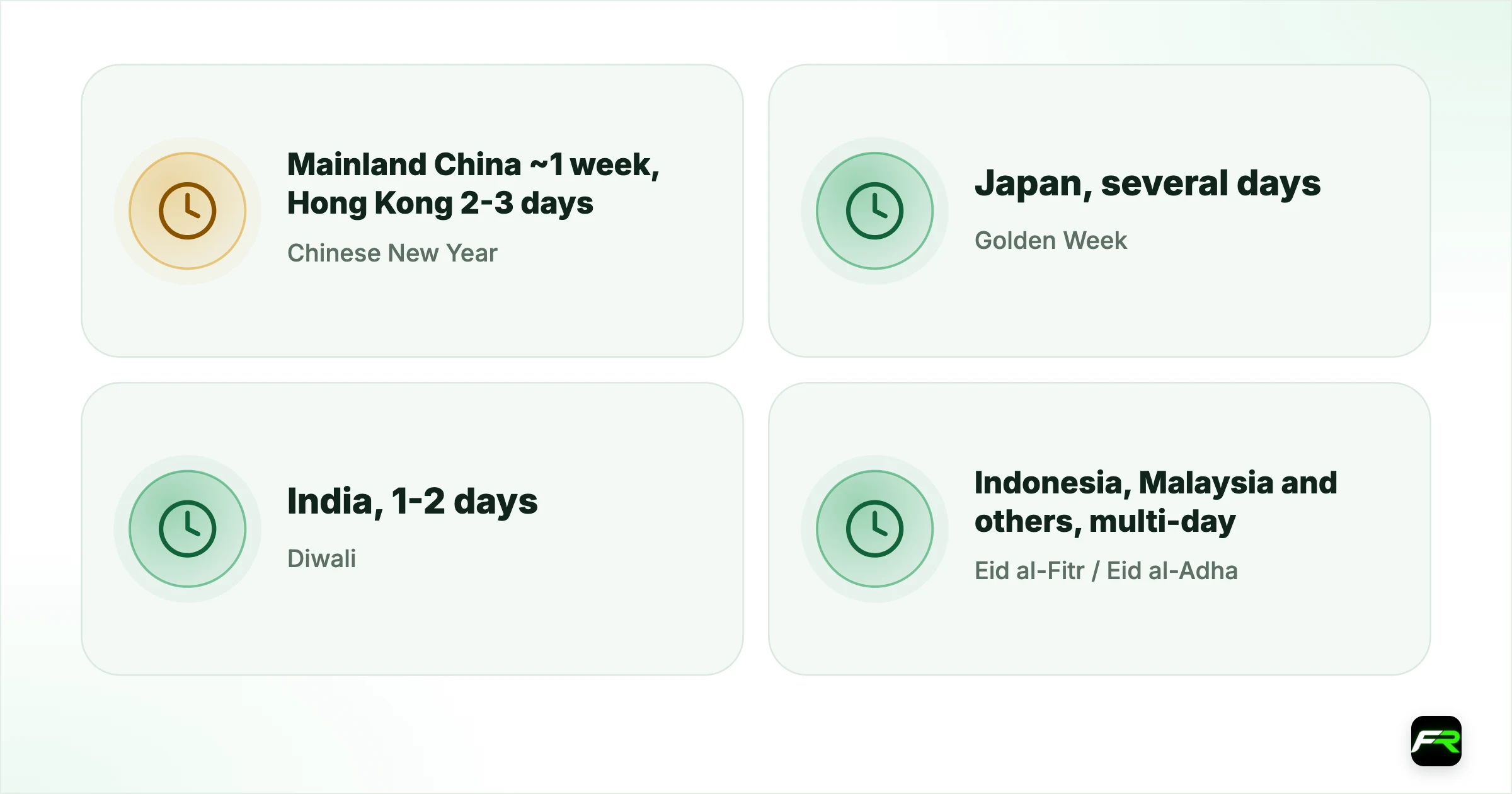
| Holiday | Region / market closed | When | Pairs most affected |
|---|---|---|---|
| Chinese New Year | Mainland China ~1 week, Hong Kong 2-3 days | Late Jan / Feb | USD/CNH, AUD pairs, gold physical demand |
| Golden Week | Japan, several days | Late Apr / early May | USD/JPY, all JPY crosses |
| Diwali | India, 1-2 days | Oct / Nov | USD/INR (exchange-traded), gold |
| Eid al-Fitr / Eid al-Adha | Indonesia, Malaysia and others, multi-day | Dates shift yearly | USD/IDR, USD/MYR, regional flow |
| Year-end (24 Dec – 2 Jan) | Global, reduced staffing | Late Dec | All pairs; very thin, gappy |
What actually happens
- Spreads widen. Fewer banks quoting means a bigger gap between bid and offer, worst on the pairs tied to the closed market.
- Moves get exaggerated. A modest order pushes price further in a thin book, and there are fewer participants to fade it, so ranges can be misleadingly wide or misleadingly quiet.
- Technical setups are less reliable. Levels get broken and reclaimed on low volume, producing false signals.
- Reopening moves. When the closed market returns, a backlog of news can be priced in one go, causing a gap or a sharp session.
Golden Week specifically
Japan’s Golden Week is a run of public holidays in late April and early May. With Japanese banks and institutions out for several days, USD/JPY and every JPY cross sees noticeably lighter liquidity. Historically this has occasionally coincided with sharp yen moves precisely because the market is shallow and a shock has less liquidity to absorb it. If you trade yen pairs, treat Golden Week like a mini Chinese New Year: reduce size, widen stops, and be cautious about holding through it.
Kenta stopped taking normal-sized USD/JPY positions during Golden Week after a year when the yen moved sharply on thin liquidity while Tokyo was closed and his stop filled several pips past its level. He now either flattens JPY positions before the holidays or cuts them to a quarter size with a wide stop, and treats the week as a low-conviction period.
Chinese New Year and the CNH effect
Chinese New Year gets one row in the table above, but it affects the widest range of pairs on this list: USD/CNH directly, AUD pairs through the Australia-China trade link, and gold through reduced Chinese physical demand. Mainland China closes for roughly a week and the PBOC stops publishing its daily fixing, so the offshore CNH market loses both its onshore anchor and a large share of its liquidity for that stretch. The Lunar New Year guide covers the mechanics and the swap-cost impact in detail, it is worth the dedicated read given how many pairs it touches.
Where to check exact holiday dates each year
Every holiday in the table above moves slightly year to year, or in the case of Eid, on a different calendar entirely. Rather than tracking each one separately, keep a general reference like timeanddate.com's holiday calendars bookmarked for the countries you trade, and for China specifically use the CFETS trading calendar, the official interbank market operator's own schedule of onshore closures.
How to adjust
- Keep a holiday calendar for the main Asian financial centres, not just your own country’s holidays.
- In the days around a major regional closure, cut position size for the affected pairs and widen stops for slippage.
- Avoid initiating breakout trades on the affected pairs during the quiet window; false breaks are more common.
- Watch the reopening session for an outsized move as backed-up news is absorbed.
- The year-end period (roughly 24 December to 2 January) is quiet globally; many traders simply stand aside.
Eid dates move each year with the Islamic calendar, and the length of the public holiday varies by country. For Indonesia and Malaysia in particular, the Eid al-Fitr period is a multi-day slowdown in regional flow; check the specific dates ahead of time.
Frequently asked
Does forex close on public holidays?
The market stays open, but when a major financial centre is on holiday the banks there stop quoting prices, so liquidity drops, spreads widen, and moves can be exaggerated on the affected pairs.
Which Asian holidays affect forex the most?
Chinese New Year (USD/CNH and regional flow, about a week), Japan’s Golden Week (all JPY pairs, several days), and the global year-end period. Diwali and Eid have smaller, more localised effects.
Is it dangerous to trade during Golden Week?
It is lighter on liquidity, so moves can be sharper and fills worse on JPY pairs. It is not off-limits, but reducing size, widening stops and avoiding breakout trades on yen pairs is prudent.
What happens when a closed market reopens?
A backlog of news from the holiday period can be priced in one go, producing a gap or a sharp opening session. It is worth watching rather than holding a position blindly into the reopen.
Should I just not trade during the year-end holidays?
Many traders stand aside from roughly 24 December to 2 January because liquidity is very light globally, spreads are wide, and price action is unreliable. If you do trade, keep size small.
Related reading
The team behind this guide
Researched, checked and approved by five forex specialists
Every guide is written, fact-checked and edited before it goes live, and updated when the facts change. Spotted an error? Tell us.