IC Markets





































Bank of Thailand and USD/THB: Tourism, Exports, and the Baht
The Thai baht is unusual: it often behaves like a commodity currency because of Thailand’s tourism earnings and current account. Here is what moves USD/THB, and how the Bank of Thailand manages it.
 WriterAbir KhanWriterWrites the guides · checks every figure against primary sources View profileAbout Abir →
 Market analysisTanbir Habib RiyadForex & Crypto AnalystForex and crypto analyst · technical and fundamental analysis View profileAbout Tanbir →
 Fact-checking & riskJannatul FerdaushFact-Checker & Risk AnalystFact-checks every figure · risk analysis · Applied Statistics, University of Dhaka View profileAbout Jannatul →
 Trading reviewJowel RanaCo-Founder & Forex TraderCo-founder · forex trader · reviews guides from a trader's view View profileAbout Jowel →
 Final approvalRanjan NiskrityFounder, Owner & Forex TraderFounder and owner · forex trader · signs off every guide View profileAbout Ranjan →
Key takeaways
- The baht is backed by tourism and exports, which usually keep Thailand's current account in surplus.
- Monthly tourist arrivals, especially from China, are one of the most useful signals for USD/THB.
- Thailand's active gold market can move the baht when gold swings sharply and local gold shops sell.
- The Bank of Thailand smooths volatility rather than targeting a level; spreads make USD/THB a slow, structural trade.
The Thai baht does not trade like a typical emerging-market currency. Thailand has historically run a current account surplus in normal years, driven by exports and, crucially, by tourism, which brings in foreign currency that has to be converted into baht. That gives the baht a structural support that many regional peers lack, and it makes USD/THB sensitive to things like tourist arrival numbers and the global travel cycle.
The tourism channel
Tourism has at times been worth more than a tenth of Thai GDP. Every foreign visitor who spends money in Thailand is, in effect, selling their home currency and buying baht. A strong tourist season supports the baht; a collapse in arrivals, as happened during the pandemic, removes a major source of foreign currency inflow and weakens it sharply. Traders who follow USD/THB watch monthly tourist arrival data, particularly the numbers from China, which is the largest single source market.
Exports and the current account
Thai exports (electronics, autos and parts, agricultural products) are the other pillar. A widening trade surplus supports the baht; a shrinking one, or a slump in a key export like autos, weakens it. Because Thailand’s current account swings between surplus and deficit depending on the tourism and export cycle, the baht can shift from being one of Asia’s stronger currencies to one of its weaker ones within a year.
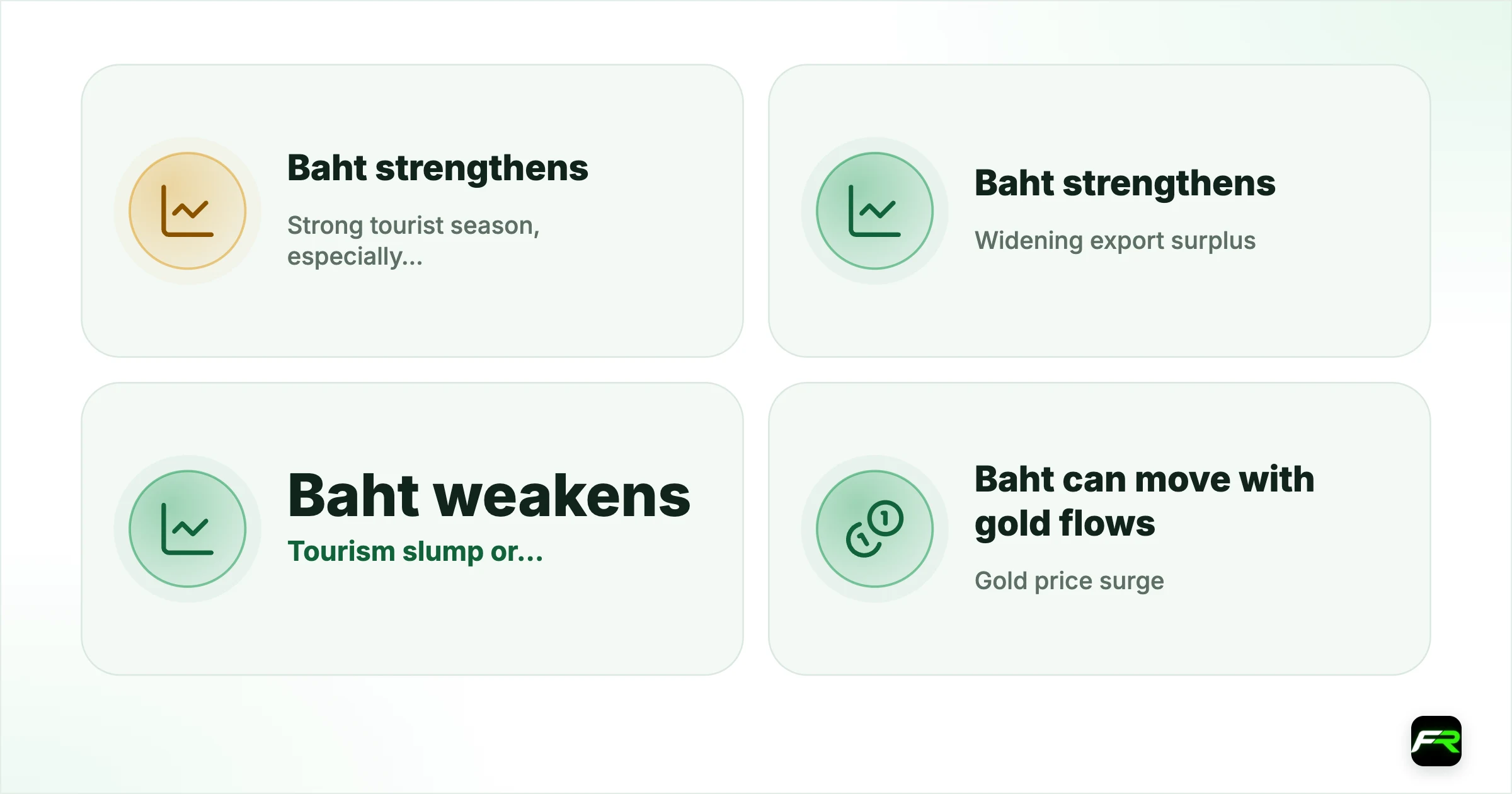
| Condition | Baht direction | USD/THB |
|---|---|---|
| Strong tourist season, especially Chinese arrivals | Baht strengthens | Falls |
| Widening export surplus | Baht strengthens | Falls |
| Tourism slump or export downturn | Baht weakens | Rises |
| Gold price surge (Thailand is a gold trading hub) | Baht can move with gold flows | Variable |
The gold link
Thailand has an unusually active domestic gold market, and Thai gold shops are large enough that their buying and selling of physical gold, which has to be paid for in dollars, can move USD/THB at the margin. When the global gold price rises sharply and Thai retail investors sell to lock in gains, that can involve converting dollars back to baht and briefly strengthening the currency. It is a second-order effect but a distinctive one for this pair.
Nok noticed USD/THB moving on days with no Thai news and traced several of the moves to gold. When gold jumped and Thai gold traders were reported to be net sellers, the baht firmed. She does not trade this directly, but it stopped her being surprised by baht strength that had no domestic explanation.
What the Bank of Thailand does
The Bank of Thailand sets the policy rate (its committee meets roughly six times a year) and intervenes to smooth baht volatility rather than target a level. It has at times expressed discomfort with a baht it considered too strong, because a strong baht hurts exporters and tourism competitiveness, and has used measures to slow speculative inflows. For a trader, the rate decisions are usually a minor event; the tradeable signals are shifts in the tourism and export data and any BoT commentary about the exchange rate being a problem.
Instruments to Watch or Avoid Timing Around This
For anyone trading USD/THB itself, the two recurring dates worth marking are the monthly Thai tourist arrival release, especially the China arrivals breakdown, and the Bank of Thailand’s roughly six scheduled rate meetings a year. Neither tends to move the pair as sharply as a Fed or BoJ event, but a clear surprise in either, a big miss in Chinese arrivals or unexpected BoT language about the baht being too strong, is worth planning around rather than being caught by. The gold-flow effect covered above is harder to plan for since it has no calendar of its own; it shows up as baht strength on days when global gold is moving sharply and Thai gold shops are reported as net sellers, which is a reason to check the gold price before assuming a baht move has a purely Thai explanation.
USD/THB itself is not a good instrument for short-term timing plays around any of this: retail spreads are wide relative to the pair’s typical daily range, so a position needs to be held for days to weeks, not hours, for the move to clear the cost of entry. Traders looking to express a short-term view on the tourism or export cycle are generally better served trading it through the more liquid USD/JPY or gold, and treating USD/THB as a slower, structural position instead.
For Thai residents, no local company is licensed to offer retail forex, so traders use offshore brokers. An individual trading their own money with a broker abroad is not committing an offence but is unregulated from the Thai side. See our Thailand broker guide.
Sources and where to check it yourself
- Bank of Thailand: monetary policy: rate decisions, meeting schedule and policy statements
For the rules and brokers that apply where you live, see our guide to the best forex brokers in Thailand.
Frequently asked
Why does the baht behave like a commodity currency?
Because Thailand’s foreign currency earnings come heavily from tourism and exports, both of which are cyclical. A strong travel and export cycle brings in foreign currency that is converted to baht, supporting it, much as commodity exports support the Australian dollar.
What tourism data should I watch for USD/THB?
Monthly tourist arrival figures, especially the number of arrivals from China, which is the largest source market and the swing factor for total arrivals.
How often does the Bank of Thailand set rates?
Its Monetary Policy Committee meets roughly six times a year on a published schedule, announcing the policy rate in the early afternoon Bangkok time.
Does gold really move the baht?
At the margin, yes. Thailand has a large, active physical gold market, and Thai gold traders buying or selling in size involves dollar-baht conversion that can nudge USD/THB, particularly around sharp moves in the global gold price.
Is USD/THB good to trade?
It is less liquid than the majors with wider retail spreads, and its main drivers (tourism, exports, gold flows) require following specific data. It is not a beginner pair.
Related reading
The team behind this guide
Researched, checked and approved by five forex specialists
Every guide is written, fact-checked and edited before it goes live, and updated when the facts change. Spotted an error? Tell us.