IC Markets





































The Trade That Taught a Filipino Trader to Stop Revenge Trading
One loss, then four larger trades in 90 minutes trying to win it back, ending with a 15% drawdown. The psychology behind revenge trading, and the concrete rules that stopped it from happening again.
 WriterAbir KhanWriterWrites the guides · checks every figure against primary sources View profileAbout Abir →
 Market analysisTanbir Habib RiyadForex & Crypto AnalystForex and crypto analyst · technical and fundamental analysis View profileAbout Tanbir →
 Fact-checking & riskJannatul FerdaushFact-Checker & Risk AnalystFact-checks every figure · risk analysis · Applied Statistics, University of Dhaka View profileAbout Jannatul →
 Trading reviewJowel RanaCo-Founder & Forex TraderCo-founder · forex trader · reviews guides from a trader's view View profileAbout Jowel →
 Final approvalRanjan NiskrityFounder, Owner & Forex TraderFounder and owner · forex trader · signs off every guide View profileAbout Ranjan →
Key takeaways
- Four trades in 90 minutes, only one of them planned, cost a $2,500 account about $365 (roughly 15%).
- Size grew from 1% to 6% while stops got worse and then disappeared: the classic revenge-trading loop.
- The trades were an attempt to get rid of an emotion, not responses to setups.
- Hard rules break the loop: a daily loss limit, a pause after a stop-out, and a written plan for every trade.
About this case study: Mark, the trader in this example, is an illustrative composite, not a real person, and the account, trades and figures are not a real trading record. They are built from patterns that are common in retail trading so the maths can be shown step by step. Market events are simplified unless a date is given.
Revenge trading, sometimes called trading on tilt, is when a loss stops feeling like a normal cost of business and starts feeling like something to be corrected immediately. The trader stops following the plan and starts trying to get the money back, usually with larger size, worse entries, and no stop. It is the fastest way an otherwise disciplined account gets damaged, and almost every trader does it at least once. This is one trader's version, and what fixed it.
The trader was in Cebu, running a $2,500 account, mostly on GBP/USD and USD/JPY. They had been trading for about a year with roughly break-even results. The day this happened, they were up slightly for the week and feeling good.
The sequence
Trade one: a GBP/USD short that followed the plan, sized at one per cent, stopped out for a $25 loss. Nothing unusual. But the trader had been sure about it, and being stopped out on a trade they were sure about stung more than the money.
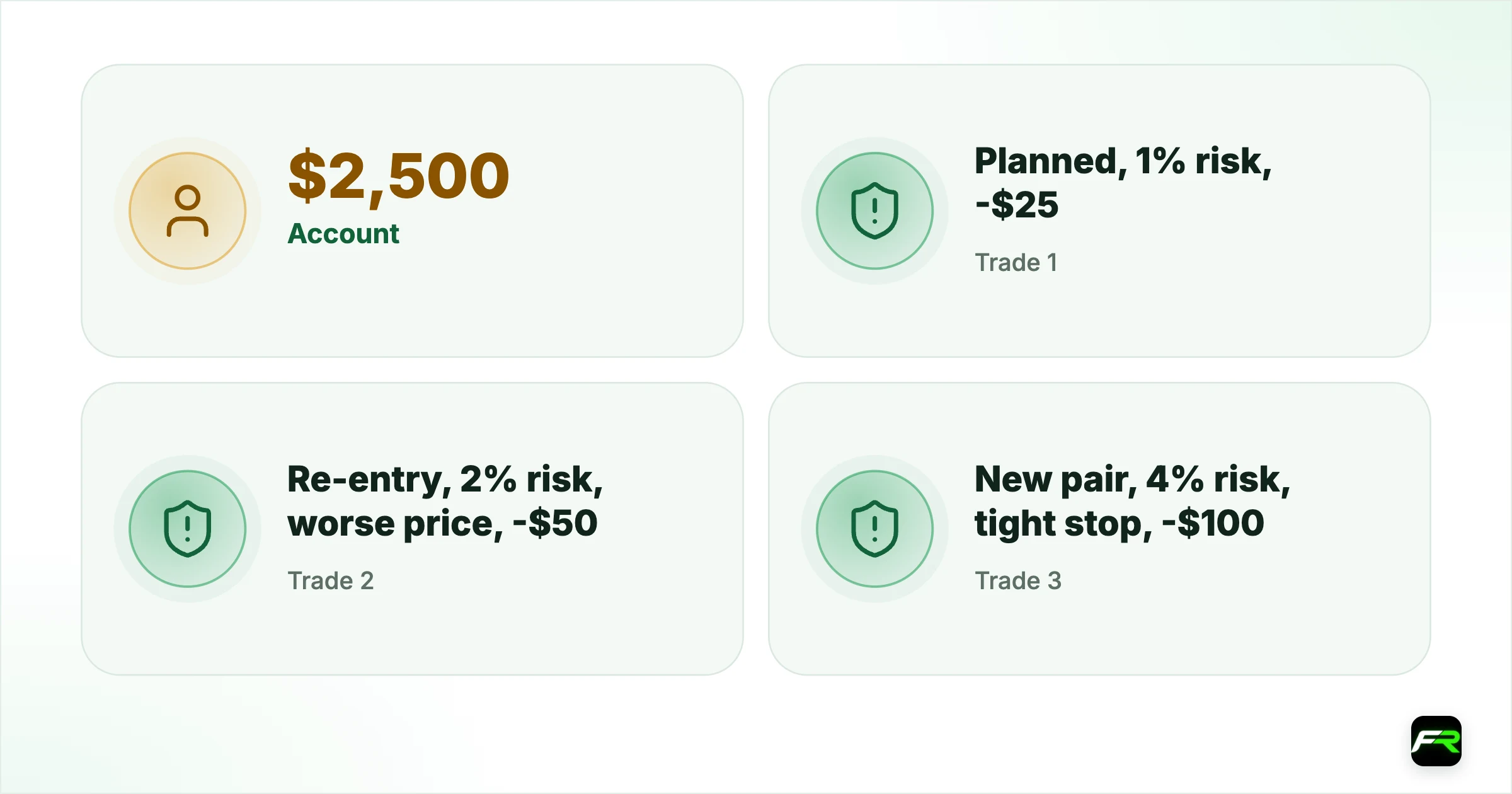
Trade two, 15 minutes later: they re-entered the same GBP/USD short at a worse price, doubled the size to two per cent, no written plan. Stopped out, $50 loss. Now down $75 on the day and genuinely annoyed.
Trade three, 20 minutes later: a USD/JPY long, four per cent size, stop placed too tight to survive normal noise. Stopped out in eight minutes, $100 loss. Trade four: GBP/USD again, six per cent size, no stop, watching it manually. It went 40 pips against them before they closed it in a panic for a $190 loss. Ninety minutes, four trades, one of them planned, total loss around $365, or roughly 15 per cent of the account. On the equity curve it looks like a cliff.
| Account | $2,500 |
|---|---|
| Trade 1 | Planned, 1% risk, -$25 |
| Trade 2 | Re-entry, 2% risk, worse price, -$50 |
| Trade 3 | New pair, 4% risk, tight stop, -$100 |
| Trade 4 | No stop, 6% size, panic close, -$190 |
| Total | -$365 (~15%) in 90 minutes |
| Planned trades in the sequence | 1 of 4 |
What was actually happening
The first loss created a discomfort the trader wanted to get rid of. Winning the money back would remove it. So each subsequent trade was really an attempt to fix an emotion, not a trade based on a setup. The size grew because a bigger position would resolve it faster. The stops got worse or disappeared because a stop-out would confirm the discomfort instead of removing it. None of it was a decision in the normal sense. It was a loop.
The loop feeds itself. Each loss makes it worse, which makes the next trade bigger, which makes the next loss worse. It only ends when the trader either runs out of margin or physically walks away from the screen. This trader walked away after trade four, which is the only reason the account survived.
Mark said the strange part was that during the 90 minutes he knew he was revenge trading. He could name it while he was doing it and could not stop. What broke the pattern for good was a rule he now calls the two-loss lockout: after two losing trades in a day, the platform gets closed for the rest of the day, no exceptions. He set a recurring alarm and told a friend to check in. He has not had a session like that in the two years since, and his account is up about 40 per cent over that time from being roughly break-even before.
The rules that stopped it
Three rules, all designed to remove the decision at the moment it is hardest to make well:
- Two-loss daily lockout. After two losing trades in a day, stop trading until the next day. Close the platform. The two losses have already told you today is not your day.
- No re-entry within 30 minutes. If you are stopped out and want straight back in, wait 30 minutes. Most revenge trades happen in the first ten. If the setup is still valid after 30 minutes, fine.
- Fixed size, checked before every entry. The position size is one per cent, calculated from the stop, written down. If you notice yourself sizing up, that is the signal to stop for the day.
The two-loss lockout is the most important. It caps the damage of a bad day at two planned losses, about two per cent, no matter what emotional state the trader is in. It does not require willpower in the moment, only the discipline to set it up in advance and honour it.
Why this matters more than strategy
A trader with a mediocre strategy and no revenge-trading problem will slowly break even or make a little. A trader with an excellent strategy who revenge trades once a month will lose, because one 15 per cent session undoes weeks of two-per-cent gains. Removing the tail risk of a bad day is worth more than any improvement to the entries. The drawdown recovery guide shows how much a single large loss costs in recovery time.
Set the lockout rule as a hard limit you cannot easily override: some traders ask their broker to set a daily loss limit, others use a separate device for the platform that they physically put away. The goal is to make the bad decision harder to execute than it is to skip.
If your broker doesn't offer a daily loss limit
A daily loss limit that automatically disables trading once a set amount is lost is the cleanest version of the two-loss lockout, but most retail brokers do not offer it as a platform feature, and asking support to add one manually is not always possible. Without it, the rule still works, it just needs a manual trigger the trader commits to in advance rather than an automatic one. Options that traders in this position actually use: closing the platform and changing the password to something not memorised, handing the phone or laptop to a partner or friend for the rest of the day, or using a browser extension or app-blocker that locks the trading platform's site or app after it has been opened twice in a day.
The common thread is that the barrier has to be something other than willpower, because willpower is exactly what a losing streak erodes. A sticky note that says 'stop after two losses' does nothing in the moment it is needed. A platform that is physically inaccessible does.
Frequently asked
Is revenge trading a discipline problem or a psychology problem?
Both, and treating it as a willpower failure does not help. The reliable fix is structural: rules that limit the damage automatically, set up when you are calm, so that willpower is not required in the moment when it is weakest.
What is a two-loss lockout?
A rule that after two losing trades in a single day, you stop trading for the rest of that day. It caps a bad day's damage at roughly two per cent regardless of your emotional state.
How long should the re-entry cooldown be?
Thirty minutes is a common choice. Long enough for the immediate urge to fade, short enough that a genuinely still-valid setup is not missed. Some traders use an hour.
Does journalling help with revenge trading?
A review the same evening helps you see the pattern and take it seriously, but it does not stop the next episode on its own. The lockout and cooldown rules are what actually prevent it. The journal is for understanding why.
What if I have a real edge and the lockout stops me trading a good setup?
You will occasionally miss a good trade because of the lockout. Over a year, the trades the lockout saves you from will cost far less than the trades it prevents. It is a favourable trade-off.
Related reading
The team behind this guide
Researched, checked and approved by five forex specialists
Every guide is written, fact-checked and edited before it goes live, and updated when the facts change. Spotted an error? Tell us.