IC Markets





































Minimum Deposit Brokers for Traders Starting With Under $100
A realistic look at trading with less than $100: which account types allow it, what the positions actually look like, and why a low minimum is a convenience, not a strategy.
 WriterAbir KhanWriterWrites the guides · checks every figure against primary sources View profileAbout Abir →
 Market analysisTanbir Habib RiyadForex & Crypto AnalystForex and crypto analyst · technical and fundamental analysis View profileAbout Tanbir →
 Fact-checking & riskJannatul FerdaushFact-Checker & Risk AnalystFact-checks every figure · risk analysis · Applied Statistics, University of Dhaka View profileAbout Jannatul →
 Trading reviewJowel RanaCo-Founder & Forex TraderCo-founder · forex trader · reviews guides from a trader's view View profileAbout Jowel →
 Final approvalRanjan NiskrityFounder, Owner & Forex TraderFounder and owner · forex trader · signs off every guide View profileAbout Ranjan →
Key takeaways
- A $5 to $100 account is a training tool, not an income source: 3% a month turns $100 into about $143 in a year.
- On very small accounts the 0.01-lot minimum can force you above 2% risk; cent accounts fix that.
- Swap and conversion costs take a bigger share of a small balance, so check them first.
- Check the licence, the account's real costs and a small withdrawal before trusting a low-minimum broker.
Plenty of brokers let you open a live account with $5, $10 or $50, and for a new trader in Asia that low barrier is genuinely useful. It lets you put real money on a real platform, which changes how you behave compared with a demo, without risking an amount that matters. The mistake is treating the low minimum as a path to income. Under $100, the account is a training tool. Here is how to use it that way.
Which account types allow it
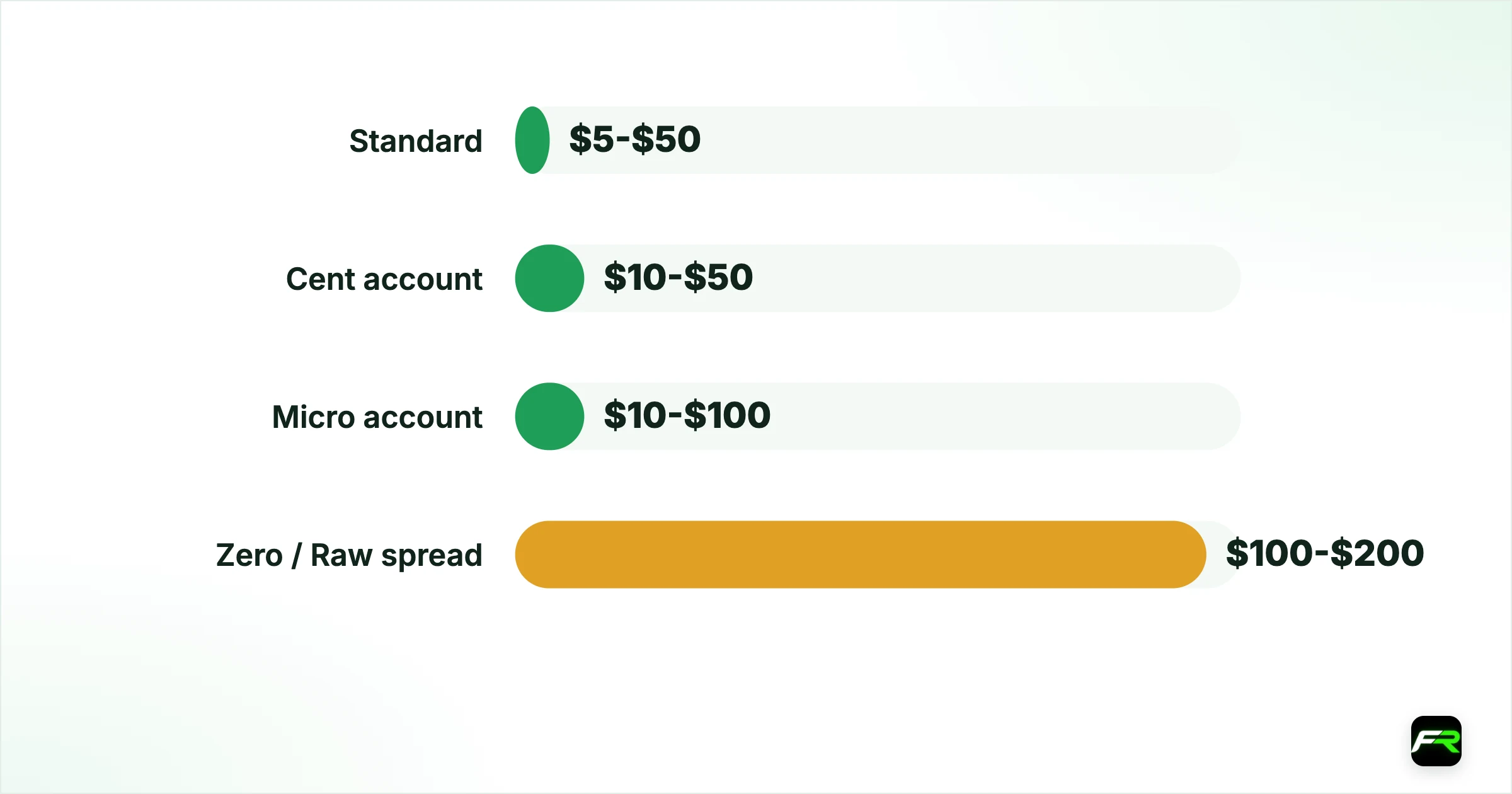
| Account type | Typical minimum | What it offers |
|---|---|---|
| Standard (some brokers) | $5-$50 | Full features, micro lots (0.01) |
| Cent account | $10-$50 | Balance shown in cents; positions ~1/100 of standard |
| Micro account | $10-$100 | Micro lots, sometimes lower leverage |
| Zero / Raw spread | $100-$200 | Tighter spread but commission; usually higher minimum |
For an account under $100, a cent account or a standard account with 0.01-lot minimum lots is the practical choice. A cent account is useful because it makes the numbers feel more substantial (a $20 deposit shows as 2,000 cents) while keeping the real position size tiny, which is good for learning without the boredom of watching a position move by pennies.
What the positions look like
On a $50 account risking two per cent, your risk per trade is $1. On EUR/USD with a 25-pip stop, that is a position of about 0.004 lots, which most brokers round to their 0.01 minimum, meaning you are actually risking closer to $2.50 on that trade, or five per cent. This is the real constraint of a very small account: the minimum lot size forces you above your intended risk percentage unless the stop is wide. A cent account solves this because its lot sizes are a hundredth of standard, so 0.01 cent-lots is genuinely tiny.
Farid opened a $50 standard account and found that every trade he took, at the 0.01 minimum lot, risked 4 to 8 per cent of the account because his stops were normal-sized. Two losing trades and he was down 15 per cent. He switched to a cent account with the same $50, where 0.01 lots is a hundredth of the size, and could finally trade at a genuine 2 per cent risk. The account grew slowly, but it survived, and he got months of practice at correct sizing.
Why a low minimum is not a strategy
An account under $100 cannot compound into meaningful money on any realistic timeline. At a strong, sustained three per cent a month, $100 becomes about $143 in a year. The value is entirely in the practice: real money on the platform, real emotions on a loss, real experience of the deposit and withdrawal process, all at a stake where a total loss costs you a meal out rather than a month's salary. Treat it as paid tuition, not a business. The beginners guide covers what $100 can realistically do.
What to check
- That the broker offers micro lots (0.01) or a cent account, so you can size positions correctly on a small balance.
- That the withdrawal minimum is not higher than the deposit minimum. Some brokers let you deposit $10 but not withdraw under $50.
- That the licence is verifiable. A low minimum is sometimes used to lower the barrier to a first deposit at a firm you should not be depositing with at all.
- That local funding in your own currency and name is supported.
- The spread on the pairs you plan to trade. On a tiny account, spread is a large share of every trade.
For a vetted shortlist of low-minimum brokers and the country-specific detail, see the FX Recap broker section, including the dedicated guide to brokers with a $10 minimum deposit.
Frequently asked
Can I really trade forex with $50?
You can open an account and trade correctly at micro or cent lot sizes, and it is good practice. But $50 cannot generate meaningful income. Treat it as a training account, not a money-maker.
What is a cent account?
An account where the balance is displayed in cents and position sizes are roughly a hundredth of standard lots. A $20 deposit shows as 2,000 cents, and 0.01 cent-lots is genuinely tiny, which lets a very small account trade at a proper risk percentage.
Why does the minimum lot size matter on a small account?
If the broker's smallest position is 0.01 standard lots, a normal-sized stop on that position can risk 4 to 8 per cent of a $50 account, far above a sensible 1 to 2 per cent. A cent account or wider stops are the fix.
Is a low minimum deposit a red flag?
Not by itself. Reputable brokers offer low minimums. But some scams use a low minimum to lower the barrier to a first deposit, so the licence check matters just as much on a $10 account as on a $10,000 one.
Can I withdraw small amounts?
Check the withdrawal minimum before depositing. Some brokers accept a $10 deposit but set the minimum withdrawal higher, which can trap a small balance.
Do swap fees matter more on a small account?
Yes, in proportion. The swap is charged per lot, not per dollar of balance, so the same overnight fee is a much bigger share of a $50 account than of a $5,000 one, and a few weeks of holding can quietly eat most of a small account's gains. If you hold trades overnight on a small balance, check the swap rates first. Our guide to how overnight swap fees erode small accounts shows the numbers.
Related reading
The team behind this guide
Researched, checked and approved by five forex specialists
Every guide is written, fact-checked and edited before it goes live, and updated when the facts change. Spotted an error? Tell us.