IC Markets





































A Malaysian Trader's First Profitable Quarter: What Changed
Two years of losing, then a first profitable quarter. An illustrative breakdown of the changes that made the difference, none about strategy.
 WriterAbir KhanWriterWrites the guides · checks every figure against primary sources View profileAbout Abir →
 Market analysisTanbir Habib RiyadForex & Crypto AnalystForex and crypto analyst · technical and fundamental analysis View profileAbout Tanbir →
 Fact-checking & riskJannatul FerdaushFact-Checker & Risk AnalystFact-checks every figure · risk analysis · Applied Statistics, University of Dhaka View profileAbout Jannatul →
 Trading reviewJowel RanaCo-Founder & Forex TraderCo-founder · forex trader · reviews guides from a trader's view View profileAbout Jowel →
 Final approvalRanjan NiskrityFounder, Owner & Forex TraderFounder and owner · forex trader · signs off every guide View profileAbout Ranjan →
Key takeaways
- After two years of losses, a $4,000 account grew about 12% in a quarter with a maximum drawdown under 6%.
- The strategy didn't change; the habits did.
- Fixed 1% risk written down before every trade kept every loss between 0.8% and 1.1%, where it had once reached 9%.
- A hard stop on the server, no trading before news and a weekly review turned break-even into steady results.
About this case study: Aiman, the trader in this example, is an illustrative composite, not a real person, and the account, trades and figures are not a real trading record. They are built from patterns that are common in retail trading so the maths can be shown step by step. Market events are simplified unless a date is given.
The gap between a trader who loses and a trader who gets steady results is usually not knowledge. It is a small number of habits, applied without exception. This illustrative case follows a composite trader in Penang who spent about two years losing money across four small accounts, then had a quarter where the account grew about 12 per cent with a maximum drawdown under 6 per cent. Nothing about their strategy changed in that quarter. Here is what did.
The account was $4,000, trading EUR/USD, GBP/USD and gold in the London and early New York sessions, which for Malaysia is late afternoon into the evening. The strategy was a straightforward pullback-to-support approach they had been using the whole time. What follows are the four changes, in the order they were made.
Change one: a fixed risk figure, written down
For two years the trader had sized positions by feel. A setup they liked got a bigger position; a marginal one got a smaller position; a trade to recover a loss got a much bigger position. In the profitable quarter they set risk at one per cent of the account, calculated the position size from the stop distance every single time, and wrote both numbers in a journal before entry. Every loss that quarter was between 0.8 and 1.1 per cent. Before, losses had ranged from 0.5 per cent to 9 per cent.
Put simply, the single biggest change was that a bad trade could no longer do real damage. Before, one revenge trade could undo a good week. After, the worst possible outcome of any trade was known and small.
Change two: a hard stop on the platform, every time
The trader used to place mental stops, planning to close manually if price hit a level. In practice they moved the level, or looked away, or told themselves the candle had not closed yet. In the profitable quarter every trade had a stop order sitting on the broker's server before they did anything else. They were stopped out 31 times that quarter. Under the old approach, at least a third of those would likely have been held longer and turned into larger losses.
Aiman keeps a printed sheet next to his keyboard with four lines: risk is 1 per cent, stop goes on before anything else, no trade in the hour before news, review every Sunday. He says he does not trust himself to remember them in the moment, which is why they are printed. His first profitable quarter came in the third year of trading, and he is careful to tell people it was year three, not month three, because the timeline is the part beginners do not want to hear.
Change three: a no-trade window around news
The trader added a rule that they would not open a position in the 60 minutes before a high-impact release for the currency they were trading, and would close or reduce any open position before it. High-impact meant central-bank decisions, US non-farm payrolls, CPI prints, and for gold, US data that moves the dollar. This removed a category of loss entirely: the trade that was going fine until a number came out and the pair moved 80 pips in two seconds.
The session volatility guide covers how much the pace changes around these events. For this trader, simply not being in the market for them turned several would-be disaster trades into non-events.
Change four: a weekly review that actually happened
Every Sunday, the trader spent 40 minutes going through the week's trades. For each one: did it follow the plan, yes or no. Not did it win, did it follow the plan. Trades that followed the plan and lost were fine. Trades that broke the plan and won were flagged as problems, because they were the ones training bad habits. Over the quarter, the share of plan-following trades went from about 60 per cent in week one to over 90 per cent by week twelve.
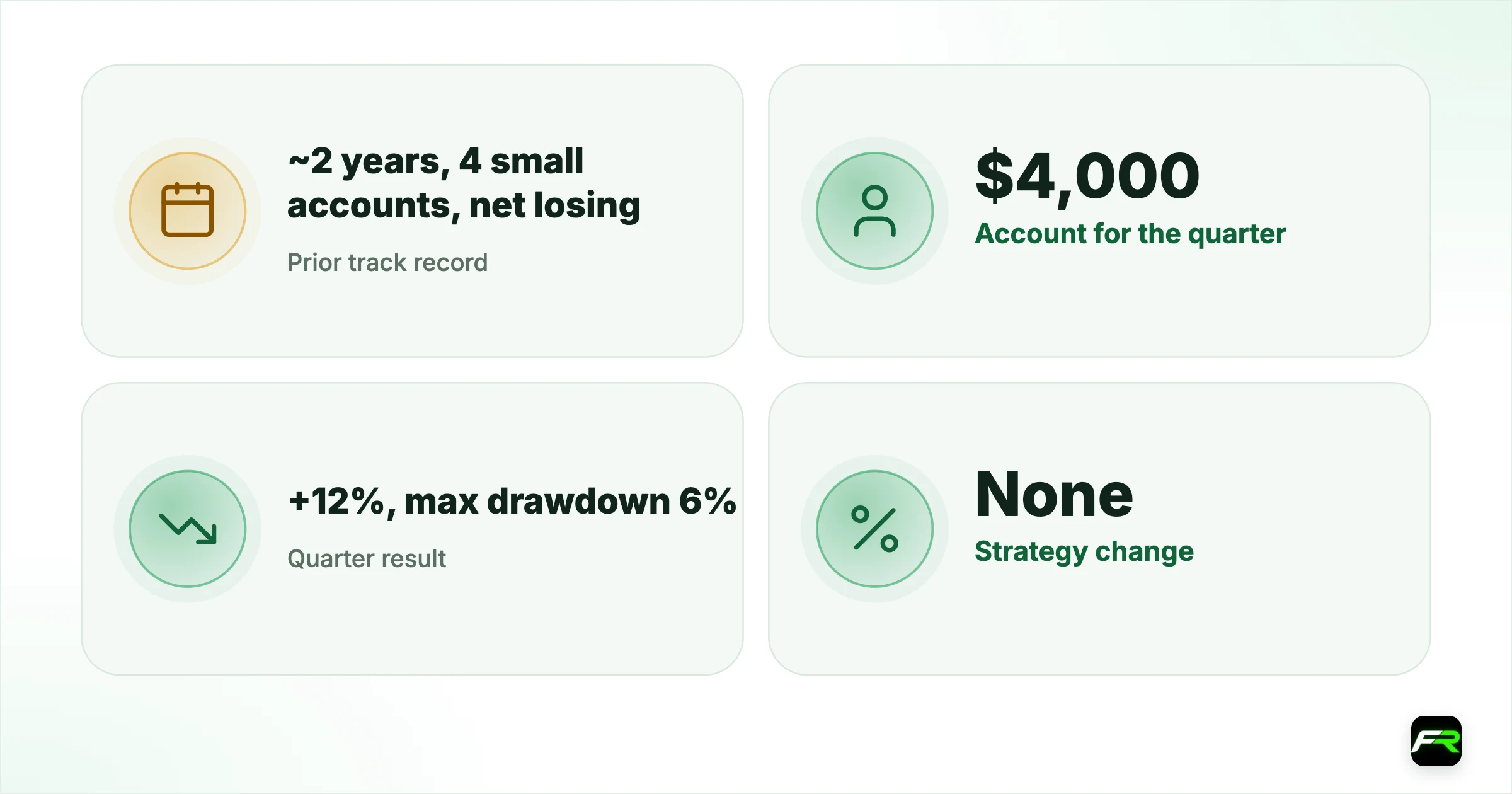
| Prior track record | ~2 years, 4 small accounts, net losing |
|---|---|
| Account for the quarter | $4,000 |
| Quarter result | +12%, max drawdown <6% |
| Strategy change | None |
| Change 1 | Fixed 1% risk, position size from the stop |
| Change 2 | Hard stop on the platform every trade |
| Change 3 | No trading in the hour before high-impact news |
| Change 4 | Weekly review scored on plan-adherence, not profit |
Why none of it was about strategy
The pullback-to-support strategy had a real edge the whole time. It was buried under position sizing that let single trades do outsized damage, mental stops that were not enforced, trades taken into news, and no feedback loop to catch the pattern. Fix those four things and the edge that was always there gets a chance to show up in the equity curve. It is one of the most common patterns in retail trading: years spent hunting for a better strategy when the strategy was fine and the risk process was the problem.
A simple template for the Sunday review
The weekly review only worked because it had a fixed shape, not because the trader was unusually reflective. The same five questions, every week, in this order:
- List every trade. Pair, direction, result in R, and one line on the setup. If a trade is missing from the log, that is itself worth noting.
- Mark plan-adherence, yes or no. Not whether it won. Whether it matched the written plan: correct size, a hard stop placed before entry, no trading inside the news window.
- Separate the two failure types. A trade that followed the plan and lost needs no action. A trade that broke the plan and won is the dangerous one, because it is the one your memory will want to repeat.
- Find the week's one repeatable pattern. Not five lessons. One. Usually it is the same mistake as the week before, which is fine; that is how you know it needs another week of attention rather than a new one.
- Write next week's one rule. A single, concrete adjustment for the coming week, not a general resolution to 'be more disciplined.' 'No trade in the hour before US CPI' is usable. 'Trade better' is not.
Forty minutes, once a week, done the same way every time. The value is almost entirely in the repetition and the fixed structure, not in any particular insight from a single session.
If you have been losing for a while, do not change your strategy first. For one month, keep the exact strategy and add only these: fixed 1 per cent risk, a hard stop on every trade, no trades around news, and the five-question Sunday review above. If the results still do not improve, then look at the strategy.
Frequently asked
How long does it usually take to become consistently profitable?
Most traders who get there took one to three years, and many never do. Anyone promising it in weeks is selling something. The timeline is long because the changes required are behavioural, and behaviour is slow to change.
What does 'scoring trades on plan-adherence' mean?
For each trade, you record whether it followed your written plan, separately from whether it made money. A losing trade that followed the plan is a good trade. A winning trade that broke the plan is a bad trade, because it rewards the behaviour that will eventually cost you.
Is a weekly review really necessary?
It is the mechanism that turns experience into learning. Without it, you repeat the same mistakes because you never see the pattern. It does not need to be long, but it needs to happen every week.
Should I stop trading news entirely?
Not forever, but until your results have settled into a steady pattern, staying flat around high-impact releases removes a whole class of large, avoidable losses. Some traders eventually trade news deliberately, at small size, once the rest of their process is solid.
What if I follow all four changes and still lose?
Then the strategy genuinely does not have an edge, and it is time to examine that. But it is worth doing the risk changes first, because in most cases the strategy is not the problem.
Related reading
The team behind this guide
Researched, checked and approved by five forex specialists
Every guide is written, fact-checked and edited before it goes live, and updated when the facts change. Spotted an error? Tell us.