IC Markets






































How Overnight Swap Fees Quietly Erode Small Accounts
On carry pairs like AUD/JPY and USD/JPY, swap can cost more than the spread over a month. How to see it and manage it.
 WriterAbir KhanWriterWrites the guides · checks every figure against primary sources View profileAbout Abir →

 Market analysisTanbir Habib RiyadForex & Crypto AnalystForex and crypto analyst · technical and fundamental analysis View profileAbout Tanbir →

 Fact-checking & riskJannatul FerdaushFact-Checker & Risk AnalystFact-checks every figure · risk analysis · Applied Statistics, University of Dhaka View profileAbout Jannatul →

 Trading reviewJowel RanaCo-Founder & Forex TraderCo-founder · forex trader · reviews guides from a trader's view View profileAbout Jowel →

 Final approvalRanjan NiskrityFounder, Owner & Forex TraderFounder and owner · forex trader · signs off every guide View profileAbout Ranjan →

Key takeaways
- Swap is charged or paid at each nightly rollover, usually triple on Wednesdays, and never shows up as a losing trade.
- Gold and EUR/USD typically cost you on both sides; long JPY-cross positions can earn a positive swap.
- Worked example: 8 trades a month held 4 nights at $1 a night costs $32 a month, about 19% of a $2,000 account a year.
- If your monthly swap bill is above 1% of the account, it is quietly undermining your strategy.
Swap is the cost that does not show up when you place a trade. Every day at the broker's rollover time, usually 22:00 or 00:00 server time, any position still open is charged or paid an interest amount based on the rate difference between the two currencies. For a day trader who is flat every night, swap is irrelevant. For a swing trader holding for days, it can be a larger drag than the spread, and on a small account it compounds into real damage without ever appearing as a losing trade.
How swap is calculated
If you hold a currency with a higher interest rate against one with a lower rate, you may earn a small positive swap. Hold it the other way and you pay. The broker also takes a markup, so in practice the paying side costs more than the earning side pays. Values are quoted per lot per night in your account currency, and Wednesday rollovers are usually charged triple to cover the weekend.
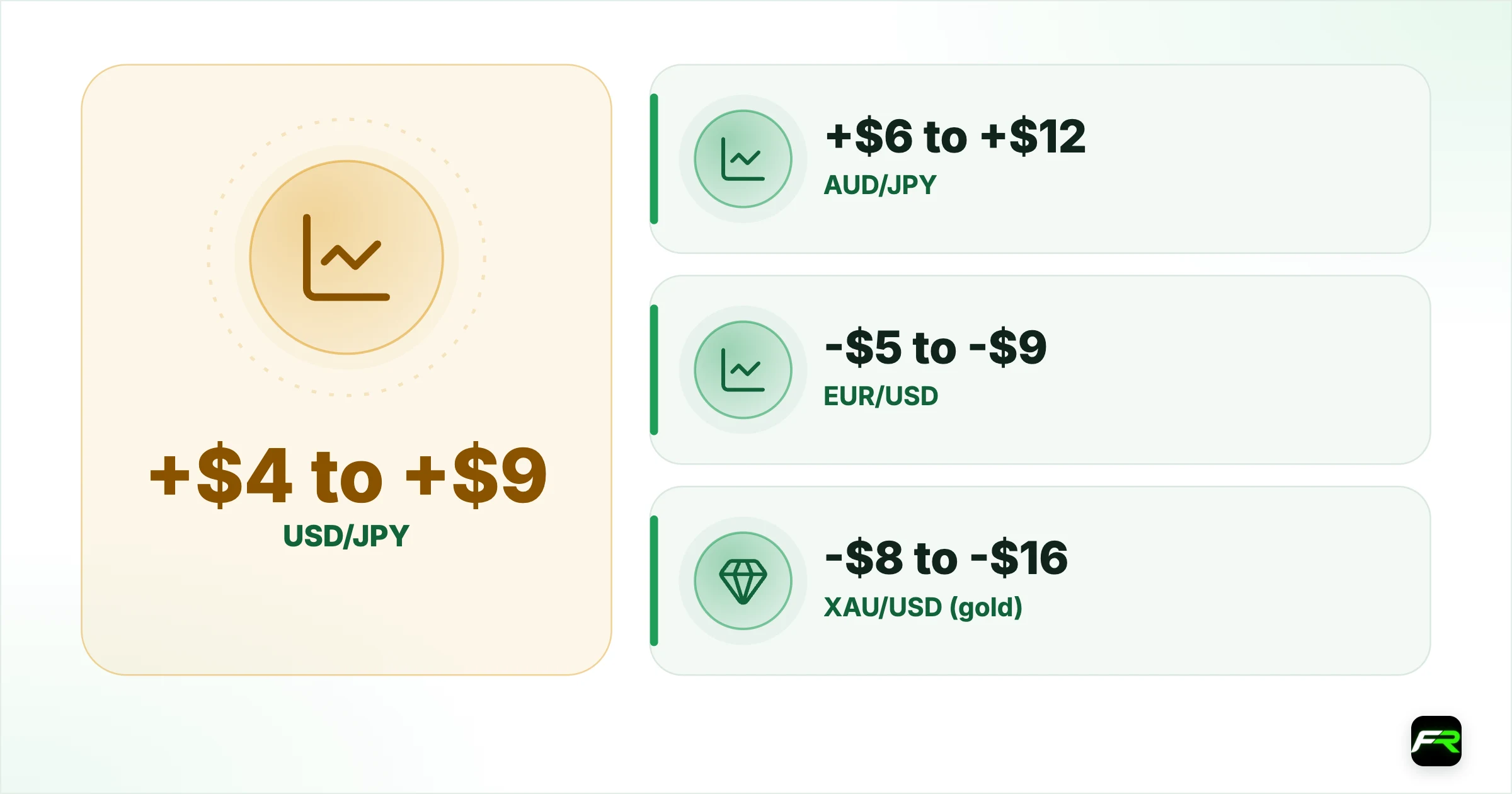
| Pair (example, per 1 lot per night) | Long swap | Short swap |
|---|---|---|
| USD/JPY | +$4 to +$9 | -$8 to -$14 |
| AUD/JPY | +$6 to +$12 | -$10 to -$18 |
| EUR/USD | -$5 to -$9 | -$2 to -$6 |
| XAU/USD (gold) | -$8 to -$16 | -$3 to -$9 |
These are illustrative ranges and vary by broker and by day. The pattern that matters: gold and EUR/USD cost you on both sides, and JPY pairs can pay you if you are long dollars or Aussie against the yen, which is the carry trade in miniature.
The small-account maths
Say you swing trade USD/JPY on a $2,000 account, holding positions an average of four nights, taking around eight trades a month at 0.10 lots. If your average swap is a $1 charge per night per 0.10 lots (short side), that is 8 trades x 4 nights x $1 = $32 a month, or 1.6 per cent of the account, every month, before you have won or lost a single trade. Over a year that is roughly 19 per cent of the starting account paid in swap. On a strategy with a thin edge, that is the difference between profit and loss.
Danai could not work out why his account was slowly shrinking despite a positive win rate. He traded USD/JPY and AUD/JPY on the short side, holding for three to six days. When he added up a month of swap charges it came to about $70 on his $3,000 account. He was paying more than 2 per cent a month to hold trades overnight. He switched to entering later in the day so trades resolved faster, took partial profits sooner, and where he could, positioned on the positive-swap side. The bleed stopped.
How to manage it
- Check the swap values for your pairs in the broker's contract specifications before you build a strategy around holding overnight.
- If you swing trade, favour the positive-swap direction where the setup allows, or at least be aware of the cost on the negative side.
- Day traders who close before rollover pay zero swap. If your edge is thin, this alone can move you from negative to positive.
- A swap-free (Islamic) account removes the interest but usually replaces it with a fixed administration fee after a few days, which can be worse for long holds. Check the terms.
Swap is charged in addition to, not instead of, the spread and any commission. A full accounting of a trade's cost is spread plus commission plus swap for every night held.
Where it matters most
Swap does the most damage to strategies that hold small positions for many nights on a small account: exactly the profile of a cautious beginner swing trader. A large account holding for one or two nights barely notices it. If you are on a $1,000 to $5,000 account and your trades routinely stay open for a week, run the monthly swap total and see what percentage of the account it is. If it is above one per cent a month, it is quietly setting your strategy up to fail.
How swap works on a prop firm challenge account
Swap does not disappear just because you are trading a funded challenge instead of your own money, but many prop firms handle it differently from a standard retail broker. A common setup is a swap-free account by default across the whole firm, since it removes one more variable from what is otherwise supposed to be a pure test of trading skill, though firms that do charge swap normally pass through broadly the same rates a retail account would see on the same pair. Some firms also restrict or ban holding positions over the weekend entirely, closing everything before the Friday close, which sidesteps triple swap Wednesday and weekend gap risk at the cost of ruling out any strategy built around multi-day holds.
The practical takeaway is to read the specific challenge's rules before assuming either way. If the firm is swap-free, the calculations in this guide do not apply to that account, but its cousins, a fixed per-lot holding fee or a ban on holding into the weekend, might create a different version of the same constraint. If the firm does charge swap, the small-account maths above applies just as directly to a funded account as to a personal one, since the daily and maximum drawdown limits a challenge imposes make an unplanned, compounding cost even less affordable than on a personal account with no hard ceiling.
Frequently asked
Do I pay swap if I close my trade the same day?
No. Swap is only charged on positions open at the broker's daily rollover time. Close before then and you pay nothing.
What is triple swap Wednesday?
The name traders use for the fact that Wednesday's swap is charged at three times the normal rate. Spot forex settles two business days forward, so a position held over Wednesday night settles over the weekend, and brokers charge three days of swap on Wednesday to cover Saturday and Sunday.
Can I earn money from positive swap?
Yes, on the positive-swap side of a pair, but the broker's markup means it pays less than the paying side costs, and the position still carries full price risk. The carry trade is built on this, and it unwinds violently at times.
Is a swap-free account the answer?
It removes the interest but most brokers apply a fixed administration fee per lot per night after a grace period, which for long holds can cost more than the swap would have. Read the specific terms before assuming it is cheaper.
Where do I find my broker's swap rates?
In the contract specifications or symbol details, usually listed as swap long and swap short in points or account-currency units per lot. Some platforms show it when you right-click a symbol.
Related reading
The team behind this guide
Researched, checked and approved by five forex specialists
Every guide is written, fact-checked and edited before it goes live, and updated when the facts change. Spotted an error? Tell us.