IC Markets





































USD/JPY and the Return of Yen Intervention: What Traders Need to Watch
How Japan's Ministry of Finance intervenes to support the yen, the levels that tend to trigger it, and the risk to USD/JPY positions.
 WriterAbir KhanWriterWrites the guides · checks every figure against primary sources View profileAbout Abir →
 Market analysisTanbir Habib RiyadForex & Crypto AnalystForex and crypto analyst · technical and fundamental analysis View profileAbout Tanbir →
 Fact-checking & riskJannatul FerdaushFact-Checker & Risk AnalystFact-checks every figure · risk analysis · Applied Statistics, University of Dhaka View profileAbout Jannatul →
 Trading reviewJowel RanaCo-Founder & Forex TraderCo-founder · forex trader · reviews guides from a trader's view View profileAbout Jowel →
 Final approvalRanjan NiskrityFounder, Owner & Forex TraderFounder and owner · forex trader · signs off every guide View profileAbout Ranjan →
Key takeaways
- Japan's Ministry of Finance orders intervention and the Bank of Japan executes it, often knocking 300 to 500 pips off USD/JPY within an hour.
- The only advance signals are escalating verbal warnings and reported rate checks.
- The MoF publishes confirmed amounts afterwards, monthly and quarterly, on its intervention operations page.
- When the yen is weak and officials are talking, keep USD/JPY longs small and always stopped.
Currency intervention is when a government directly buys or sells its own currency in the market to change its value. Japan has done this repeatedly when the yen has weakened past levels the Ministry of Finance (MoF) considers excessive. For a USD/JPY trader, intervention is a specific tail risk: a 300 to 500 pip drop in the pair within an hour, with no scheduled warning, triggered by an official decision rather than by data.
How intervention works
The MoF decides, and the Bank of Japan executes on its behalf, selling dollars from Japan's foreign exchange reserves and buying yen. Because the amounts are large and concentrated, the effect on price is immediate and violent. Intervention is sometimes 'checked' first (officials verbally warn the market and ask brokers for rate levels, which signals a move may be coming) and sometimes done without warning to maximise the shock. It can also be co-ordinated, with other countries acting alongside Japan, which makes it more powerful.
The levels that tend to trigger it
Japan does not announce a defended level. But the market watches for round numbers and prior intervention zones. In past episodes, verbal warnings have escalated as USD/JPY approached and pushed through psychologically important levels, and actual intervention has tended to come after a rapid move rather than a slow grind. The speed of the yen's decline matters as much as the level: the MoF has said repeatedly that it is concerned with 'disorderly' moves, meaning large moves over a short period.
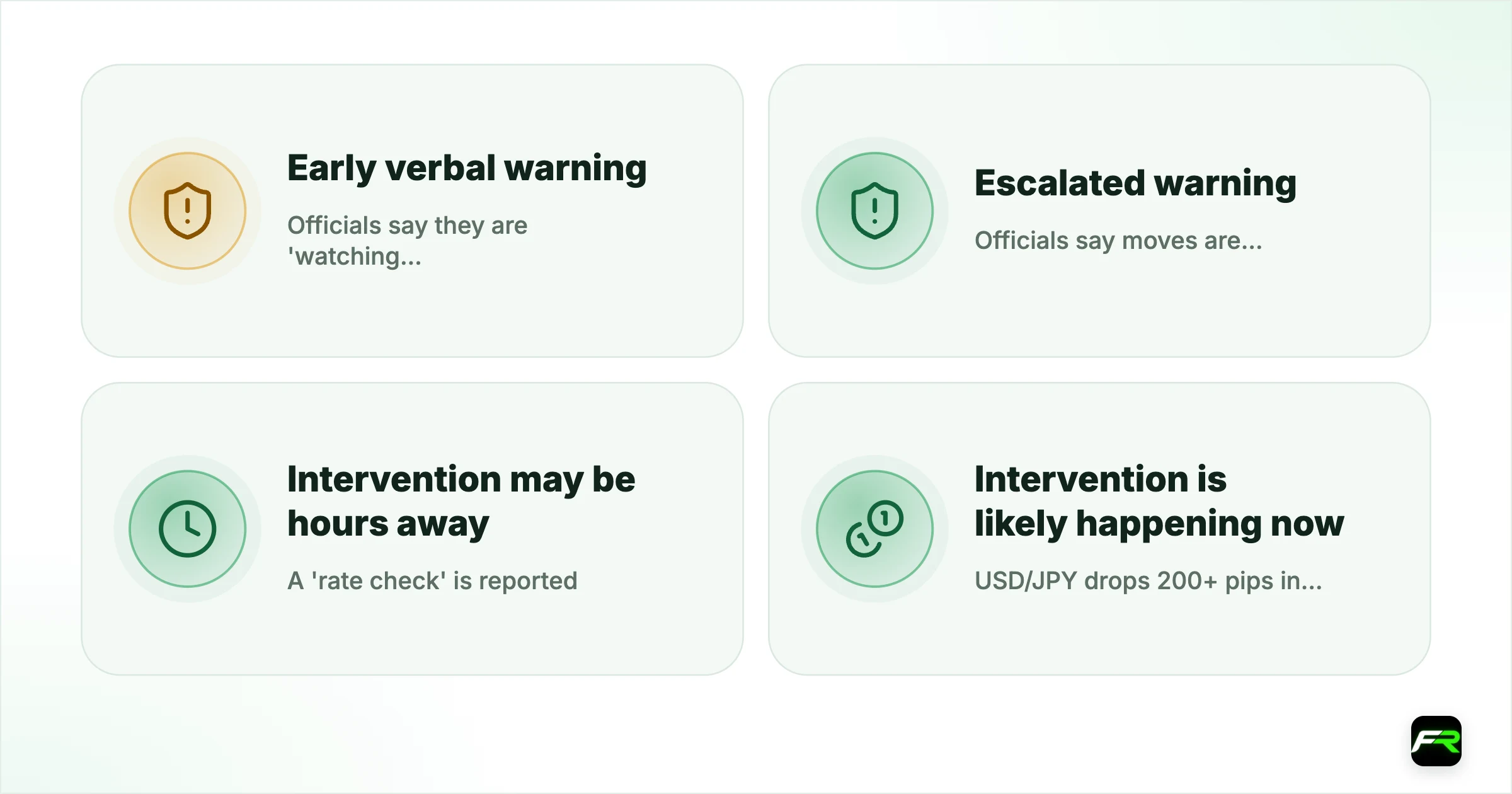
| Signal | What it means for a USD/JPY long |
|---|---|
| Officials say they are 'watching FX with a sense of urgency' | Early verbal warning; risk rising |
| Officials say moves are 'one-sided and speculative' | Escalated warning; intervention plausible soon |
| A 'rate check' is reported | Intervention may be hours away |
| USD/JPY drops 200+ pips in minutes with no news | Intervention is likely happening now |
What it does to a position
A trader long USD/JPY into an intervention can be down 300 to 500 pips before a stop even fills, because the move is faster than the stop can execute in a thin moment. On a 1-lot position that is a $2,000 to $3,500 loss in an hour. On a correctly sized position (one per cent risk, appropriate stop) the loss is contained to the planned amount even with some slippage. On an oversized position with no stop, it is account-ending. This is one of the clearest arguments for never holding a large, unstopped USD/JPY position when the yen is weak and officials are talking.
Kenta was long USD/JPY through a night when Japan intervened. He was up on the position when he went to sleep and woke to find it had been stopped out for a 90-pip loss after a 400-pip spike down and partial recovery. His stop saved him from the worst of it. He now treats any period where officials are issuing verbal warnings as a no-hold zone for large USD/JPY longs, and keeps positions small and stopped whenever the yen is near levels that have drawn intervention before.
How to trade around intervention risk
- Follow the MoF and BoJ commentary. Escalating language is the warning.
- When the yen is weak and officials are talking, cut USD/JPY long size and keep hard stops.
- Do not try to catch the falling knife during an intervention; the recovery, if there is one, comes later and is unpredictable.
- Be aware that intervention effects often fade over days or weeks if the underlying rate gap has not changed, so a lower USD/JPY after intervention is not automatically a new trend.
Intervention is unscheduled. There is no calendar entry for it. The only defence is correct position sizing and a stop, because a large unstopped position can lose several per cent of the account before you can react.
Where MoF Publishes Intervention Data
Japan does not confirm intervention on the day, but the Ministry of Finance publishes the amounts afterwards on its Foreign Exchange Intervention Operations page. There are two releases worth knowing:
- Monthly release. Published at the end of each month, it gives the total amount spent on intervention over the past month, with no daily breakdown. It is the first official confirmation that intervention happened.
- Quarterly release. Published about five weeks after each quarter ends, it lists every intervention day, the amount, and which currencies were bought and sold. The same page links a historical data file going back to 1991.
For a trader, the monthly figure answers the question the market argues about for weeks: was that sudden drop really intervention? The quarterly detail then shows how much was spent per day, which is a useful gauge of how determined Japan was at each level.
For the rules and brokers that apply where you live, see our guide to forex brokers in Japan.
Frequently asked
How do I know intervention is coming?
You do not get a definite signal, but escalating verbal warnings from Japan's Ministry of Finance ('watching with urgency', 'disorderly', 'speculative') and reports of 'rate checks' are the warning signs. Intervention itself shows up as a fast, newsless drop in USD/JPY.
How far can USD/JPY move on intervention?
Past episodes have produced moves of 300 to 500 pips within an hour, sometimes with a partial recovery afterwards. The speed can exceed a stop's ability to fill at the intended price.
Does intervention change the trend?
Not necessarily. If the underlying driver (the US-Japan interest-rate gap) is unchanged, the yen often drifts back toward its pre-intervention level over days or weeks. Intervention buys time; it does not fix the differential.
Can Japan intervene to weaken the yen too?
Yes, historically Japan has intervened to weaken an overly strong yen as well, though the recent episodes have been to support it. The MoF acts against moves in either direction that it considers disorderly.
When did Japan last intervene in the yen?
According to the Ministry of Finance's own data, Japan spent about ¥11.7 trillion buying yen on 30 April, 4 May and 6 May 2026, and its monthly release of 28 August 2026 reported a further ¥15.4 trillion of intervention between 30 July and 26 August 2026 (the daily detail follows in the quarterly release). Earlier recent episodes were in April-May 2024 (about ¥9.8 trillion) and on 11-12 July 2024 (about ¥5.5 trillion). Check the MoF's intervention page for anything newer.
Where can I check MoF's intervention data?
On the Ministry of Finance's Foreign Exchange Intervention Operations page (mof.go.jp), which carries a monthly release with the total amount, a quarterly release listing each intervention day and amount, and a historical data file back to 1991.
Should I avoid USD/JPY when intervention is a risk?
You do not have to avoid it, but you should size small, keep a hard stop, and reduce or close large long positions when officials are issuing escalating warnings. The tail risk is real and unscheduled.
Related reading
The team behind this guide
Researched, checked and approved by five forex specialists
Every guide is written, fact-checked and edited before it goes live, and updated when the facts change. Spotted an error? Tell us.