IC Markets





































Which Brokers Offer Local Language Support for Asian Traders
How to test whether a broker's Bahasa, Thai, Vietnamese or Hindi support is real, and why it matters most when a withdrawal is stuck.
 WriterAbir KhanWriterWrites the guides · checks every figure against primary sources View profileAbout Abir →

 Market analysisTanbir Habib RiyadForex & Crypto AnalystForex and crypto analyst · technical and fundamental analysis View profileAbout Tanbir →

 Fact-checking & riskJannatul FerdaushFact-Checker & Risk AnalystFact-checks every figure · risk analysis · Applied Statistics, University of Dhaka View profileAbout Jannatul →

 Trading reviewJowel RanaCo-Founder & Forex TraderCo-founder · forex trader · reviews guides from a trader's view View profileAbout Jowel →

 Final approvalRanjan NiskrityFounder, Owner & Forex TraderFounder and owner · forex trader · signs off every guide View profileAbout Ranjan →

Key takeaways
- Local-language support matters most when a withdrawal or account problem goes wrong.
- Test it before depositing: ask a specific question in your language and check the hours it really covers.
- Telegram and WhatsApp groups are often run by affiliates, not the broker. Never send money through them.
- If support stalls, escalate in writing, file a formal complaint, then go to the regulator of the company that holds your account.
Many brokers serving Asia advertise support in local languages: Bahasa Indonesia and Bahasa Malaysia, Thai, Vietnamese, Hindi, Tagalog. The claim is common because it is cheap to put on a website and hard for a prospective client to check. The quality ranges from a full local team available around the clock to a single machine-translated FAQ page and an English-only live chat. This guide is about telling the difference before it matters.
Why it matters
Day to day, if your platform works and your deposits clear, you rarely contact support. Language support becomes important at exactly one moment: when something goes wrong. A held withdrawal, a disputed fill, a verification problem. In that situation, being able to explain the issue precisely in your own language, and understand the reply, is the difference between a two-day resolution and a two-week one. If the support that handles disputes is English-only and your English is functional but not fluent, you are at a disadvantage when you can least afford it.
How to test it
- Open a live chat before you deposit and write your opening message in your local language. See whether the reply is in that language, and whether it is fluent or clearly machine-translated.
- Ask a specific question that requires a real answer (for example, the exact swap-free administration fee schedule, or the withdrawal processing time to your local bank). A canned bot cannot answer it.
- Ask what hours local-language support is available. Around-the-clock in your language is rare; business hours in your time zone is more common; English-only outside those hours is normal.
- Check whether phone support is offered in your language, and whether the number is local or international.
- Look at the local-language section of the website for machine-translation errors. A sloppy translation of the client agreement is a sign the local presence is thin.
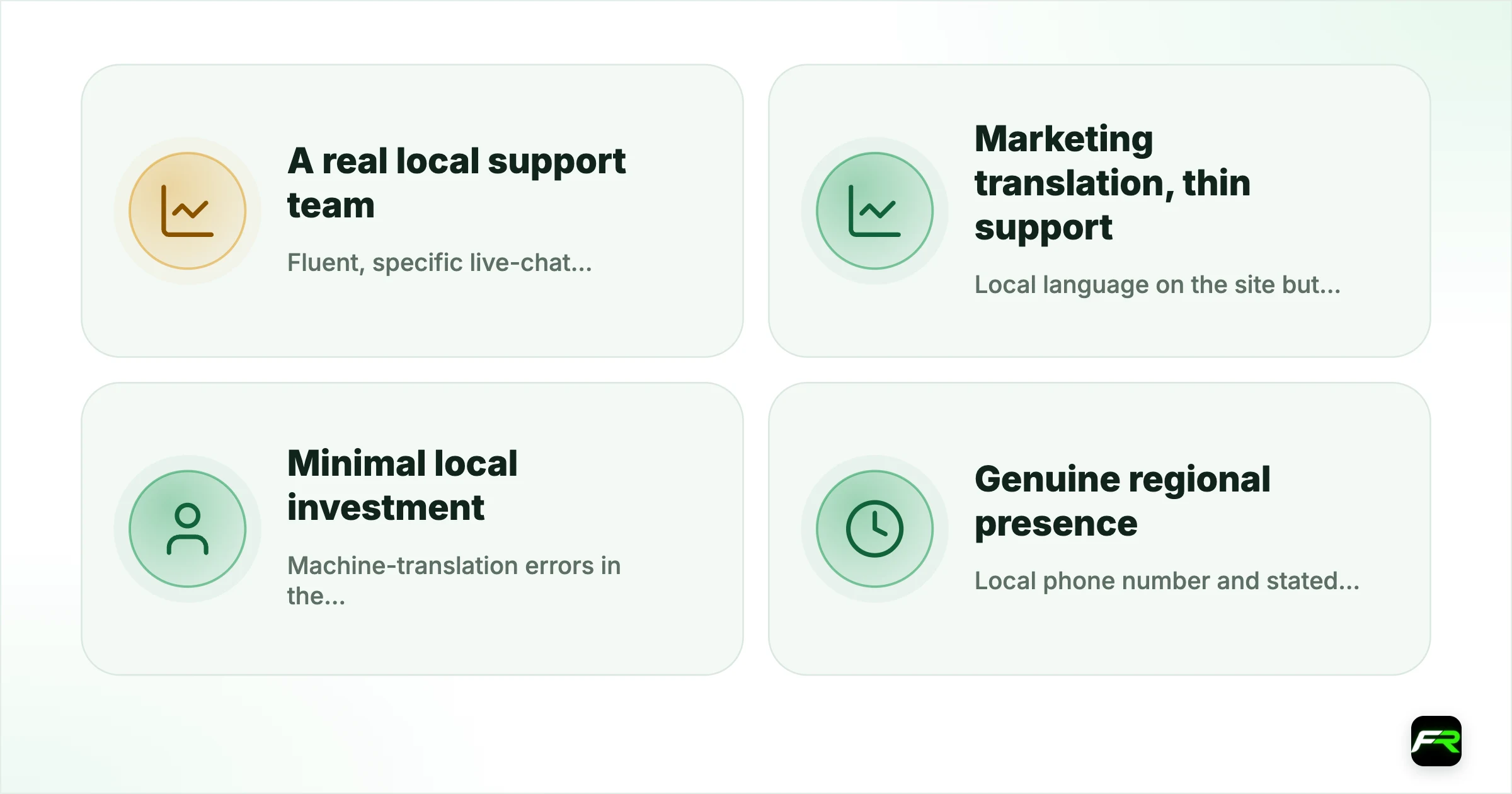
| Signal | What it tells you |
|---|---|
| Fluent, specific live-chat replies in your language | A real local support team |
| Local language on the site but English-only chat | Marketing translation, thin support |
| Machine-translation errors in the client agreement | Minimal local investment; be cautious |
| Local phone number and stated local business hours | Genuine regional presence |
| A dedicated local Telegram or WhatsApp channel | Convenient, but confirm it is official, not an affiliate |
Nguyen chose a broker partly for its advertised Vietnamese support. When a withdrawal was delayed, the Vietnamese live chat turned out to be available only during Vietnam business hours, and outside those hours he got an English-speaking agent who could not access his case. The issue took nine days. He now checks support hours and tests the chat with a real question before funding any account, and treats the delay experience as the true test of a broker.
What to Do If Local Support Doesn't Resolve It
Nguyen's nine days are a common story, and waiting it out is not the only option. If a withdrawal or account problem is not moving, escalate in this order:
- Put it in writing. Move from live chat to email or the broker's ticket system, give your account number and the exact dates and amounts, and ask for a case reference. A written record is what every later step relies on.
- Ask for the formal complaints process. Regulated brokers must have a written complaints procedure with a response deadline. Ask for it by name and file a formal complaint, not another chat message.
- Check which company holds your account. Your client agreement names the entity and its regulator. That regulator, not the one on the marketing page, is where the next step goes.
- Take it to the regulator or dispute service. Strong regulators run complaints or dispute-resolution routes for clients of the firms they license. Our guide to checking a broker is regulated explains how to find the right regulator for your entity.
- Stop depositing. Do not add funds to an account with an unresolved withdrawal, whatever the support agent suggests.
If the broker is licensed only offshore, the regulator route is weak or missing, which is the main reason to test support and withdrawals before you deposit a meaningful amount. Our guide to why forex withdrawals get stuck covers the most common causes.
The affiliate channel trap
Some of the most active local-language help for Asian traders is in Telegram and WhatsApp groups run by affiliates, not the broker. These can be genuinely useful for signup help and platform questions, but the person running the group is paid per funded account, and they are not a substitute for official support when money is involved. Confirm any local channel is operated by the broker itself before you rely on it for anything important, and always deal with the broker directly for deposits, withdrawals and disputes.
Never send deposit funds to a personal account or a payment link provided by a local 'helper' or affiliate. Fund only through the broker's official deposit page. Money handed to an intermediary is the most common way traders in the region lose funds.
The bottom line
Local-language support is a real convenience and worth having, but verify it with a live test rather than trusting the marketing. The more important checks remain the same for any broker: a verifiable licence, fair pricing on the pairs you trade, a clean withdrawal record, and local funding in your own name. Good support in your language is a bonus on top of those, not a replacement for them.
Frequently asked
How do I check if a broker's local-language support is real?
Open a live chat before depositing, write in your local language, and ask a specific question that needs a real answer. Fluent, specific replies indicate a real team; machine-translated or English-only replies indicate marketing translation only.
Is 24/7 support in my language common?
No. Business hours in your time zone is more typical, with English-only support outside those hours. Check the stated hours before you assume help will be available when you need it.
Are broker Telegram or WhatsApp groups official?
Often they are run by affiliates, not the broker. They can help with signup and platform questions, but the operator is paid per funded account and is not a substitute for official support on money matters. Verify before relying on one.
Does local support matter if my English is decent?
It matters most during a dispute, when precision counts and you are already stressed. If your English is functional but not fluent, having genuine local-language support for a withdrawal or verification problem is a real advantage.
What should I never do through a local helper?
Never send deposit money to a personal account or payment link provided by an affiliate or helper. Fund only through the broker's official deposit page, in your own name.
What should I do if support can't resolve my issue?
Put the complaint in writing with your account number, dates and amounts, ask for the broker's formal complaints procedure and file under it, then check which regulated company holds your account and take the complaint to that regulator or its dispute service. Stop depositing until the issue is resolved.
Related reading
The team behind this guide
Researched, checked and approved by five forex specialists
Every guide is written, fact-checked and edited before it goes live, and updated when the facts change. Spotted an error? Tell us.