IC Markets





































RBI’s Gold Reserves and What They Signal About the Rupee
The RBI keeps adding gold and bringing some home. What a central bank's gold position says about its currency strategy, and USD/INR.
 WriterAbir KhanWriterWrites the guides · checks every figure against primary sources View profileAbout Abir →
 Market analysisTanbir Habib RiyadForex & Crypto AnalystForex and crypto analyst · technical and fundamental analysis View profileAbout Tanbir →
 Fact-checking & riskJannatul FerdaushFact-Checker & Risk AnalystFact-checks every figure · risk analysis · Applied Statistics, University of Dhaka View profileAbout Jannatul →
 Trading reviewJowel RanaCo-Founder & Forex TraderCo-founder · forex trader · reviews guides from a trader's view View profileAbout Jowel →
 Final approvalRanjan NiskrityFounder, Owner & Forex TraderFounder and owner · forex trader · signs off every guide View profileAbout Ranjan →
Key takeaways
- The RBI held 880.52 tonnes of gold at end-March 2026, about 16.7% of its reserves, up from under 14% a year earlier.
- It has brought roughly 214 tonnes back onshore since September 2022, including 100 tonnes from the Bank of England in May 2024.
- Gold held at home adds diversification, no counterparty risk and protection from asset freezes.
- For USD/INR it signals a central bank equipped and willing to smooth the rupee for a long time.
The Reserve Bank of India holds a large stockpile of gold as part of its foreign exchange reserves, and it has been adding to it and bringing some of it back onshore from vaults abroad. On its own this is a slow-moving story, but a central bank’s approach to gold tells you something about how it thinks about currency risk, and that has implications for how it will manage the rupee.
India's Actual Gold Holdings and Reserve Total Right Now
| Figure | Current level |
|---|---|
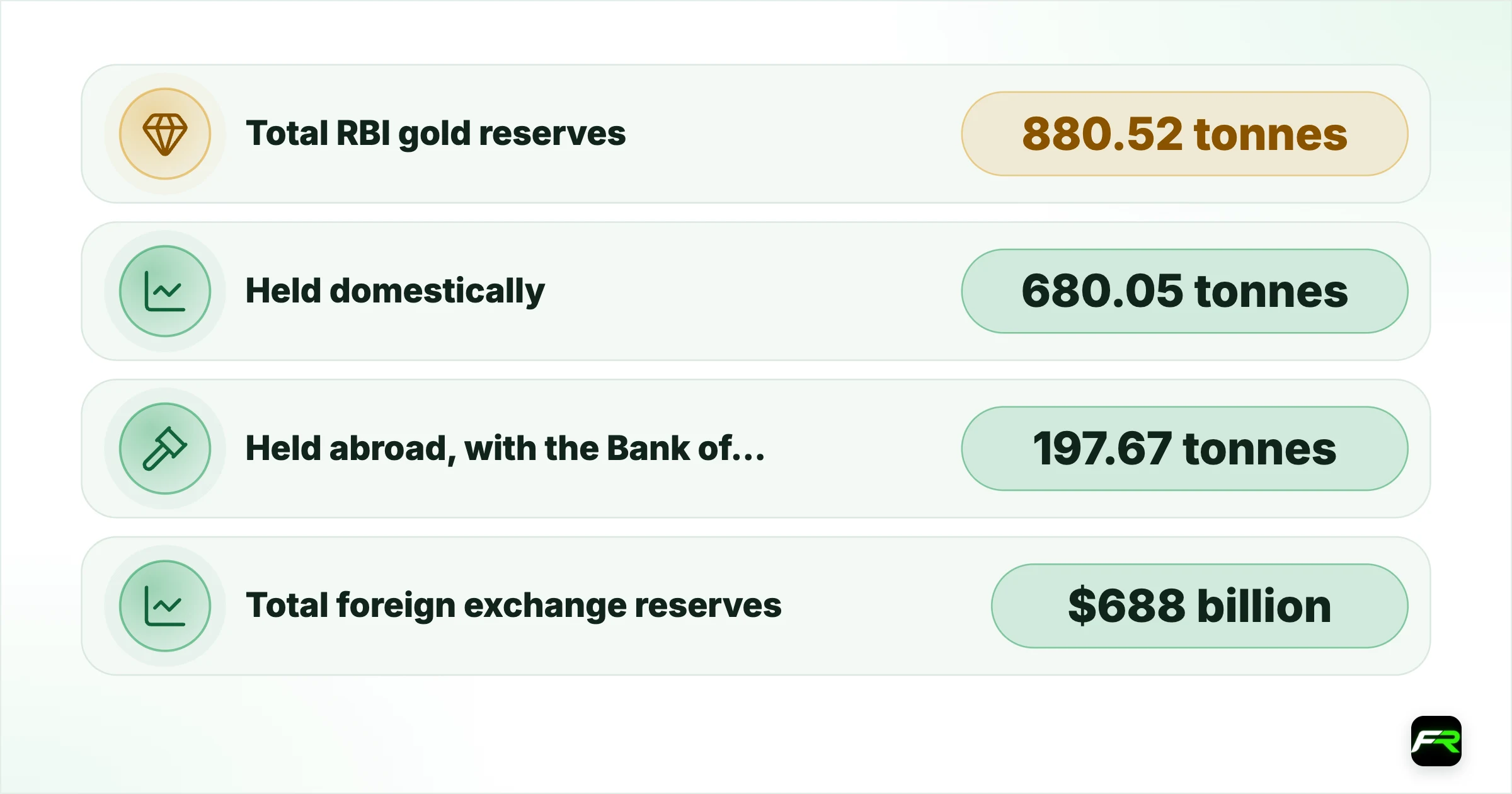
| Total RBI gold reserves | 880.52 tonnes (end-March 2026) |
| Held domestically | 680.05 tonnes |
| Held abroad, with the Bank of England and the BIS | 197.67 tonnes |
| Total foreign exchange reserves | $688 billion (as of March 27, 2026) |
| Gold’s share of total reserves | About 16.7%, up from under 14% a year earlier |
The last major repatriation was the 100-tonne transfer from the Bank of England in May 2024, the largest single move since the 1990s, part of a broader shift that has brought roughly 214 tonnes of gold back onshore since September 2022, with a further batch following home that October. The RBI publishes its headline foreign exchange reserves figure weekly in its Weekly Statistical Supplement, and the World Gold Council tracks central-bank gold reserves by country, India included, for anyone who wants the current number rather than one that may already be a quarter out of date.
Why the RBI holds gold
Gold in official reserves does three things. It diversifies away from holding everything in dollars and US Treasuries. It provides a reserve asset with no counterparty and no default risk. And, held domestically, it cannot be frozen by another government, which matters more since the freezing of Russian reserves held abroad. The RBI adding gold and repatriating it fits a pattern of building resilience into its reserve position rather than a bet on the gold price.
What it signals for currency strategy
A central bank that is diversifying reserves and building gold is signalling that it takes external financial risk seriously and is preparing to defend the currency through stress. For USD/INR, that reinforces what traders already know: the RBI intervenes actively to smooth rupee moves, and it has the reserves (dollars plus gold) to do so for a long time. The practical effect is that sharp rupee sell-offs get met with intervention, and the rupee is unlikely to be allowed into a disorderly slide as long as reserves are ample.
| RBI reserve behaviour | What it tells a trader |
|---|---|
| Adding gold, repatriating it | Building resilience, prioritising defensive capacity |
| Ample total reserves (dollars + gold) | Strong ability to intervene and smooth rupee moves |
| Reserves falling during a defence | The RBI is spending firepower; watch for a step-change if it eases off |
| Reserves rebuilt after a sell-off | The RBI is comfortable and the rupee range is likely stable |
Deepak tracks India’s headline reserve figure (published weekly) alongside USD/INR. When reserves are near record levels, he assumes the RBI will keep the pair in a tight range and trades it accordingly, expecting mean reversion. When reserves have fallen sharply during a period of currency defence, he watches for the moment the RBI decides it has spent enough, which is when USD/INR tends to gap to a new range.
What it does not tell you
The RBI’s gold position does not predict the direction of the rupee. That is set by oil prices, foreign portfolio flows, the dollar index and US rates. What the reserve picture tells you is about volatility and the likelihood of a disorderly move: strong reserves mean the RBI can and will smooth things, so USD/INR stays rangy. It is a signal about how the pair will move, not which way.
Central-bank reserve and gold data is published with lags and different countries report on different schedules. India’s weekly reserve figure is relatively timely; detailed gold holdings and location data come less often.
Frequently asked
Why is the RBI adding gold to its reserves?
To diversify away from a heavy concentration in dollars and US Treasuries, to hold an asset with no counterparty risk, and, by keeping it onshore, to hold reserves that cannot be frozen by another government.
Does more RBI gold mean a stronger rupee?
Not directly. It means the RBI has more capacity to defend the rupee and smooth its moves, which reduces volatility and keeps USD/INR range-bound. The direction is still set by oil, capital flows and the dollar.
How do I track India’s reserves?
The RBI publishes the headline foreign exchange reserves figure weekly. Falling reserves during a currency defence are a signal to watch for a change in the RBI’s defended range.
What is reserve repatriation?
Bringing gold that was stored in vaults abroad (historically often in London) back to domestic storage. It reduces exposure to the risk of foreign-held assets being blocked.
Is the RBI’s gold buying big enough to move the world price?
India is one of several large central-bank buyers, and collectively that buying has supported the gold price. India’s individual purchases are meaningful but not, on their own, a primary driver of the world price.
Related reading
The team behind this guide
Researched, checked and approved by five forex specialists
Every guide is written, fact-checked and edited before it goes live, and updated when the facts change. Spotted an error? Tell us.