IC Markets





































The 2% Rule on a $1,000 Account, With Real Numbers
The 2% risk rule sized for small starter accounts: what $20 of risk buys on each major pair, and why positions should feel tiny.
 WriterAbir KhanWriterWrites the guides · checks every figure against primary sources View profileAbout Abir →
 Market analysisTanbir Habib RiyadForex & Crypto AnalystForex and crypto analyst · technical and fundamental analysis View profileAbout Tanbir →
 Fact-checking & riskJannatul FerdaushFact-Checker & Risk AnalystFact-checks every figure · risk analysis · Applied Statistics, University of Dhaka View profileAbout Jannatul →
 Trading reviewJowel RanaCo-Founder & Forex TraderCo-founder · forex trader · reviews guides from a trader's view View profileAbout Jowel →
 Final approvalRanjan NiskrityFounder, Owner & Forex TraderFounder and owner · forex trader · signs off every guide View profileAbout Ranjan →
Key takeaways
- The 2% rule caps the loss on any one trade at 2% of the account: $20 on a $1,000 account.
- $20 of risk means small positions: about 0.10 lots on EUR/USD with a 20-pip stop, 0.01 lots on gold with a $20 stop.
- At 2% risk, eight straight losses cost about 15% and need about 18% to recover; at 10% risk they cost about 57%.
- Recalculate 2% after every loss, so the risk shrinks automatically during a drawdown.
The 2% rule says you never risk more than two per cent of your account on a single trade. On a $1,000 account that is $20. This one number, applied without exception, is the difference between a losing streak being a bad week and a losing streak being the end of the account. Here is exactly what $20 of risk looks like on the pairs a new trader in Asia is most likely to trade.
What $20 buys you
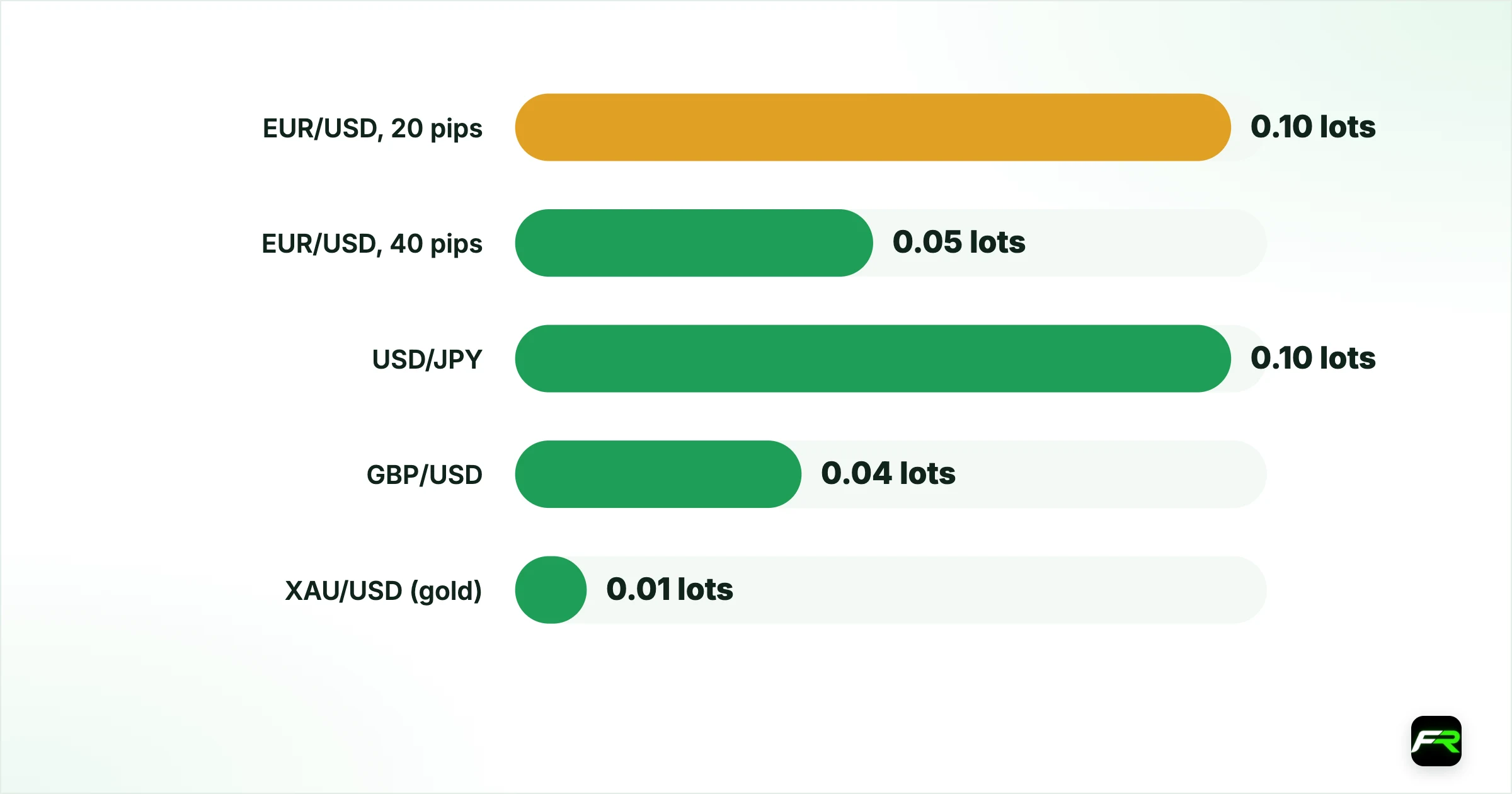
| Pair | Stop distance | Position size | Loss if stopped |
|---|---|---|---|
| EUR/USD | 20 pips | 0.10 lots | ~$20 |
| EUR/USD | 40 pips | 0.05 lots | ~$20 |
| USD/JPY | 30 pips | 0.10 lots | ~$20 |
| GBP/USD | 35 pips | 0.04 lots | ~$18 |
| XAU/USD (gold) | $20 | 0.01 lots | ~$20 |
These positions are small. A 0.10-lot EUR/USD trade makes or loses about $1 per pip. A 20-pip winner is $20. That feels like nothing next to the account you wish you had. It is the correct size for the account you actually have.
Why the positions feel too small
A $1,000 account cannot generate meaningful income, and no amount of leverage changes that safely. What it can do is give you months of practice at correct position sizing while the stakes are low, so that when the account is $5,000 or $10,000, the habit is already built. Traders who scale up the risk on a small account because the positions feel pointless almost always lose the account within a few weeks, because a strategy that produces seven-loss streaks (all of them do) wipes out an account risking 10 per cent per trade. This is the practical version of what statisticians call risk of ruin: the probability that a losing streak long enough to happen eventually, given your win rate and risk per trade, actually happens before your edge has time to play out. At 2% risk, a normal losing streak dents the account. At 10%, the same streak has a real chance of ending it.
Sanjay's first account was 90,000 rupees, about $1,000. He risked 5 per cent a trade because $20 felt like a joke. A six-loss streak in his third week took the account to $650, then a revenge trade took it to $400. He reopened with the same money, forced himself to 2 per cent, and treated the account as a training tool rather than a money-maker. Eight months later it was at $1,450, and more importantly he had not blown it. He says the boredom of small positions was the price of still being in the game.
1% or 2%?
Both are defensible. One per cent ($10 on this account) is more conservative and survives longer streaks. Two per cent ($20) grows faster in good runs and still survives a normal losing streak. A reasonable approach is two per cent while learning on a small account and one per cent once the account is large enough that the dollar amounts matter. What is not defensible is anything above two to three per cent, because the drawdown maths turns against you fast.
| Risk per trade | Drawdown after 8 losses | Gain needed to recover |
|---|---|---|
| 1% | ~8% | ~9% |
| 2% | ~15% | ~18% |
| 5% | ~34% | ~52% |
| 10% | ~57% | ~133% |
Applying it
- Before any trade, calculate two per cent of your current balance. That is your risk.
- Decide the stop from the chart.
- Size the position so the stop-out loses your risk amount, no more.
- If you take a loss, your next two per cent is smaller, because it is two per cent of the reduced balance. That is the rule protecting you.
If a $10 to $20 risk per trade genuinely is not worth your time, that is a sign the account is too small to trade meaningfully yet. The better move is to keep practising on a demo or cent account while you save, not to over-leverage a small live account.
How overnight swap affects a $20 risk unit
The table above only counts the stop-out cost. If any of those positions are held overnight, swap adds a second, quieter cost on top of the planned $20 risk, and it can matter more on a small account than it looks at first glance. Gold and JPY-pair swap charges commonly run several dollars per lot per night on the paying side, so the $20-risk, 0.10-lot USD/JPY position in the table above, held for three or four nights, can rack up $2 to $4 in swap alone, on top of whatever the trade itself does. That is 10 to 20 per cent of the planned risk unit, quietly added, whether the trade wins or loses.
This is not a reason to avoid holding trades. It is a reason to know the swap cost on your specific pair before you decide to hold, and to treat it as part of the plan rather than a surprise on the statement. The overnight swap guide has the full numbers by pair and shows how the cost compounds on a small account that swing trades regularly.
Frequently asked
Is 2% too aggressive?
It is at the upper end of sensible. It survives a normal losing streak but a bad run of ten-plus losses would still hurt. One per cent is safer; anything above three per cent is not recommended for retail accounts.
Does the 2% include the spread?
Your total cost on a stopped-out trade is the stop distance plus the spread plus any commission. Size so that the full round-trip cost stays within your 2%, which in practice means treating the stop as slightly wider than the raw pip distance.
Can I risk 2% on the account or 2% on my capital?
On the current account balance. After a loss, 2% of a smaller balance is a smaller dollar figure, which automatically reduces your risk as the account shrinks.
How do I grow a $1,000 account?
Slowly, if the strategy works, or by adding funds from savings. At a strong 3% a month, $1,000 becomes about $1,400 in a year. Small accounts grow by dollars slowly even when the percentages look good.
What if my broker's minimum trade is 0.01 lots and my calc says 0.005?
Then your stop is too tight for the account. Widen the stop (which also improves your win rate on volatile pairs), pick a less volatile instrument, or accept slightly more than 2% on that specific trade and note it.
Related reading
The team behind this guide
Researched, checked and approved by five forex specialists
Every guide is written, fact-checked and edited before it goes live, and updated when the facts change. Spotted an error? Tell us.