IC Markets



































Common Scams Targeting New Traders in Southeast Asia
Managed-account pitches, recovery scams, fake brokers and signal-group funnels: the scams targeting new traders in the region, and the red flags.
 WriterAbir KhanWriterWrites the guides · checks every figure against primary sources View profileAbout Abir →
 Market analysisTanbir Habib RiyadForex & Crypto AnalystForex and crypto analyst · technical and fundamental analysis View profileAbout Tanbir →
 Fact-checking & riskJannatul FerdaushFact-Checker & Risk AnalystFact-checks every figure · risk analysis · Applied Statistics, University of Dhaka View profileAbout Jannatul →
 Trading reviewJowel RanaCo-Founder & Forex TraderCo-founder · forex trader · reviews guides from a trader's view View profileAbout Jowel →
 Final approvalRanjan NiskrityFounder, Owner & Forex TraderFounder and owner · forex trader · signs off every guide View profileAbout Ranjan →
Key takeaways
- Most scams aimed at new traders in Southeast Asia follow four scripts: managed accounts, recovery scams, fake or clone brokers, and signal or course upsells.
- Guaranteed returns, deposits to personal accounts and fees to withdraw are the clearest warning signs.
- Nobody legitimate recovers trading losses for an upfront fee, and regulators never cold-call victims.
- Check a broker's exact entity on the regulator's own register before depositing anything.
The scams that target new forex traders across Southeast Asia are not clever. They are a handful of scripts, repeated endlessly, and once you know the shape of each one they are easy to spot. This guide covers the four most common structures and the specific red flags for each. It does not name firms; the point is to recognise the pattern regardless of the brand attached to it.
The managed-account pitch
Someone, often a contact from a WhatsApp or Telegram group, offers to trade your money for you and share the profits. They show screenshots of consistent gains. You send funds to an account they specify. For a while the dashboard shows your balance growing. When you try to withdraw, there is a fee to pay first, then a tax, then a compliance hold, and eventually the person stops replying. The money was never traded. The screenshots and the dashboard were fabricated.
- Red flag: anyone trading your money who is not a licensed, regulated fund manager. Unlicensed money management is illegal across the region and is the structure most scams use.
- Red flag: a fixed or guaranteed monthly return. No real trading produces that.
- Red flag: you send money to a personal account or a wallet, not to a regulated broker’s official deposit page.
- Red flag: a fee required to withdraw. Legitimate withdrawals never require an upfront payment; any fee is deducted from the payout.
The recovery scam
After you have lost money, whether to a scam or just to bad trading, someone contacts you claiming to be a recovery agent, a lawyer, or a regulator, offering to get your funds back for a fee. It targets the same person a second time, right after the first scam or a bad trading loss has already cost them money. There is no legitimate service that recovers trading losses for an upfront fee. Real regulators do not contact individuals offering paid recovery. Anyone who does is running the scam.
The fake or clone broker
An invented broker with no real licence anywhere, or a clone that copies a legitimate broker’s name, licence number and address onto a lookalike domain. You deposit, you trade, everything seems fine, and then withdrawals are refused or the site vanishes. The fake broker guide in the FX Recap broker section covers the checks in detail. The core one: find the exact company name and licence number, look it up on the regulator’s own website (the FCA register, ASIC's register and CySEC's register are the ones most brokers advertising in the region claim) and confirm the entity exists and the licence covers dealing in forex.
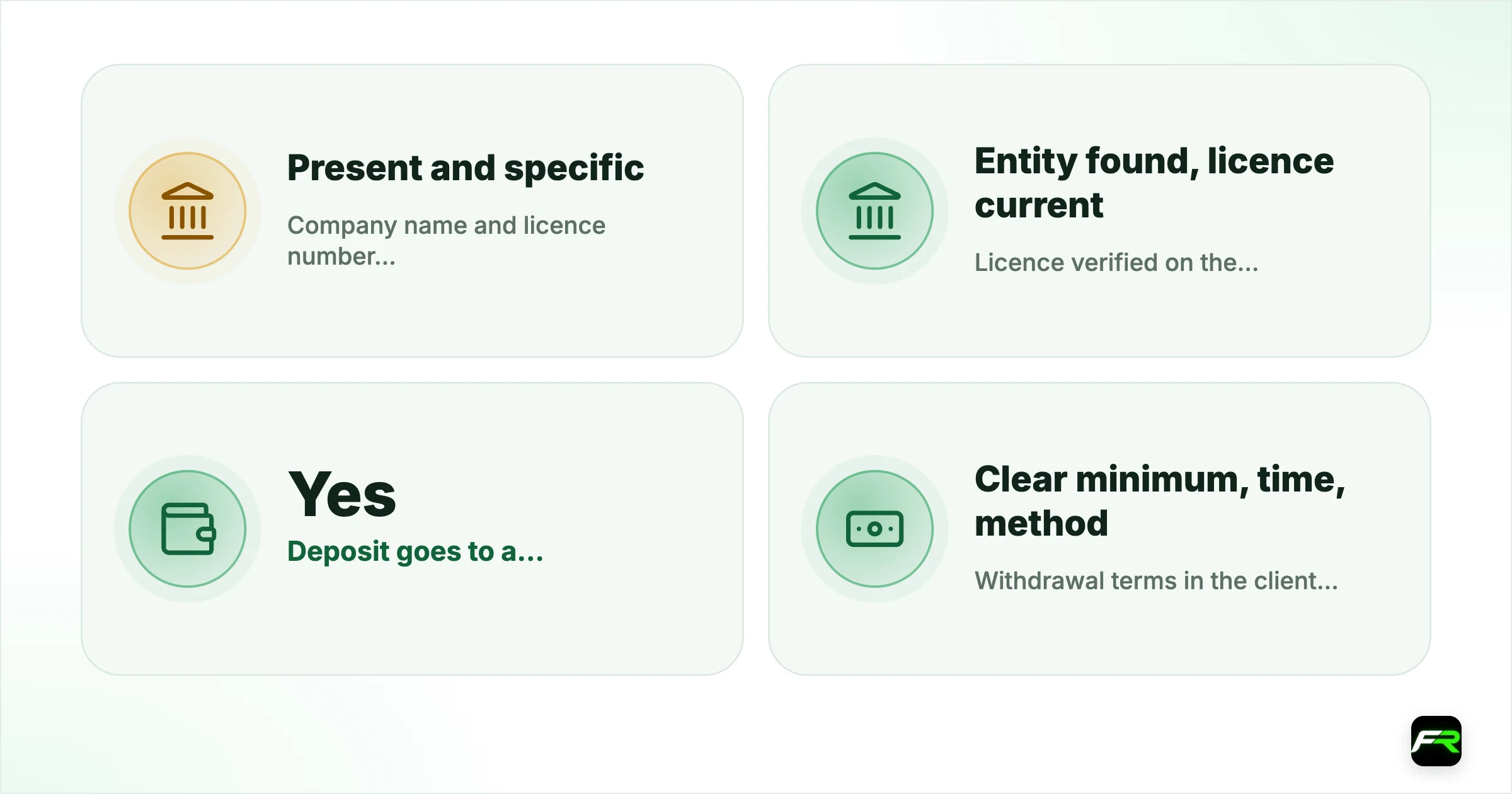
| Check | Pass | Fail |
|---|---|---|
| Company name and licence number in the footer or client agreement | Present and specific | Vague or absent |
| Licence verified on the regulator’s own website | Entity found, licence current | Not found or expired |
| Deposit goes to a company or named payment processor | Yes | Personal account or personal crypto wallet |
| Withdrawal terms in the client agreement | Clear minimum, time, method | Conditions buried, volume requirements to withdraw |
The signal-group funnel
A free Telegram or WhatsApp signal group posts calls, some of which win, building trust over a few weeks. Then comes the upsell: a paid VIP group, a course, or a specific broker you must sign up through using their referral link. Sometimes the broker is a clone; sometimes it is real but the group operator earns a commission on your deposits and losses, which aligns their incentives against you. The winning free signals were a marketing cost.
Reza was added to a Telegram group by a former classmate. The signals looked good for two weeks and he made a small profit trading them. Then the analyst offered a managed service: send $500 and he would double it in a month. Reza sent it. The dashboard showed $1,100, then a $300 withdrawal fee was required to release it. Reza recognised the pattern, refused, and lost the $500. The classmate, it turned out, was paid to recruit.
The crypto/USDT-specific version of these scams
The same four structures run on crypto rails with small changes. The managed-account pitch asks for USDT instead of a bank transfer, which removes the one trace a bank or card chargeback could have given you. The fake broker becomes a fake "trading platform" that only accepts crypto deposits, often the biggest single tell since no licensed forex broker restricts funding to crypto alone. Recovery scams targeting crypto losses specifically promise to trace or reverse a USDT transfer for an upfront fee, which is not something any legitimate service can actually do once a transfer has confirmed on-chain. Treat a crypto-only funding requirement as a red flag in its own right, on top of the checks above.
Where to report a confirmed scam
Report to three places, not just one. Your country's financial regulator or central bank (the one whose name the scam invoked, if any), your local police or a national cybercrime unit, and the bank or payment platform you sent money through, to attempt a reversal or flag the receiving account. If the payout went to a crypto wallet, report the transaction to the exchange that received it as well; exchanges do sometimes freeze funds tied to reported fraud before they are moved again. Reporting rarely gets your money back, but it is what gets an operator's accounts and domains taken down before the next person sends money.
The rules that protect you
- Never let anyone who is not a licensed fund manager trade your money.
- Never send deposit funds to a personal account, a wallet, or a payment link from an intermediary. Use the broker’s official deposit page only.
- Never pay a fee to withdraw. Legitimate withdrawals deduct any fee from the payout.
- Verify every broker’s licence on the regulator’s own website before depositing.
- Treat anyone who contacts you after a loss offering paid recovery as a scammer, always.
- Be sceptical of free signal groups that funnel you toward a specific broker link.
For a running list of specific operators to avoid, see the FX Recap scam broker list. This guide is about the structures; that list tracks the current names.
Frequently asked
Is it legal for someone to trade my forex account for me?
Only if they are a licensed, regulated fund manager. Unlicensed money management is illegal across Southeast Asia and is the structure most forex scams use. If the person is not licensed, do not let them handle your funds.
Can I recover money lost to a forex scam?
Rarely, and never through a service that charges an upfront fee. Anyone contacting you offering paid recovery is running a second scam. Report the original scam to your local regulator and police.
How do I check if a broker is real?
Find the exact company name and licence number in the footer or client agreement, look it up on the regulator’s own website, and confirm the entity exists and the licence covers forex dealing. If there is no entity name at all, stop.
Are free signal groups scams?
Not all, but many are a funnel: winning free calls build trust, then you are pushed toward a paid group, a course, or a broker referral link where the operator earns on your deposits and losses. Be sceptical of any group tied to a specific broker link.
Are there crypto-specific versions of these scams I should watch for?
Yes. The same structures run on USDT and other crypto rails, usually with a crypto-only funding requirement as the extra tell, a fake platform that won't accept a bank transfer or card, or a recovery scammer claiming they can reverse an on-chain transfer for a fee. Treat crypto-only funding as a red flag on top of the checks in this guide.
What is the single biggest red flag?
Being asked to send money in (a fee, a tax, a verification amount) before a withdrawal is released. Legitimate brokers never require that; any fee is taken from the payout.
Related reading
The team behind this guide
Researched, checked and approved by five forex specialists
Every guide is written, fact-checked and edited before it goes live, and updated when the facts change. Spotted an error? Tell us.