IC Markets





































Stop Loss Placement on Gold: Why Tight Stops Fail
Gold’s daily range in 2026 has often been $40 to $70. A $5 stop gets hit on noise every time. Here is where gold stops actually belong, with real pip ranges and the position-size trade-off.
 WriterAbir KhanWriterWrites the guides · checks every figure against primary sources View profileAbout Abir →
 Market analysisTanbir Habib RiyadForex & Crypto AnalystForex and crypto analyst · technical and fundamental analysis View profileAbout Tanbir →
 Fact-checking & riskJannatul FerdaushFact-Checker & Risk AnalystFact-checks every figure · risk analysis · Applied Statistics, University of Dhaka View profileAbout Jannatul →
 Trading reviewJowel RanaCo-Founder & Forex TraderCo-founder · forex trader · reviews guides from a trader's view View profileAbout Jowel →
 Final approvalRanjan NiskrityFounder, Owner & Forex TraderFounder and owner · forex trader · signs off every guide View profileAbout Ranjan →
Key takeaways
- Gold's daily range has often been $40 to $70 in 2026, so stops of $3 to $5 are inside normal noise.
- Place the stop beyond the structure that proves the trade wrong, plus a $2 to $5 buffer for spikes.
- Keep risk fixed and let the position shrink: $50 of risk with a $20 stop is 0.025 lots.
- Never set a gold stop closer than about 1.5 times the current hourly ATR.
The single most common way to lose money on gold is a stop that is too tight. A trader sees a clean setup, wants to keep the loss small, places the stop $3 to $5 from entry, and gets knocked out on a normal wiggle minutes later. Then price goes where they expected, without them. Repeat that ten times and the account is down significantly on a strategy that was actually right more than half the time.
Gold is volatile. Through 2026 its average daily range has frequently been $40 to $70, and intraday swings of $15 to $25 within an hour are routine. A stop has to sit outside that noise or it is not a stop, it is a coin flip.
Where the stop belongs
Place the stop beyond the structure that would invalidate your trade, not at a fixed distance. If you are buying a pullback to support, the stop goes below the support zone, usually with a buffer of $2 to $5 beyond the actual low to account for a spike. On the timeframes most retail traders use, that typically means:
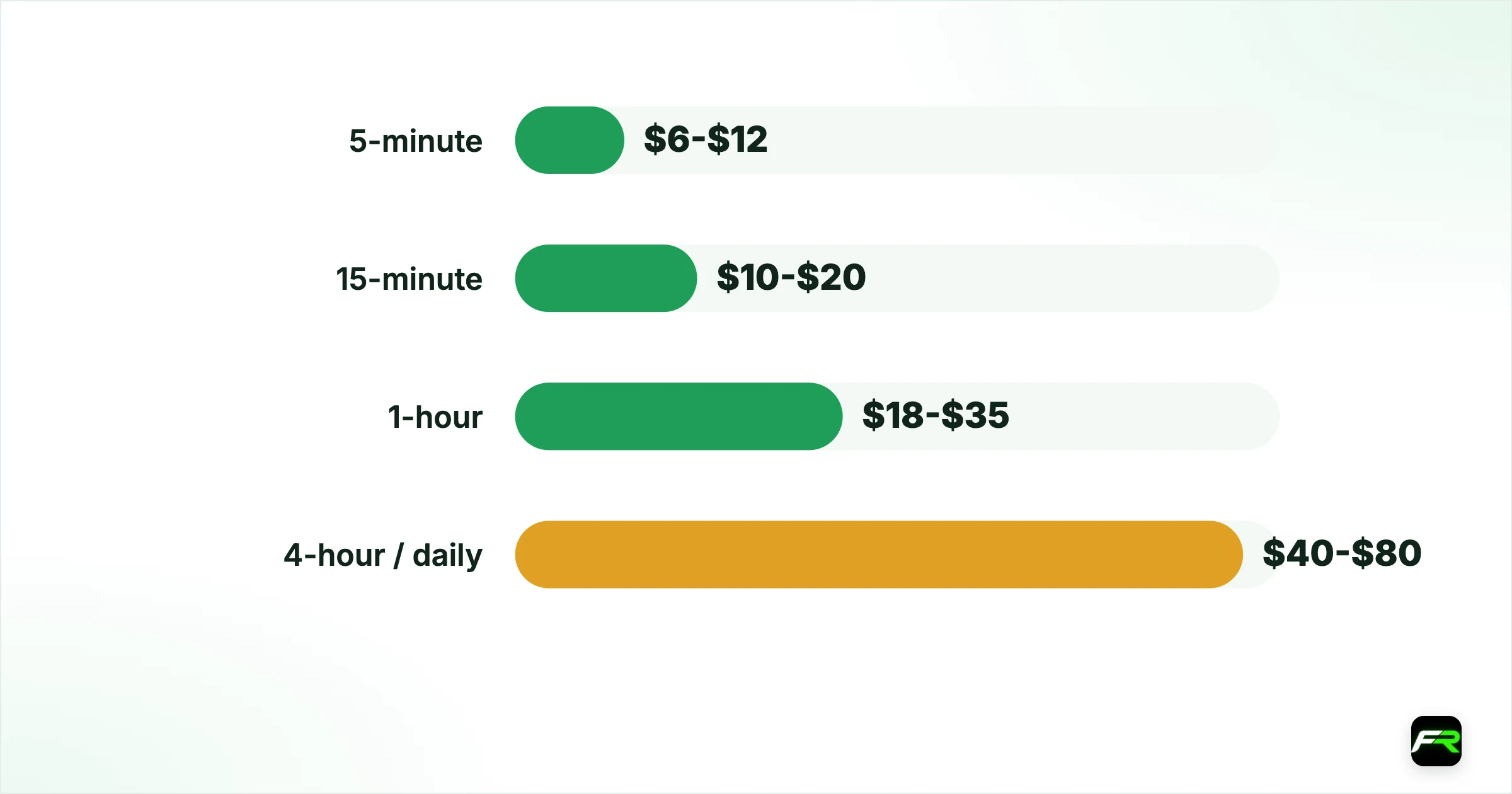
| Timeframe | Typical gold stop distance | Reasoning |
|---|---|---|
| 5-minute | $6-$12 | Beyond the recent micro swing plus buffer |
| 15-minute | $10-$20 | Beyond the last 15-min swing point |
| 1-hour | $18-$35 | Beyond the hourly structure |
| 4-hour / daily | $40-$80 | Beyond the daily swing; small position |
The position-size trade-off
A wider stop means a smaller position, and that is the point. One lot of gold is 100 ounces, so a $1 move in the price is $100 on a full 1-lot position, and 0.10 lots is $10 per $1 of price. On a $5,000 account risking one per cent ($50), a $20 gold stop means the position is $50 / $20 / $100 per lot per $1, which is 0.025 lots. That is small, and it should be. Gold's volatility forces tiny positions, which is exactly the protection a beginner needs on an instrument that can move $50 in a session.
On a $5,000 account, 1% risk = $50. A $20 gold stop means the position is $50 / $20 / ($100 per lot per $1) = 0.025 lots. A $40 stop means 0.0125 lots. Gold positions are small by necessity.
Kwan traded gold with $4 stops for months because he wanted his losses under $30 on his $2,000 account. He was stopped out on noise so often that he was down 25 per cent on a strategy his backtests said should have been profitable. He switched to structure-based stops, usually $15 to $22, and accepted 0.02-lot positions. His trade count dropped, his win rate rose from 33 per cent to 44 per cent, and the account started climbing. His conclusion: the tight stops were not reducing his risk, they were guaranteeing his losses.
What tight stops actually do
A tight stop feels like risk control because the dollar loss per trade is small. But if the stop is inside the noise, the probability of being hit on any given trade is very high, maybe 70 to 80 per cent, regardless of whether your directional read is correct. So you take many small losses, your win rate collapses, and the few winners cannot cover the volume of losses. The dollar risk per trade was low; the expected value of the strategy went negative.
A structure-based stop has a lower probability of being hit by noise, maybe 45 to 55 per cent on a decent setup, so your win rate reflects your actual edge. The dollar risk per trade is the same one per cent because the position is smaller. You have traded a higher hit rate for a smaller position, which is the correct trade to make.
Practical rules
- Stop goes beyond the structure that invalidates the trade, plus a $2 to $5 buffer for spikes.
- Never place a gold stop closer than about 1.5 times the current hourly ATR.
- Let the position size fall out: smaller stop still means smaller position because risk stays at 1 per cent.
- If the structure-based stop makes the position smaller than your broker's minimum lot, the timeframe is too small for your account. Move up a timeframe.
Widening a stop after a trade is open, to avoid taking the loss, is the opposite of this advice and is how accounts blow up. Set the correct stop before entry and do not move it further away.
How spread widens exactly when your stop needs room
There is a second cost that compounds the tight-stop problem: the spread itself widens during the same high-volatility moments that are already forcing your stop to sit further away. Around a Fed decision, a strong jobs report, or a sudden risk-off move, gold's spread can widen from a normal 20 to 40 cents out to several dollars for a few minutes, exactly when the structure-based stop above already needs the extra room. A trader who sizes for the calm-market spread and then trades through a news spike is paying twice: a wider required stop distance, and a wider spread eating into both the stop and the target on entry and exit.
The practical adjustment is to add the spread on top of the structure-based distance, not fold it in as an afterthought. If the structure says the stop belongs $20 away and the spread during the news window you are trading has widened to $3, treat the effective stop as $23 for position-sizing purposes. On the calmer timeframes in the table above, where spread is closer to its normal resting level, this barely changes the numbers. Around scheduled news, it can be the difference between a stop that holds and one that gets taken by the spread alone before price has genuinely moved against you.
If you cannot check a broker's live spread during the specific news window you plan to trade, the safer default is to stay flat through the release and re-enter once the spread has settled back down, rather than sizing for a spread you are guessing at.
Frequently asked
How tight is too tight for a gold stop?
Anything inside roughly 1.5 times the current hourly ATR is likely to be hit on noise. In 2026 conditions that usually means stops under $8 to $10 on intraday timeframes are too tight.
Why does a wider stop improve my win rate?
It reduces the chance of being stopped out by random movement, so your recorded win rate reflects whether your directional read was right rather than whether price wiggled. The dollar risk stays the same because the position is smaller.
What lot size should I trade gold with $2,000?
One per cent is $20. With a $15 to $25 stop, that puts the position around 0.01 to 0.015 lots, which is at or near many brokers' minimum. If you cannot size that small, the account is too small for gold on that timeframe.
Should I use a fixed dollar stop or ATR-based?
ATR-based adjusts automatically as volatility changes, which suits gold. A fixed dollar stop is simpler but needs manual widening when the market speeds up.
Is a guaranteed stop worth it on gold?
Some brokers offer guaranteed stops for a fee that fill at your exact price even in a fast move, with no slippage, unlike a standard stop which fills at the next available price and can be executed well past your level during a gap or a news spike. On gold, which can gap around news, guaranteed stops have real value for position traders, though the fee eats into returns on frequent trading.
Related reading
The team behind this guide
Researched, checked and approved by five forex specialists
Every guide is written, fact-checked and edited before it goes live, and updated when the facts change. Spotted an error? Tell us.