IC Markets





































How a $5,000 USD/JPY Trade Lost 40% in One Session
One oversized USD/JPY trade, no stop, held through a BoJ meeting: the entry, size and skipped maths behind a $2,000 loss.
 WriterAbir KhanWriterWrites the guides · checks every figure against primary sources View profileAbout Abir →
 Market analysisTanbir Habib RiyadForex & Crypto AnalystForex and crypto analyst · technical and fundamental analysis View profileAbout Tanbir →
 Fact-checking & riskJannatul FerdaushFact-Checker & Risk AnalystFact-checks every figure · risk analysis · Applied Statistics, University of Dhaka View profileAbout Jannatul →
 Trading reviewJowel RanaCo-Founder & Forex TraderCo-founder · forex trader · reviews guides from a trader's view View profileAbout Jowel →
 Final approvalRanjan NiskrityFounder, Owner & Forex TraderFounder and owner · forex trader · signs off every guide View profileAbout Ranjan →
About this case study: Bima, the trader in this example, is an illustrative composite, not a real person, and the account, trades and figures are not a real trading record. They are built from patterns that are common in retail trading so the maths can be shown step by step. Market events are simplified unless a date is given.
The account started the month at $5,000. By the next morning it was worth about $3,000. Nothing exotic happened. There was no gap, no broker problem, no manipulation. The trader took one position that was far too large for the account, left no stop loss, and held it through a scheduled Bank of Japan decision. This is the most common way a retail account in Asia gets damaged, so it is worth walking through slowly.
The pair was USD/JPY. The trader was based in Jakarta, trading in the evening after work, which puts them right in the middle of the Tokyo session when USD/JPY is at its most active. The setup itself was reasonable. The execution around it was where it went wrong.
The trade as it was placed
USD/JPY was trading near 151.20. The trader expected it to fall back toward 150.00 over the following days and went short. So far, fine. The problem was size. They opened 2 standard lots, which on USD/JPY is a position of 200,000 units, worth roughly $13.40 per pip at that rate. On a $5,000 account, that is a notional exposure around 40 times the account balance, using most of the available margin on a high-leverage offshore entity.
At $13.40 per pip, a 40-pip move against the position is a $536 loss, about 11 per cent of the account. A 150-pip move is a $2,010 loss, close to the 40 per cent that actually happened. USD/JPY routinely moves 60 to 100 pips in a single active session, and considerably more than that around a central-bank meeting. The trade only had room to be wrong by about 35 pips before the loss reached ten per cent of the account, and there was no stop loss set to enforce even that.
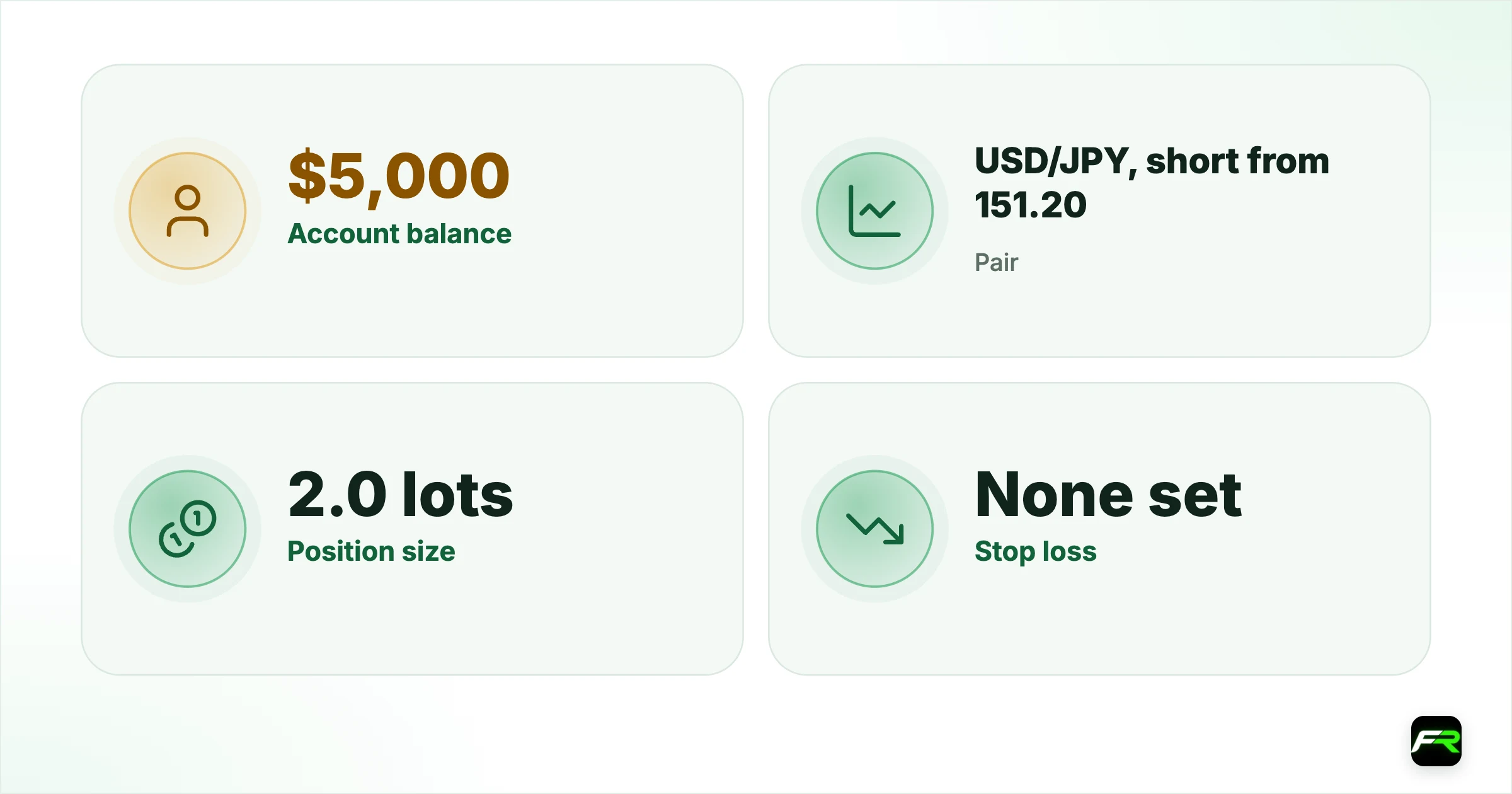
| Account balance | $5,000 |
|---|---|
| Pair | USD/JPY, short from 151.20 |
| Position size | 2.0 lots (~$13.40 per pip) |
| Stop loss | None set |
| 1% risk would have allowed | ~4 pips at that size, or 0.19 lots at a 40-pip stop |
| Actual move against the trade | ~150 pips into the BoJ decision |
| Loss | ~$2,000 (40% of the account) |
Why the pip value wasn't $26
It is worth stopping on the pip value itself, because sizing this trade correctly depends entirely on getting it right. USD/JPY quotes to two decimal places, so one pip is 0.01 yen. On a standard lot of 100,000 units, that move is worth 1,000 yen, and converting yen back to dollars means dividing by the USD/JPY rate itself, not multiplying by a flat figure. At 151.20, that is 1,000 / 151.20, or about $6.61 per pip per standard lot, not the $10 a pair like EUR/USD uses. Two standard lots is therefore close to $13.20 to $13.40 per pip depending on the exact rate at the time, not $26. A pip value calculator does this conversion automatically and is worth checking before sizing any yen pair, since it is the single most common place traders miscalculate risk.
The event that was ignored
The Bank of Japan was scheduled to announce a policy decision the next day, Tokyo morning. The trader either did not check the calendar or checked it and decided it did not matter. When the decision landed, the first read of the statement was dovish: the yen weakened and USD/JPY spiked about 150 pips to 152.70 within the hour. Only later, as the market digested the full statement, did the pair reverse and drift back toward 150.00, the trader's original target. The idea was right over a few days. The timing on the night was wrong, and at 2 lots the account could not afford to wait.
That whipsaw is the danger of holding through an event. Price can move 100 pips in one direction and 150 back within an hour. A position sized so that 35 pips is uncomfortable cannot survive that, regardless of whether the final direction was right. Watching roughly $2,000 disappear, the trader closed the position near 152.70 in a panic, and the later drop back to 150.00 happened without them.
Bima had been trading a $5,000 account for four months and was up about 8 per cent. He read a few analysis pieces calling for USD/JPY to fall and decided to take a large position to make the month. He did not set a stop because, in his words, he did not want to get stopped out on noise before the move happened. The Bank of Japan meeting was on his calendar app but he had muted the notification. He now trades a fixed 0.15 lots on USD/JPY regardless of conviction, keeps a stop on every trade, and closes everything before any scheduled central-bank event. His account took nine months to recover to where it had been.
What one per cent risk would have looked like
On a $5,000 account, one per cent is $50. If the trader wanted a 40-pip stop below the entry, the position size that risks exactly $50 is about 0.19 lots on USD/JPY, roughly one tenth of what they actually traded. With that stop in place, the spike would have closed the trade for a $50 loss, one per cent. Even with no stop at all, the same 150-pip move at that size would have cost about $190, under four per cent, a larger than usual but survivable loss. The account would have ended the session at $4,950, or $4,810 at worst, instead of $3,000, and the trader would still have had the capital and the confidence to take the next setup.
The strategy was not the issue. A short from 151.20 targeting 150.00 with a stop at 151.60 is a perfectly reasonable trade with a better than 1:3 risk-to-reward. Sized correctly and with the stop in place, it would have been a small loss on the day and possibly a winner later in the week. Sized at 2 lots with no stop through a BoJ meeting, the same idea was account-threatening.
- Decide the dollar risk first: one to two per cent of the balance.
- Decide where the stop goes based on the chart, not on how much you can afford.
- Work out the position size from those two numbers, never the other way around.
- Check the economic calendar for the pair. If a central-bank meeting or major data release is due before the trade would close, either size much smaller or do not take it.
A position with no stop loss is not a position with unlimited patience. It is a position with unlimited loss. The only thing that closes it is a margin call, and by then the damage is done.
The lesson that actually transfers
Every part of this loss was avoidable with three habits: fixed percentage risk, a stop on every trade, and no open positions through scheduled events. None of them require skill or a better strategy. They require doing the maths before the trade instead of after it. The traders who last are not the ones with the best entries. They are the ones who never let a single trade cost more than a small, planned amount.
Frequently asked
Would a stop loss alone have saved the account?
Partly. A stop at 151.60, 40 pips away, would have closed the trade for about a $536 loss instead of $2,000. But the real fix is size: at 0.19 lots that same 40-pip stop is a $50 loss. A stop limits the damage; correct sizing makes the damage trivial.
Is it ever right to trade through a Bank of Japan meeting?
Experienced traders sometimes do, at very small size, with a defined stop and an understanding that the position can gap through it. For anyone still learning, being flat before the decision is the right call every time.
How do I know what a pip is worth on USD/JPY?
On a standard lot (100,000 units) a pip is worth roughly $6.50 to $7 depending on the exact rate. On a mini lot (10,000) it is about $0.65 to $0.70, and on a micro lot (1,000) about $0.065. Position size scales the pip value linearly.
What leverage was this trader using?
The 2-lot position on a $5,000 account implies around 1:40 effective leverage on that trade, but the account was on a 1:500 offshore entity, which is what made the position possible in the first place. A 1:30 regulated entity would have rejected the order.
How long does it take to recover a 40% loss?
A 40 per cent loss requires a 67 per cent gain to get back to even. At a realistic 2 to 4 per cent a month with disciplined risk, that is a year or more of consistent trading, which is why avoiding the loss matters far more than any strategy.
Related reading
The team behind this guide
Researched, checked and approved by five forex specialists
Every guide is written, fact-checked and edited before it goes live, and updated when the facts change. Spotted an error? Tell us.