IC Markets





































A Singapore Trader's $10,000 Account: 6 Months, Month by Month
An illustrative month-by-month log of a $10,000 account over six months: win rate, drawdown and one lesson each month.
 WriterAbir KhanWriterWrites the guides · checks every figure against primary sources View profileAbout Abir →
 Market analysisTanbir Habib RiyadForex & Crypto AnalystForex and crypto analyst · technical and fundamental analysis View profileAbout Tanbir →
 Fact-checking & riskJannatul FerdaushFact-Checker & Risk AnalystFact-checks every figure · risk analysis · Applied Statistics, University of Dhaka View profileAbout Jannatul →
 Trading reviewJowel RanaCo-Founder & Forex TraderCo-founder · forex trader · reviews guides from a trader's view View profileAbout Jowel →
 Final approvalRanjan NiskrityFounder, Owner & Forex TraderFounder and owner · forex trader · signs off every guide View profileAbout Ranjan →
Key takeaways
- A part-time $10,000 account finished six months at about $11,600, up roughly 16%, with a worst drawdown of about 5%.
- Two of the six months lost money, which is a normal part of a good result.
- Fewer marginal trades, plus a one-line written reason before each entry, lifted results sharply.
- During a losing streak the trader halved risk to 0.5% rather than sizing up to recover.
About this case study: Wei Jie, the trader in this example, is an illustrative composite, not a real person, and the account, trades and figures are not a real trading record. They are built from patterns that are common in retail trading so the maths can be shown step by step. Market events are simplified unless a date is given.
Most trading content shows you either the win or the blow-up. The ordinary middle, where an account grinds sideways with a slight upward drift and the trader learns something small each month, almost never gets written up because it does not make a good screenshot. This is that middle. This illustrative case follows a composite Singapore-based trader through six months of a $10,000 account, trading major pairs and gold part-time around a full-time job, flat months included.
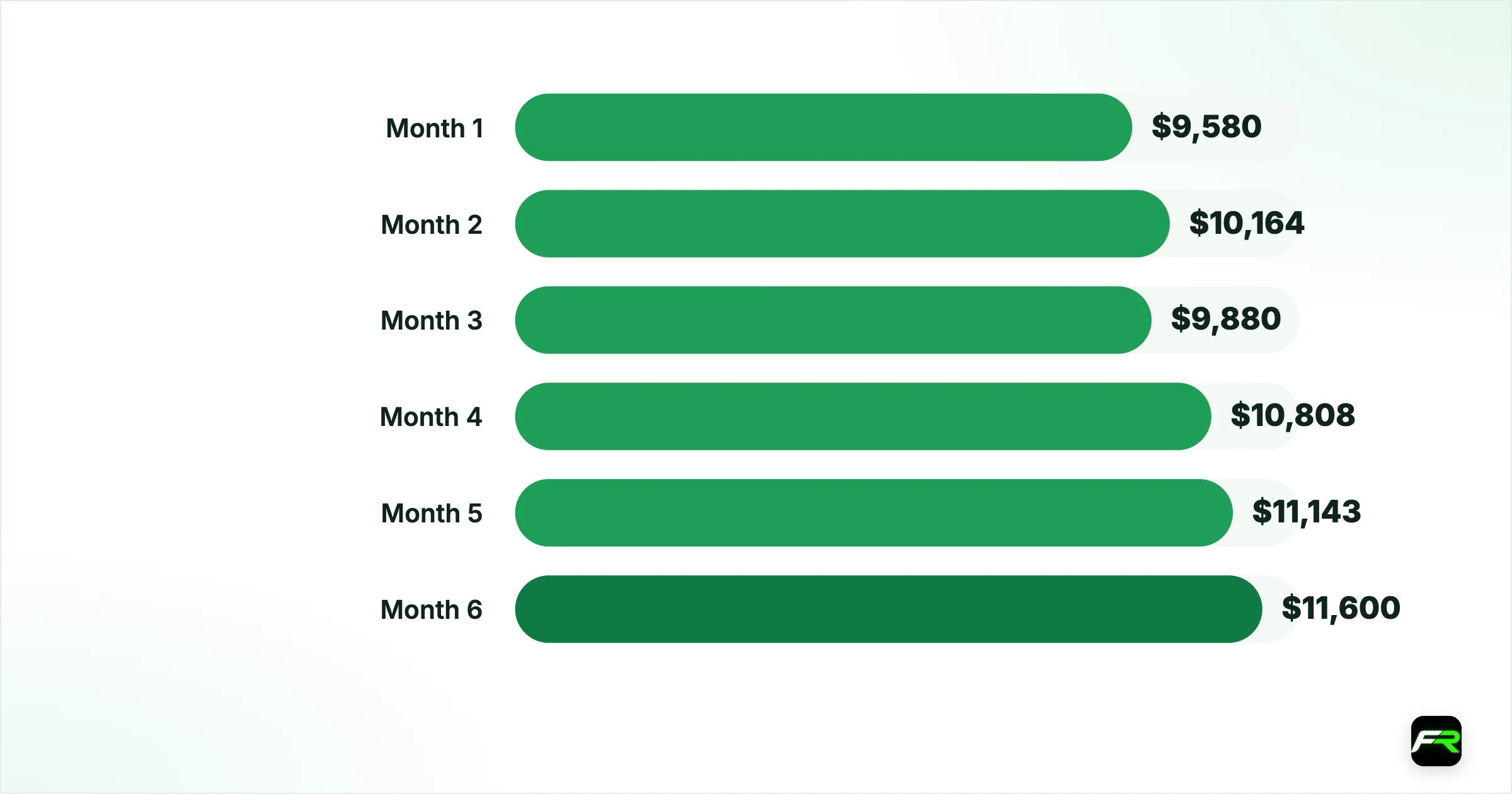
The headline figure: the account finished the six months at about $11,600, a gain of roughly 16 per cent. That is a good outcome, well above what most retail accounts manage, and it came with a worst peak-to-trough drawdown of about 5 per cent and two losing months out of six. Here is the month-by-month.
| Month | Trades | Win rate | Result | Balance end |
|---|---|---|---|---|
| Month 1 | 22 | 45% | -4.2% | $9,580 |
| Month 2 | 18 | 50% | +6.1% | $10,164 |
| Month 3 | 25 | 40% | -2.8% | $9,880 |
| Month 4 | 20 | 55% | +9.4% | $10,808 |
| Month 5 | 16 | 50% | +3.1% | $11,143 |
| Month 6 | 19 | 47% | +4.1% | $11,600 |
Month 1: the cost of overtrading
Twenty-two trades in a month, part-time, is too many. The trader admitted they were taking marginal setups out of a feeling that they should be doing something. Nine of the 22 trades were on days they later marked as low-conviction. Of those nine, two won. The month closed down 4.2 per cent, almost all of it from the marginal trades. The lesson written in the journal: a trade you would not explain to someone else is a trade you should not take.
Month 2: fewer trades, better result
Trade count dropped to 18. The trader started a proper trading journal: every trade written down before entry with the setup, the stop, the target and a one-line reason. If they could not write the reason in one clear sentence, they skipped it. Win rate rose to 50 per cent and the month closed up 6.1 per cent. Same strategy, same market conditions, fewer and better trades.
Month 3: a drawdown handled correctly
A run of six losses in eight trades in the second week took the account from $10,164 down to about $9,700, an intra-month drawdown of 4.5 per cent. The important thing is what the trader did not do. They did not increase size to win it back. They did not abandon the strategy. They cut their risk from one per cent to half a per cent for the rest of the month, kept trading the same setups, and let the losing streak burn out. The month still closed down 2.8 per cent, but the drawdown was contained and the account was intact.
Wei Jie trades in the evening after work and on Saturday mornings reviewing the week. His rule after month three was that any drawdown past 5 per cent cuts his risk in half automatically until the account makes a new equity high. He says the rule removed the emotional decision at exactly the point where he used to make his worst ones. His journal from month three has a single line for the week of the losing streak: did nothing stupid, which he counts as the best trading week of the six months.
Month 4: the best month, and why it was dangerous
Plus 9.4 per cent, a 55 per cent win rate, and the trader's own note that this was the month they were most at risk of ruining things. A good month breeds the belief that you have figured it out, which is when size creeps up and the rules start to slip. The trader deliberately kept risk at one per cent and did not add trades. They noted that three of the winners were partly luck, trades that went their way despite a mediocre entry, and that they should not read too much into the result.
Months 5 and 6: consistency
Plus 3.1 and plus 4.1 per cent. Trade counts of 16 and 19. Win rates near 50 per cent. Nothing dramatic. The account made new highs each month without a drawdown worse than 3 per cent. This is what a working process looks like once the obvious mistakes have been removed: modest, repeatable, occasionally boring.
| Starting balance | $10,000 |
|---|---|
| Ending balance | ~$11,600 (+16%) |
| Losing months | 2 of 6 |
| Worst drawdown | ~5% (month-2 high to month-3 low) |
| Average trades per month | 20 |
| Overall win rate | ~47% |
| Biggest single lesson | Overtrading marginal setups was the largest cost |
What to take from it
A 16 per cent half-year, if annualised naively, sounds like more than 30 per cent a year, and that is roughly the ceiling of what a skilled retail trader who sticks to a process can hope for without taking on damaging risk. The path there is not exciting. It is cutting the marginal trades, writing down every entry, halving risk in a drawdown, and not letting a good month go to your head. The trader here did not use a special strategy. They used ordinary support and resistance with a stop on every trade, and they removed their own worst habits one month at a time.
For the rules and brokers that apply where you live, see our guide to MAS-licensed forex brokers in Singapore.
Frequently asked
Is 16% in six months a realistic target?
It is a good outcome, achieved by a trader who stuck to a written process in favourable-enough conditions. Many months are flat or negative. Setting it as a target creates pressure to overtrade. A better framing is: follow the process, and the returns are whatever the market gives.
Why cut risk during a drawdown instead of stopping?
Stopping entirely means you are not trading when the strategy starts working again, and losing streaks end unpredictably. Cutting risk in half keeps you in the game at lower stakes while the streak burns out, then you scale back up once the account makes a new high.
How many trades per month is right?
There is no fixed number, but for a part-time trader, 15 to 25 quality setups a month is plenty. If you are taking 40-plus, some of them are almost certainly marginal, and marginal trades are usually where the month's losses come from.
What does 'write the trade down before entry' actually mean?
Before clicking buy or sell, write the setup, the entry, the stop price, the target price, and one sentence explaining why. If the sentence is vague or you cannot write it, the trade is not clear enough to take.
Did the trader use leverage?
The account was on a regulated entity with 1:30 leverage, which is more than enough for correctly sized positions. At 1 per cent risk with sensible stops, the positions used a small fraction of available margin.
Related reading
The team behind this guide
Researched, checked and approved by five forex specialists
Every guide is written, fact-checked and edited before it goes live, and updated when the facts change. Spotted an error? Tell us.