IC Markets





































Drawdown Recovery Math: Why a 50% Loss Needs a 100% Gain
The asymmetry that catches every over-leveraged trader: losses and the gains needed to recover them are not symmetrical. A simple table, and what it means for how much you should ever risk.
 WriterAbir KhanWriterWrites the guides · checks every figure against primary sources View profileAbout Abir →
 Market analysisTanbir Habib RiyadForex & Crypto AnalystForex and crypto analyst · technical and fundamental analysis View profileAbout Tanbir →
 Fact-checking & riskJannatul FerdaushFact-Checker & Risk AnalystFact-checks every figure · risk analysis · Applied Statistics, University of Dhaka View profileAbout Jannatul →
 Trading reviewJowel RanaCo-Founder & Forex TraderCo-founder · forex trader · reviews guides from a trader's view View profileAbout Jowel →
 Final approvalRanjan NiskrityFounder, Owner & Forex TraderFounder and owner · forex trader · signs off every guide View profileAbout Ranjan →
Key takeaways
- Losses and recoveries aren't symmetrical: a 50% loss needs a 100% gain to get back to where you started.
- Past about 40% drawdown the climb back (67% or more) is one most retail traders never finish.
- At 1% risk a 15-loss streak costs about 14%; at 3% it costs about 37%.
- A simple circuit breaker helps: after a 15% drop from the peak, cut risk to 0.5% until a new high.
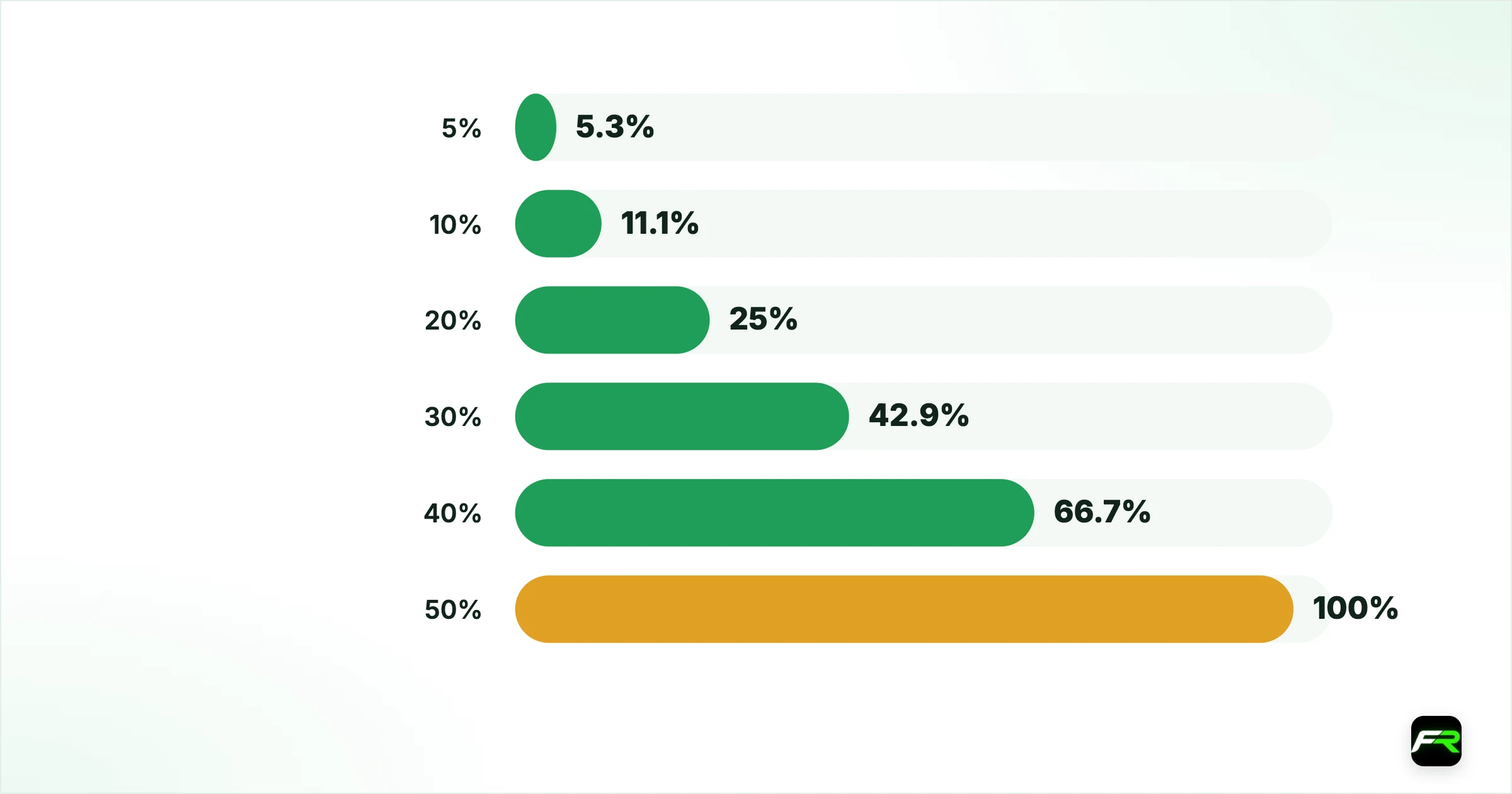
If you lose 50 per cent of an account, you do not need a 50 per cent gain to get back. You need 100 per cent. This asymmetry is the reason position sizing matters more than any strategy, and it is the trap that closes on every trader who risks too much per trade. The maths is not complicated, but seeing it laid out changes how you think about a bad trade.
The table
| Loss from peak | Gain needed to recover |
|---|---|
| 5% | 5.3% |
| 10% | 11.1% |
| 20% | 25% |
| 30% | 42.9% |
| 40% | 66.7% |
| 50% | 100% |
| 60% | 150% |
| 70% | 233% |
| 80% | 400% |
| 90% | 900% |
A $10,000 account that falls to $5,000 has lost 50 per cent. To get back to $10,000 from $5,000 is a $5,000 gain on a $5,000 base, which is 100 per cent. The deeper the hole, the steeper the climb, and past about 40 per cent it becomes a climb most retail traders never finish.
Why it compounds the damage
Two things make a deep drawdown worse than the number suggests. First, the account is smaller, so the same trading in dollar terms is a bigger percentage swing, which raises volatility and the chance of a further drop. Second, the psychology. A trader down 50 per cent is rarely trading calmly. They size up to recover faster, which is exactly the move that takes 50 per cent to 80 per cent. The revenge trading case study is this happening in real time.
The pattern we see most often: a trader is up 15 per cent over a few months. One over-sized trade or a revenge session takes them down 35 per cent from the peak. They now need a 54 per cent gain just to get back to that peak. Trading calmly at 2 to 4 per cent a month, that is a year or more. Trading aggressively to speed it up, most of these accounts are gone within two months. The traders who survive are the ones who accept the year and go back to 1 per cent risk.
What it means for risk per trade
Work backwards from the table. If you never want to be in a hole that takes more than a few months to climb out of, you need to keep your maximum drawdown under about 20 per cent, which needs a 25 per cent recovery. To keep drawdown under 20 per cent, your risk per trade has to be small enough that a realistic losing streak stays inside that. At 1 per cent risk, a 15-loss streak (rare, but possible) is about a 14 per cent drawdown. At 3 per cent risk, the same streak is 37 per cent, well into the danger zone. At 10 per cent risk, a 6-loss streak is 47 per cent and the account may not recover.
- 1% risk: even a bad losing streak keeps drawdown roughly recoverable.
- 2% risk: acceptable, with a worse streak still climbable.
- 3-5% risk: one bad run puts the account in a hole that takes a year-plus to fix.
- 10%+ risk: a normal losing streak can end the account.
The takeaway
The recovery table is the strongest argument for small position sizes that exists. You are not risking 1 per cent per trade to be cautious. You are risking 1 per cent because the maths of recovery means a 40 per cent drawdown is close to fatal, and the only reliable way to avoid a 40 per cent drawdown is to make sure no single trade, and no normal losing streak, can get you close to it.
Set a personal drawdown circuit breaker: if the account falls 15% from its peak, cut risk to 0.5% per trade until it makes a new high. It slows the recovery but it stops the 15% turning into 40%.
Drawdown, as used throughout this guide, is an account-level measure: the decline from the account's peak balance or equity. A related but different metric worth knowing is maximum adverse excursion (MAE), which measures how far a single open trade moved against you before it closed, whether it ended as a winner or a loser. A trade that dips 3R underwater before recovering to close at +1R has a 3R MAE despite being a winning trade on the log. Reviewing MAE across your trade history can reveal that your stops are actually placed correctly, but you are routinely enduring far more heat than your eventual result suggests, which is a separate problem from the account-level drawdown this guide covers.
How this applies to a prop firm's daily and max drawdown rule
A funded prop firm account turns this same recovery maths from a risk-management guideline into a hard rule with no room to negotiate. A personal account can sit at a 30 per cent drawdown and spend a year climbing back; a prop firm challenge cannot, because it typically enforces two separate limits, a daily loss limit (often 4 to 5 per cent) and a maximum overall drawdown (often 8 to 10 per cent), and breaching either one closes the account immediately, win or lose on the next trade. There is no recovery period, because the account simply stops existing at the moment of breach.
This changes what the recovery table above means in practice. On a personal account, the table describes how painful a given loss will be to recover from. On a prop firm account, every row past the firm's own drawdown limit is not a description of a hard road back, it is a description of an account that no longer exists. If the max drawdown limit is 10 per cent, the trader's real task is never to let the account see anything past roughly half that from ordinary trading variance, since the daily limit usually gets breached first on the way to the max one. The trailing drawdown guide covers the added complication that many firms measure the max limit from a rising high-water mark rather than the starting balance, which tightens the room further the more profitable the account becomes.
Frequently asked
Why isn't a 50% loss fixed by a 50% gain?
Because the gain is calculated on the smaller balance. 50% of $10,000 is $5,000. Getting from $5,000 back to $10,000 is a $5,000 gain on a $5,000 base, which is 100%.
What is a 'good' maximum drawdown for a retail trader?
Under 20% is comfortable and recoverable. 20-30% is manageable but stressful. Past 40% the recovery odds drop sharply, mostly because of the trading behaviour a deep drawdown triggers.
How does drawdown relate to risk per trade?
Your maximum realistic drawdown is roughly your risk per trade times your longest plausible losing streak. At 1% risk and a 15-loss streak, that is about 14%. At 5% risk it is about 54%.
Should I stop trading during a drawdown?
Reducing risk (for example halving it) is usually better than stopping entirely, because losing streaks end unpredictably and stopping means missing the recovery. But if you are trading emotionally, a short break can be the right call.
Is a drawdown the same as a loss?
A drawdown is the decline from a peak in account value, whether or not positions are closed. A 20% drawdown means the account is 20% below its highest point, which you recover by making new highs.
Related reading
The team behind this guide
Researched, checked and approved by five forex specialists
Every guide is written, fact-checked and edited before it goes live, and updated when the facts change. Spotted an error? Tell us.