IC Markets





































Inside the US-Japan Currency Intervention and What Happens Next
Japan's yen intervention tends to slow a move rather than reverse it, unless the rate gap changes too. The historical pattern.
 WriterAbir KhanWriterWrites the guides · checks every figure against primary sources View profileAbout Abir →
 Market analysisTanbir Habib RiyadForex & Crypto AnalystForex and crypto analyst · technical and fundamental analysis View profileAbout Tanbir →
 Fact-checking & riskJannatul FerdaushFact-Checker & Risk AnalystFact-checks every figure · risk analysis · Applied Statistics, University of Dhaka View profileAbout Jannatul →
 Trading reviewJowel RanaCo-Founder & Forex TraderCo-founder · forex trader · reviews guides from a trader's view View profileAbout Jowel →
 Final approvalRanjan NiskrityFounder, Owner & Forex TraderFounder and owner · forex trader · signs off every guide View profileAbout Ranjan →
Key takeaways
- Japanese intervention buys time but rarely changes USD/JPY's direction on its own; the US-Japan rate gap decides that.
- Co-ordinated US-Japan action has historically produced larger, more durable moves than Japan acting alone.
- In spring 2024 Japan spent about ¥9.8 trillion; USD/JPY fell from around 160 and settled near 157 by late May.
- If intervention coincides with a Fed pivot or a BoJ hike, the drop is far more likely to hold.
Japanese yen intervention comes in waves. Officials warn, the market tests the level, intervention hits, USD/JPY drops sharply, and then the debate begins about whether it holds. Occasionally the intervention is co-ordinated or at least tacitly supported by the United States, which makes it more forceful. Looking at how past episodes played out is the best guide to what tends to happen next.
What co-ordination adds
Solo intervention by Japan uses Japan’s own reserves and its own market power. When the US Treasury signals agreement, or acts alongside, the message to the market is stronger: this is not one country leaning against a trend, it is the two governments on the same side. Co-ordinated intervention has historically produced larger, more durable moves than solo action, because speculators are less willing to fight a combined effort. Whether any given episode is genuinely co-ordinated is often unclear at the time and confirmed only later.
The historical pattern
| Condition at the time of intervention | What tends to follow |
|---|---|
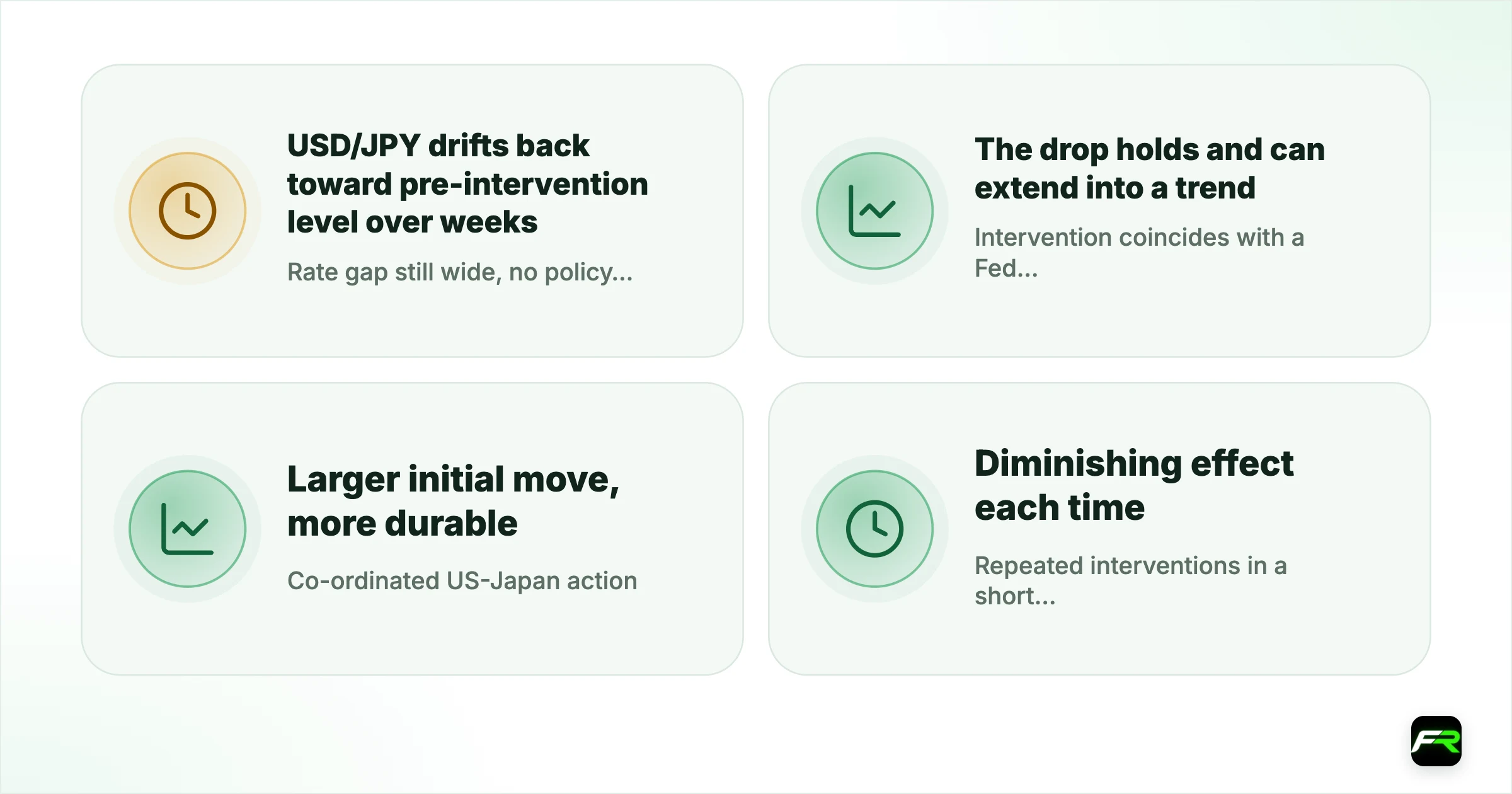
| Rate gap still wide, no policy change | USD/JPY drifts back toward pre-intervention level over weeks |
| Intervention coincides with a Fed pivot to cuts | The drop holds and can extend into a trend |
| Co-ordinated US-Japan action | Larger initial move, more durable |
| Repeated interventions in a short period | Diminishing effect each time |
The consistent lesson: intervention works on the underlying driver’s timeline, not against it. If the US-Japan interest-rate gap that pushed USD/JPY up is unchanged, intervention buys weeks, not a new direction. If the gap is also narrowing (the Fed cutting, the BoJ hiking), intervention can mark the start of a real move lower because it is pushing with the fundamentals rather than against them.
A Specific Example: How a Past Intervention Episode Played Out
The clearest recent case is spring 2024. USD/JPY pushed through the politically sensitive 160 level and hit a 34-year low for the yen, around 160.24, on April 29, a public holiday in Japan with thin liquidity. Within minutes the pair dropped sharply, a move the market treated as confirmed intervention before Japan’s Ministry of Finance said anything, and a second wave followed a few days later as USD/JPY pushed back up toward the high 150s. Japan’s finance ministry later confirmed it had spent roughly ¥9.8 trillion, about $62 billion, defending the yen between April 26 and May 29, 2024, one of the largest intervention totals on record for a single stretch. By late May the pair had settled around 157, above the pre-intervention low but well off the 160 high, which is the pattern the table above describes: a sharp initial move, then a partial drift back, because the underlying US-Japan rate gap had not changed.
Kenta traded a post-intervention bounce in USD/JPY, going long after a 400-pip drop, expecting it to retrace as it had in a previous episode. It did, and he took a modest profit. He is careful to note that this only worked because the rate gap had not changed. He would not take the same trade if the Fed had just signalled a cutting cycle, because then the intervention and the fundamentals would both be pointing down.
How to trade around it
- Do not chase the drop during the intervention itself; the move is faster than a stop can fill cleanly.
- In the days after, ask whether the rate gap has changed. If not, a retrace toward the pre-intervention level is the base case.
- If a Fed pivot or a BoJ hike coincides, the drop is more likely to hold and extend.
- Reduce large USD/JPY long size whenever officials are issuing escalating verbal warnings, because the intervention is unscheduled.
The retrace-after-intervention trade has worked in past episodes but is not a rule. It depends entirely on the interest-rate backdrop, and it can fail badly if that backdrop shifts at the same time.
The bigger question
Intervention is a signal that Japan considers the yen’s weakness a problem, but it does not fix the cause. The cause is the interest-rate gap, and only the two central banks can close that. So the durable move in USD/JPY, up or down, will come from the BoJ’s hiking path and the Fed’s cutting path, not from the Ministry of Finance’s reserves. Intervention is a speed bump. The rate-path guide covers the underlying driver.
Sources and where to check it yourself
- Japan Ministry of Finance: intervention operations: confirmed amounts, monthly and quarterly, back to 1991
- US Treasury foreign exchange report: the US view on Japan's currency practices, twice a year
Frequently asked
Does yen intervention usually work?
It reliably produces a large, immediate drop in USD/JPY. Whether that drop holds depends on the interest-rate backdrop. If the US-Japan rate gap is unchanged, the pair tends to drift back over weeks. If the gap is also narrowing, the move can hold and extend.
What does co-ordinated intervention mean?
Two or more governments acting together to move a currency, or one publicly backing another’s action. It is more forceful than solo intervention because speculators are less willing to fight a combined effort.
Should I trade the bounce after intervention?
It has worked in past episodes where the rate gap was unchanged, on the logic that intervention slows rather than reverses the trend. It is not a rule and can fail if the rate backdrop shifts at the same time.
Why can’t Japan just fix the yen with intervention?
Because the yen’s weakness comes from the interest-rate gap with the US, which only the Fed and the BoJ can change. Intervention spends reserves to slow the move but does not address the cause.
How much does Japan spend on intervention?
Past single episodes have involved tens of billions of dollars in a day, drawn from Japan’s large foreign exchange reserves. The Ministry of Finance discloses monthly intervention totals with a lag.
Related reading
The team behind this guide
Researched, checked and approved by five forex specialists
Every guide is written, fact-checked and edited before it goes live, and updated when the facts change. Spotted an error? Tell us.