IC Markets





































Monetary Authority of Singapore’s Unusual Policy Tool, Explained
Singapore's central bank manages the exchange rate, not an interest rate, guiding the dollar within an undisclosed band. What it means for USD/SGD.
 WriterAbir KhanWriterWrites the guides · checks every figure against primary sources View profileAbout Abir →
 Market analysisTanbir Habib RiyadForex & Crypto AnalystForex and crypto analyst · technical and fundamental analysis View profileAbout Tanbir →
 Fact-checking & riskJannatul FerdaushFact-Checker & Risk AnalystFact-checks every figure · risk analysis · Applied Statistics, University of Dhaka View profileAbout Jannatul →
 Trading reviewJowel RanaCo-Founder & Forex TraderCo-founder · forex trader · reviews guides from a trader's view View profileAbout Jowel →
 Final approvalRanjan NiskrityFounder, Owner & Forex TraderFounder and owner · forex trader · signs off every guide View profileAbout Ranjan →
Key takeaways
- Singapore runs monetary policy through the exchange rate, not an interest rate.
- MAS guides the Singapore dollar within an undisclosed band against a trade-weighted basket (the S$NEER).
- It adjusts the slope, width and mid-point at reviews in April and October; a steeper slope means tightening.
- USD/SGD is one of Asia's least volatile pairs and often reflects broad dollar moves more than MAS itself.
Almost every central bank in the world manages its economy by setting a short-term interest rate. Singapore is the notable exception. The Monetary Authority of Singapore (MAS) runs monetary policy through the exchange rate, guiding the Singapore dollar along a path within a band against a trade-weighted basket of the currencies of its major trading partners. Understanding this makes USD/SGD easier to read.
Why Singapore does it this way
Singapore is a small, extremely open economy. Trade is worth more than twice its GDP, and a large share of what Singaporeans consume is imported. That means the exchange rate has a much bigger influence on domestic inflation than a domestic interest rate would, because a stronger Singapore dollar directly lowers the price of imports. So MAS decided decades ago that the exchange rate was the more effective lever, and it has used it ever since.
The three settings
MAS describes its policy in terms of the slope, width and mid-point of the currency band. It adjusts these at its scheduled reviews, twice a year in April and October, with the option of an off-cycle move if conditions demand it.
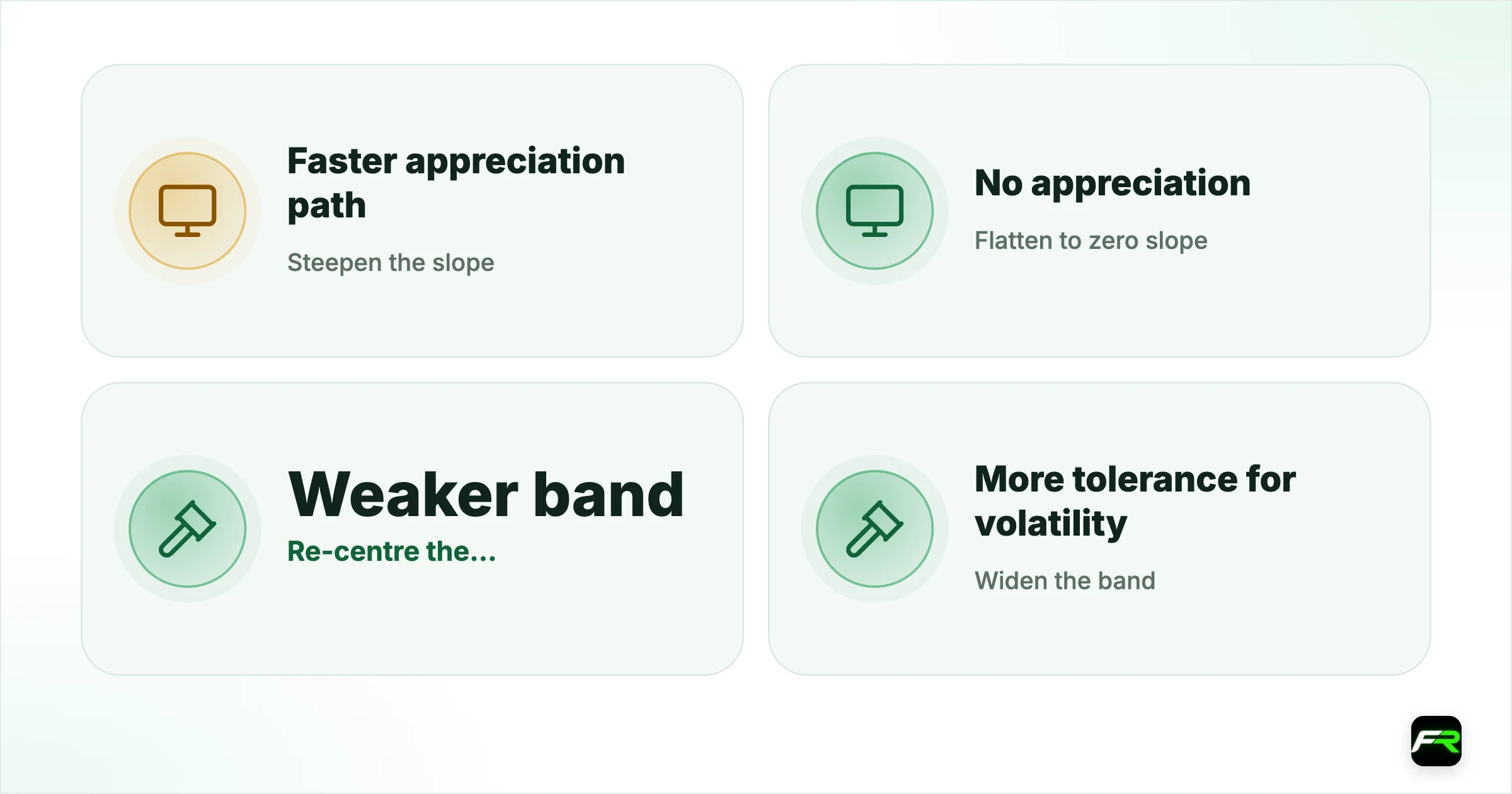
| MAS action | Effect on the S$NEER band | What it signals |
|---|---|---|
| Steepen the slope | Faster appreciation path | Tightening, to fight inflation |
| Flatten to zero slope | No appreciation | Neutral / easing |
| Re-centre the mid-point down | Weaker band | Significant easing |
| Widen the band | More tolerance for volatility | Uncertainty, flexibility |
The S$NEER is the Singapore dollar nominal effective exchange rate, its value against the trade-weighted basket. MAS does not publish the exact band, the basket weights, or the mid-point, but analysts estimate them closely from market behaviour.
What it means for USD/SGD
Because the Singapore dollar is managed against a basket rather than against the dollar directly, USD/SGD is partly a function of where the dollar sits against the euro, yen and yuan. When the dollar is broadly strong, USD/SGD rises even if MAS policy is unchanged. When MAS tightens (steepens the slope), it puts a gentle upward drift under the Singapore dollar, which caps USD/SGD over time. The pair is one of the least volatile in Asia day to day, precisely because MAS smooths it, which also means retail moves are small and the spread is a larger share of any trade.
Wei stopped trying to day-trade USD/SGD after realising the daily ranges were often 30 to 50 pips, too small to cover the spread and make a worthwhile return. He watches the MAS reviews for the bigger picture (a tightening review tends to support the Singapore dollar for months) but does his active trading in USD/JPY and gold, which actually move.
The MAS review dates
MAS statements land in April and October, usually in the morning Singapore time, alongside the quarterly GDP estimate. A change in the slope or mid-point can move the Singapore dollar a per cent or more against the basket, which is a large move for this currency. An unchanged statement, which is common, produces little reaction. Off-cycle moves are rare and reserved for shocks.
Singapore does not issue government bonds to finance spending; it runs fiscal surpluses. So unlike the rupiah or rupee, the Singapore dollar is not a leveraged bet on foreign bond flows. Its main drivers are MAS policy and the broad direction of the US dollar.
Where to Follow MAS Policy Yourself
MAS publishes every Monetary Policy Statement in full on its own site, along with the Macroeconomic Review that accompanies each one, at mas.gov.sg/monetary-policy. Reading the statement itself, rather than a secondhand summary, is worth doing directly around each April and October review: the specific wording MAS uses about the slope (steepen, maintain, or reduce) is the whole signal, and a paraphrase can blur the difference between a small and a large policy shift.
For the rules and brokers that apply where you live, see our guide to MAS-licensed forex brokers in Singapore.
Frequently asked
What is MAS’s current policy stance?
As of the July 2026 review, MAS is in a tightening stance: it slightly increased the rate of appreciation of the Singapore dollar policy band, its second tightening move of the year after April 2026, in response to inflation risk from Middle East-linked energy prices rather than any change of view on domestic growth, which it described as firm. This changes at every scheduled review, so check MAS’s own statement at mas.gov.sg/monetary-policy for whatever the latest one says by the time you read this.
Does MAS set an interest rate?
No. It manages monetary policy through the exchange rate, guiding the Singapore dollar within an undisclosed band against a trade-weighted basket of currencies. Singapore domestic interest rates are largely determined by global rates and capital flows.
How often does MAS review policy?
Twice a year, in April and October, alongside the advance GDP estimate. Off-cycle adjustments are possible but rare.
What is the S$NEER?
The Singapore dollar nominal effective exchange rate: its value against a basket of the currencies of Singapore’s main trading partners, weighted by trade. MAS targets a path for this, not for USD/SGD directly.
Why is USD/SGD so quiet?
Because MAS deliberately smooths the Singapore dollar’s movements. Daily ranges are small, which makes short-term trading difficult once you account for the spread.
Does a MAS tightening mean USD/SGD will fall?
It puts upward pressure on the Singapore dollar against the basket over time, which tends to cap USD/SGD. But USD/SGD also depends on where the dollar sits against the euro, yen and yuan, so a strong-dollar environment can push it up regardless.
Related reading
The team behind this guide
Researched, checked and approved by five forex specialists
Every guide is written, fact-checked and edited before it goes live, and updated when the facts change. Spotted an error? Tell us.