IC Markets




































Bank of Japan's Rate Path and Why USD/JPY Keeps Swinging
USD/JPY swings as markets keep repricing BoJ hikes and Fed cuts. The rate-gap framework that explains the moves.
 WriterAbir KhanWriterWrites the guides · checks every figure against primary sources View profileAbout Abir →
 Market analysisTanbir Habib RiyadForex & Crypto AnalystForex and crypto analyst · technical and fundamental analysis View profileAbout Tanbir →
 Fact-checking & riskJannatul FerdaushFact-Checker & Risk AnalystFact-checks every figure · risk analysis · Applied Statistics, University of Dhaka View profileAbout Jannatul →
 Trading reviewJowel RanaCo-Founder & Forex TraderCo-founder · forex trader · reviews guides from a trader's view View profileAbout Jowel →
 Final approvalRanjan NiskrityFounder, Owner & Forex TraderFounder and owner · forex trader · signs off every guide View profileAbout Ranjan →
Key takeaways
- USD/JPY is a bet on the gap between US and Japanese interest rates, and both central banks' paths are uncertain.
- Faster Fed cuts or faster BoJ hikes narrow the gap and push USD/JPY lower; the opposite lifts it.
- Watch US CPI and jobs data, the Fed's dot plot, BoJ meetings and Outlook Reports, and Japanese wage data.
- Until one path becomes clear, trade USD/JPY as a wide, swinging range: 70 to 130 pips on an ordinary day.
USD/JPY has spent recent years swinging in wide ranges rather than trending cleanly, and the reason is a two-sided uncertainty. On one side, the market cannot decide how quickly the Bank of Japan will keep raising rates after finally moving away from its long stretch near zero. On the other, it cannot decide how quickly the Federal Reserve will cut. USD/JPY is essentially a bet on the gap between those two paths, and when both are uncertain, the bet keeps getting re-priced.
The rate-gap framework
Hold dollars and you earn the US policy rate. Hold yen and you earn the Japanese policy rate. The wider that gap, the more attractive it is to hold dollars against yen, and the higher USD/JPY tends to sit. Most of the multi-year moves in USD/JPY map onto this gap. When the gap is expected to widen (Fed hiking, BoJ on hold), USD/JPY rises. When it is expected to narrow (Fed cutting, BoJ hiking), USD/JPY falls.
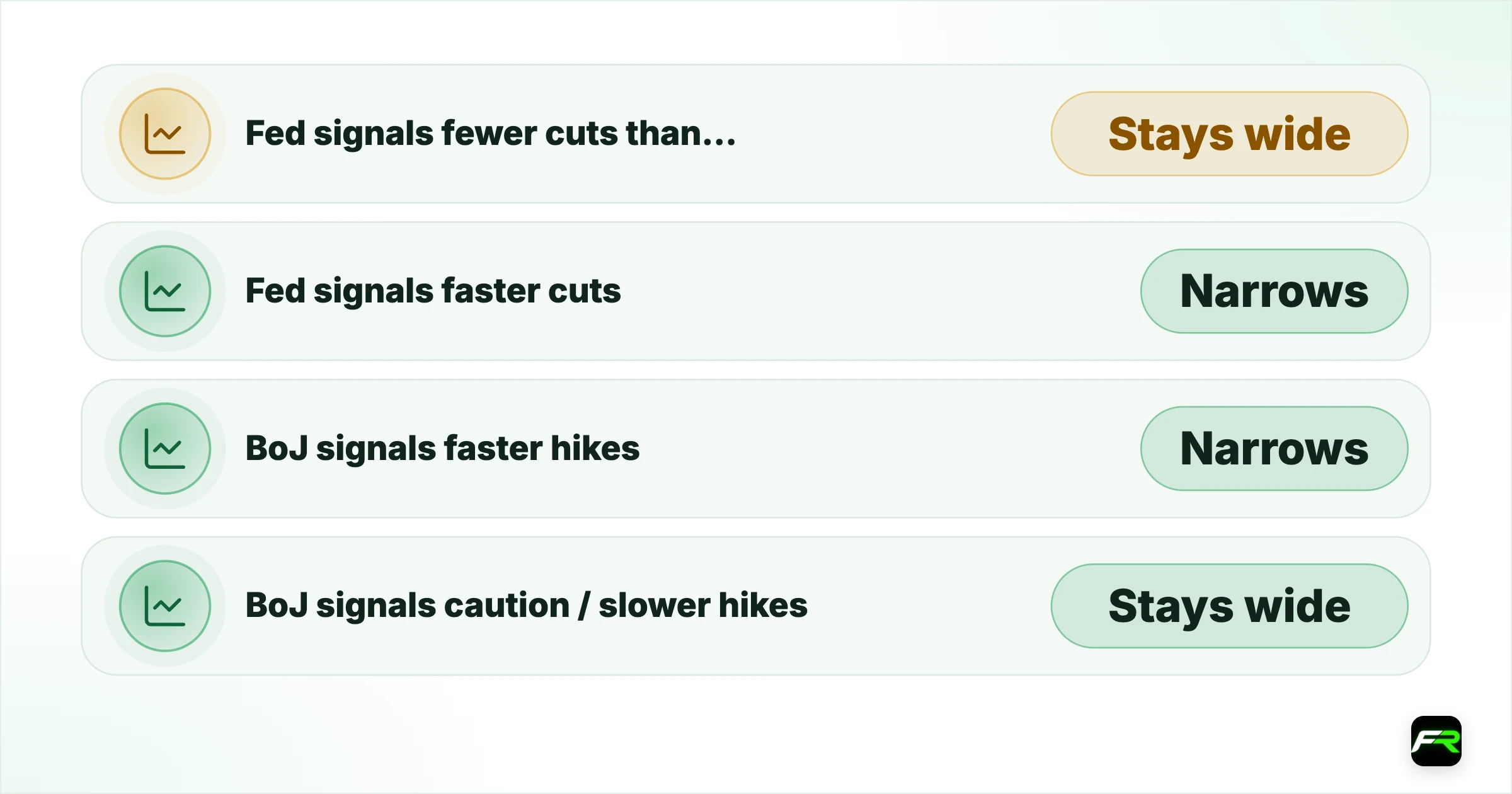
| Expectation shift | Rate gap | USD/JPY |
|---|---|---|
| Fed signals fewer cuts than expected | Stays wide | Rises |
| Fed signals faster cuts | Narrows | Falls |
| BoJ signals faster hikes | Narrows | Falls |
| BoJ signals caution / slower hikes | Stays wide | Rises |
Why the swings are so large
When both central banks are on a clear, agreed path, USD/JPY trends. When both are uncertain, every piece of US data and every BoJ comment shifts the expected gap, and USD/JPY moves with it. A hot US inflation print pushes back the expected Fed cuts and lifts USD/JPY 100 pips. A hawkish BoJ member speech does the opposite. Because the two forces can move in the same direction (both widening or both narrowing the gap) or offset each other, the pair can have a 400-pip week and end roughly flat.
What to watch
- US CPI and jobs data: the main inputs to the Fed's path.
- The Fed's dot plot (four times a year): the clearest statement of where policymakers expect rates. It is published under Projection Materials on the Fed's FOMC calendar page after the March, June, September and December meetings.
- BoJ meetings and the Outlook Report: how confident the BoJ is about continuing to hike. The report comes out quarterly, usually in January, April, July and October, alongside that month's policy meeting.
- Wage data in Japan: the BoJ has tied its willingness to tighten to sustained wage growth.
Aiko stopped trying to hold USD/JPY trades for weeks and switched to shorter swings of two to four days, because the pair kept reversing on her. She trades the reaction to US data and BoJ comments rather than a directional view on the pair, and keeps a stop that accounts for the pair's habit of doing 150 pips in a day. Her results improved once she accepted that USD/JPY was in a swinging phase, not a trending one, and traded it accordingly.
Two events sit on top of this backdrop and deserve their own playbook: the BoJ policy meetings themselves, covered in why USD/JPY moves every time the Bank of Japan meets, and the risk of Japan stepping into the market directly, covered in yen intervention levels to watch.
The bigger picture
The swinging resolves when one of the two paths becomes clear. If the Fed commits to a cutting cycle and the BoJ commits to steady hikes, the rate gap narrows convincingly and USD/JPY can trend lower for months. If US inflation stays sticky and the BoJ hesitates, the gap holds and USD/JPY stays elevated. Until then, treating the pair as range-bound and volatile, and sizing for its daily range, is the realistic approach. The carry trade guide covers what a decisive narrowing would do.
For the rules and brokers that apply where you live, see our guide to forex brokers in Japan.
Frequently asked
Why is USD/JPY so volatile?
Because it is a bet on the gap between US and Japanese interest rates, and right now both the Fed's cutting path and the BoJ's hiking path are uncertain. Every relevant data point re-prices the expected gap and moves the pair.
What single thing moves USD/JPY the most?
Over months, the expected path of US versus Japanese interest rates. On any given day, US inflation and jobs data, Fed communication, and BoJ commentary are the main triggers.
Should I trend-trade or swing-trade USD/JPY?
In a swinging phase like the current one, shorter swings that trade the reaction to data tend to work better than holding for a big directional move, because the pair keeps reversing. That can change if one central bank's path becomes clear.
What is the Fed dot plot?
A chart published four times a year, with the March, June, September and December FOMC meetings, showing where each Fed policymaker expects interest rates to be over the next few years. A shift in the median dot changes the expected US side of the rate gap, which is why it can move USD/JPY more than the rate decision itself.
How does Japanese wage data affect BoJ policy?
The BoJ has said it needs to see sustained wage growth feeding into stable inflation before it tightens confidently. Strong results from the spring wage negotiations ('shunto') and firm monthly wage figures make further hikes more likely, narrowing the US-Japan rate gap and pushing USD/JPY lower; weak wage data does the opposite.
How wide is a normal daily range for USD/JPY now?
Often 70 to 130 pips on an ordinary day, and 200-plus around US data or BoJ events. Size stops and positions for that, not for a calmer pair.
Related reading
The team behind this guide
Researched, checked and approved by five forex specialists
Every guide is written, fact-checked and edited before it goes live, and updated when the facts change. Spotted an error? Tell us.