IC Markets





































Demo Account to Live Account: When Asian Traders Should Make the Switch
A practical readiness checklist, not generic advice. The specific things a demo can and cannot teach, the numbers that say you are ready, and why the first live account should be small.
 WriterAbir KhanWriterWrites the guides · checks every figure against primary sources View profileAbout Abir →
 Market analysisTanbir Habib RiyadForex & Crypto AnalystForex and crypto analyst · technical and fundamental analysis View profileAbout Tanbir →
 Fact-checking & riskJannatul FerdaushFact-Checker & Risk AnalystFact-checks every figure · risk analysis · Applied Statistics, University of Dhaka View profileAbout Jannatul →
 Trading reviewJowel RanaCo-Founder & Forex TraderCo-founder · forex trader · reviews guides from a trader's view View profileAbout Jowel →
 Final approvalRanjan NiskrityFounder, Owner & Forex TraderFounder and owner · forex trader · signs off every guide View profileAbout Ranjan →
Key takeaways
- A demo teaches the platform and the strategy, not how you react to losing real money.
- Go live after 50 to 100 logged demo trades, a positive result, a written plan and 90%+ plan adherence.
- Start live small ($200 to $500, or a cent account) for two to three months, at the same 1% to 2% risk.
- A rough first few live months is common; drop the size, rebuild discipline, then scale up.
The demo-to-live transition is where a lot of traders come unstuck. Someone does well on a demo for months, switches to a $2,000 live account, and falls apart, because the demo never tested the one thing that matters most: how they behave when it is their own money. Here is how to know when you are actually ready, and how to make the switch so a wobble does not cost you much.
What a demo can teach
- The platform: placing orders, setting stops and targets, reading the charts, using the calendar.
- The mechanics of your strategy: what the setup looks like, where the stop goes, how to manage the trade.
- Position sizing arithmetic: turning a risk percentage and a stop distance into a lot size.
- Whether the strategy has any edge at all, over a large enough sample.
What a demo cannot teach
The demo cannot teach you how you respond to a real loss, a real drawdown, or a real winning streak, because part of your brain knows the money is not real. On a demo, a losing streak is a mild annoyance. On a live account, the same streak can trigger revenge trading, size creep, moving stops, or abandoning the strategy. Every trader who has done both will tell you the psychology is completely different, and the demo gives you no practice at it.
The readiness checklist
You are ready to go live when you can tick all of these:
- At least 50, ideally 100, demo trades logged with the setup, stop, target and outcome for each. Small samples tell you nothing.
- A positive result over that sample, not from one or two big winners but from a consistent edge (losses all near your planned risk, winners varying above it).
- A written trading plan that specifies exactly what you trade, when, how you size, and where stops and targets go.
- A plan-adherence rate above 90 per cent over your last 20 demo trades. You follow your own rules almost every time.
- You have sat through a demo losing streak of five-plus trades without changing the strategy or the size.
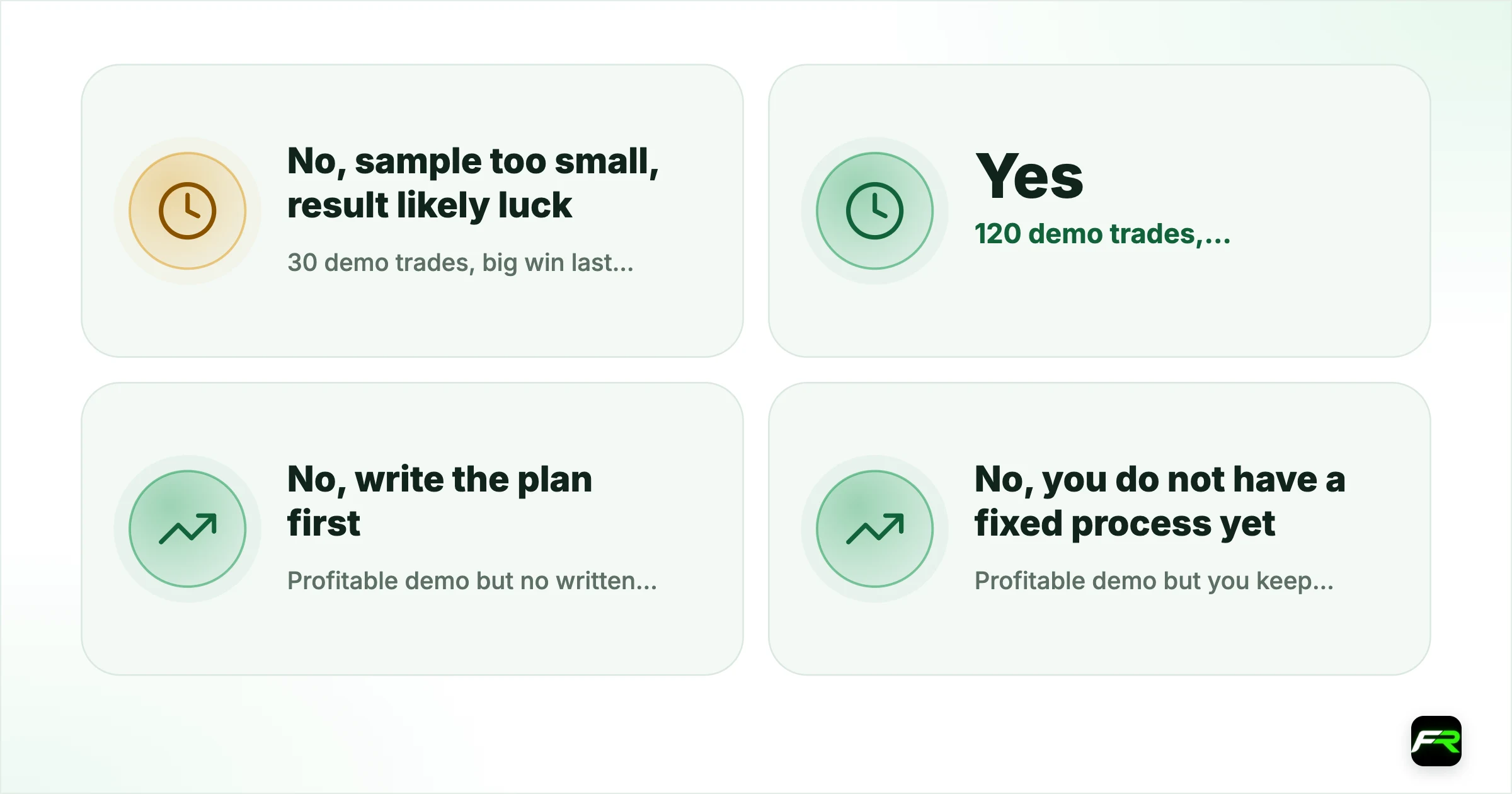
| Signal | Ready? |
|---|---|
| 30 demo trades, big win last week, up overall | No, sample too small, result likely luck |
| 120 demo trades, +18R, losses all near 1R, plan followed 95% of the time | Yes |
| Profitable demo but no written plan | No, write the plan first |
| Profitable demo but you keep tweaking the strategy | No, you do not have a fixed process yet |
Wei Jie demo-traded for four months, about 90 trades, and was up nicely. He went live with $3,000 and lost 12 per cent in the first three weeks, mostly to revenge trading after losses that would have been non-events on the demo. He dropped his live size to $500, rebuilt his composure over two months at low stakes, then scaled back up. He says the demo told him the strategy worked; it told him nothing about whether he could handle a real drawdown, and that was the part he actually needed to learn.
How to make the switch
Go live small. Not $3,000, but $200 to $500, or a cent account. The point of the first live account is not returns; it is to get practice at the emotions at a stake where a bad month costs you a meal out, not a month's savings. Trade it exactly as you traded the demo, with the same strategy and the same one-to-two-per-cent risk, for two to three months. If your plan-adherence stays above 90 per cent under real conditions and the results hold, then scale the account up gradually, through both gains and top-ups.
Do not fund your first live account with money you need. If losing all of it would affect your rent, your food, or your family, the account is too big, regardless of what the demo said.
If the live account falls apart
It is common. Going live and struggling for a month or two does not mean you cannot trade; it means the psychology is the last skill to develop and it can only be practised with real money on the line. Drop the size, not the strategy. Rebuild at low stakes. Most traders who make it went through exactly this. The first profitable quarter case study is a trader who took years, mostly on this step.
Frequently asked
How long should I demo trade before going live?
Long enough to log at least 50 to 100 trades, have a written plan, follow it more than 90 per cent of the time, and have sat through a losing streak without changing anything. That is usually two to four months, not weeks.
Why did I do well on demo and badly live?
Because the demo does not test how you respond to a real loss or drawdown. On a demo a losing streak is a mild annoyance; live, the same streak can trigger revenge trading and size creep. The psychology is the untested part.
How much should my first live account be?
Small: $200 to $500, or a cent account. The goal is practice at the emotions, not returns. A large first account means a normal early wobble costs you money you cannot afford to lose.
Should I go back to demo if my live account struggles?
Reduce your live size rather than going fully back to demo, because you need real money on the line to practise the psychology. Rebuild composure at low stakes, then scale back up.
What is plan-adherence and why does it matter more than profit?
It is the percentage of trades that followed your written plan, regardless of whether they won. A high adherence rate means you have a repeatable process; profit without adherence is usually luck that will reverse.
Related reading
The team behind this guide
Researched, checked and approved by five forex specialists
Every guide is written, fact-checked and edited before it goes live, and updated when the facts change. Spotted an error? Tell us.