IC Markets





































How 1:1000 Leverage Wiped Out a USD/CNH Account in a Day
A $1,200 account at 1:1000 on USD/CNH, wiped out by one move in the yuan fixing. How extreme leverage removes the room for a normal mistake.
 WriterAbir KhanWriterWrites the guides · checks every figure against primary sources View profileAbout Abir →
 Market analysisTanbir Habib RiyadForex & Crypto AnalystForex and crypto analyst · technical and fundamental analysis View profileAbout Tanbir →
 Fact-checking & riskJannatul FerdaushFact-Checker & Risk AnalystFact-checks every figure · risk analysis · Applied Statistics, University of Dhaka View profileAbout Jannatul →
 Trading reviewJowel RanaCo-Founder & Forex TraderCo-founder · forex trader · reviews guides from a trader's view View profileAbout Jowel →
 Final approvalRanjan NiskrityFounder, Owner & Forex TraderFounder and owner · forex trader · signs off every guide View profileAbout Ranjan →
Key takeaways
- A $1,200 account opened 6 lots of USD/CNH (about $8.40 a pip) because 1:1000 leverage made it possible with $600 of margin.
- A weaker-than-expected PBOC fixing moved USD/CNH about 180 pips against the position; margin call came at about 110.
- On a 30:1 regulated account the largest possible position was about 0.36 lots, and the same move would have cost about $90.
- The daily 01:15 GMT fixing is a scheduled event for USD/CNH; size for it or be flat.
About this case study: Li Feng, the trader in this example, is an illustrative composite, not a real person, and the account, trades and figures are not a real trading record. They are built from patterns that are common in retail trading so the maths can be shown step by step. Market events are simplified unless a date is given.
Leverage does not make you money and it does not lose you money. Position size does. But very high leverage removes the natural limit on how large a position a small account can open, and that is how it does its damage. This is a case study of a $1,200 account on a 1:1000 offshore entity that was gone within 24 hours, not because of a crash, but because the trader used the leverage the broker offered.
The pair was USD/CNH, the offshore version of the Chinese yuan. It is less commonly traded by retail accounts than USD/JPY, moves in tighter ranges most of the time, and is heavily influenced by the daily reference rate the People's Bank of China sets each morning. That last point is what caught the trader out.
What 1:1000 actually allowed
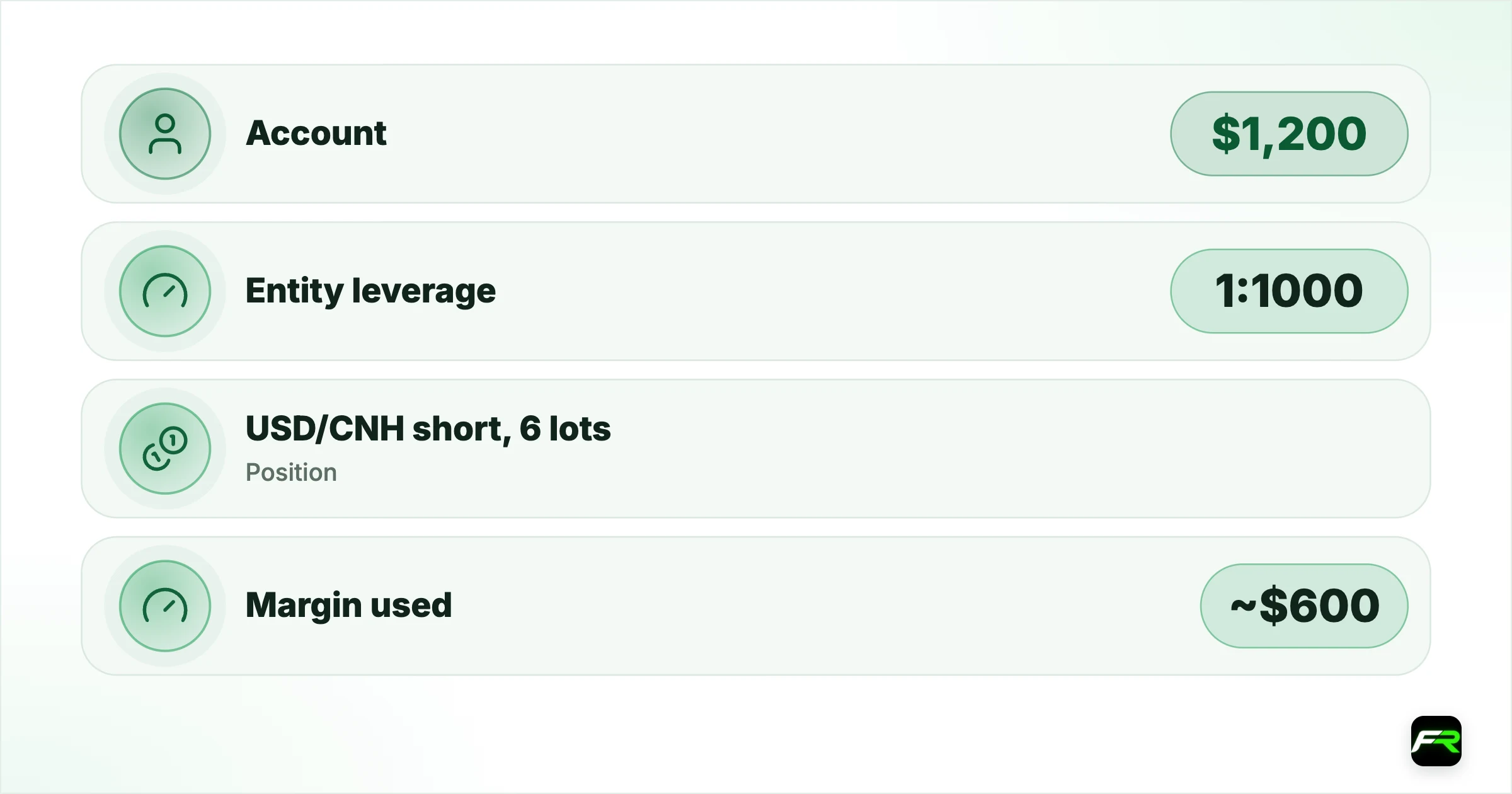
On a $1,200 account with 1:1000 leverage, the notional position the trader could open was up to about $1,200,000. They opened 6 standard lots of USD/CNH, a $600,000 position, using about $600 of margin at 1:1000. That felt measured to them, since it left half the balance as free margin. But USD/CNH is quoted to four decimals at around 7.1 yuan, so one pip on a standard lot is 10 yuan, about $1.40, and six lots is roughly $8.40 per pip. On a $1,200 account a 70-pip move is a loss of about $590, half the account.
USD/CNH regularly moves 100 to 200 pips around the daily fixing and on trade or policy headlines. The position had room to be wrong by about 110 pips before the broker's stop-out closed it. On a pair that can move that far in an hour, that is no room at all. Had the trader been on a 1:30 regulated entity, the largest position the account could have opened would have been about 0.36 lots, and the same 180-pip move would have cost around $90, unpleasant but entirely survivable.
| Account | $1,200 |
|---|---|
| Entity leverage | 1:1000 |
| Position | USD/CNH short, 6 lots (~$8.40/pip) |
| Margin used | ~$600 |
| Move to stop-out | ~110 pips |
| Actual move after the PBOC fixing | ~180 pips against the position |
| Outcome | Margin call, account effectively wiped |
| Max position on a 1:30 entity | ~0.36 lots, loss on same move ~$90 |
The PBOC fixing
Every morning around 09:15 Beijing time, the People's Bank of China publishes a reference rate for the yuan against the dollar. The onshore yuan is allowed to trade in a band around it, and the offshore yuan takes its cue from the same signal. When the fixing comes in stronger or weaker than the market expected, USD/CNH can jump immediately. The trader had shorted USD/CNH expecting the yuan to strengthen. The fixing landed weaker than expected, signalling official tolerance for a softer yuan, and USD/CNH rallied about 180 pips over the session. The position was short into that. The margin call came well before the move was done.
The yuan fixing guide explains the mechanism in full. The point for this case study is that it is a scheduled, daily event that moves the pair, and the trader either did not know about it or did not account for it.
Li Feng had practised on a demo for two months and done well. He chose the broker specifically for the 1:1000 leverage because a video said it let a small account grow faster. He opened six lots of USD/CNH because the margin it used was only half his balance, which felt conservative. He did not know the PBOC set a rate every morning. When the account was margin-called he assumed the broker had done something. He moved to a broker with 1:30 leverage, not because he had to, but because he decided the temptation to over-size was the real problem and removing the option was the fix.
Leverage as a signal, not a tool
A regulated broker under the FCA, ASIC or CySEC caps retail forex leverage at 1:30 on major currency pairs. The FCA's PS19/18 policy statement set that limit after its own data, and a matching EU-wide study by ESMA, showed that higher leverage correlated with faster and larger retail losses. An entity offering 1:1000 is doing so from a light-touch jurisdiction with fewer conduct rules. So when a broker leads its marketing with the leverage number, it is telling you which kind of entity you are dealing with, and it is aiming at traders who do not yet understand why the cap exists. The leverage risk guide shows the dollar maths.
None of the leverage on offer is needed for correctly sized trading. If you risk one per cent of a $1,200 account on a trade with a 50-pip stop, the position is about 0.02 lots on a dollar-quoted major like EUR/USD, or about 0.17 lots on USD/CNH, whose pips are worth less, and 1:30 covers either with room to spare. The moment a leverage cap stops you opening a trade, the trade is too big for the account.
If your plan requires more than 1:30 leverage to place the position you want, the problem is the position size, not the leverage. Cutting the size fixes it. Finding a broker with a higher cap just delays the account failure.
Why the account stopped at zero, not negative
A position this oversized on a fast-moving pair raises an obvious question: could the loss have gone past the account balance and left the trader owing the broker money? On most brokers serving retail clients in Asia, no. Negative balance protection is a standard feature on regulated entities and on most reputable offshore ones too: if a price gap or a fast market causes losses to exceed the account equity, the broker absorbs the shortfall rather than billing the client for it. The margin call and automatic close-out exist specifically to trigger before that happens, closing the position while there is still equity left, or as close to it as the market's speed allows.
It is not a reason to relax about sizing. Negative balance protection stops the loss at zero; it does nothing to stop the loss reaching zero in the first place, and a wiped account is still a wiped account whether the final number reads $0 or -$400. Confirm the feature is actually offered before trading with any offshore entity, since a small number of unregulated brokers do not guarantee it, and a large enough overnight gap can outrun even a broker that does. That gap risk, the chance that price jumps past your stop instead of trading through it, is a separate danger from leverage and worth understanding on its own.
The takeaway
The trader did not lose because USD/CNH moved 180 pips. Pairs move that far routinely. They lost because a $1,200 account had a $600,000 position open into a scheduled central-bank signal, which was only possible because the entity allowed it. One per cent risk with a 50-pip stop would have capped the position at about 0.17 lots of USD/CNH and turned a wipeout into a $12 loss. High leverage did not cause that. It just removed the barrier that would otherwise have stopped it. Every account has a risk of ruin, the probability that a long enough losing streak at your current sizing wipes the account out, and oversizing a single trade this much is the fastest way to make that probability close to certain rather than a distant tail case.
Sources and where to check it yourself
- CFETS RMB central parity rate: the daily fixing that moved USD/CNH in this case
- FCA policy statement PS19/18: why the UK capped retail leverage at 30:1 on major pairs
Frequently asked
Is 1:1000 leverage illegal?
Not everywhere. It is not permitted for retail clients of FCA, ASIC, CySEC or most other tier-one regulators, which cap retail forex at 1:30. It is available from offshore entities in jurisdictions like Seychelles, Vanuatu and Saint Vincent that impose lighter rules.
Can I set a lower leverage on a 1:1000 account?
Most brokers let you request a lower leverage in the account settings, and doing so is a reasonable way to enforce discipline on yourself. But the cleaner fix is to size positions by risk, which makes the account leverage almost irrelevant.
Why is USD/CNH riskier than USD/JPY for a beginner?
It is less liquid at retail brokers so spreads are wider, and it is driven by the daily PBOC fixing and by trade and policy headlines that are hard to anticipate. USD/JPY has tighter spreads and clearer, more widely followed drivers.
What is the difference between CNH and CNY?
CNY is the onshore yuan, traded within mainland China under tight controls. CNH is the offshore yuan, traded in Hong Kong and elsewhere with fewer restrictions. Retail brokers offer USD/CNH. The two track each other closely but can diverge under stress.
How small should a $1,200 account trade?
One per cent is $12. On a 50-pip stop that is roughly 0.02 lots on a major pair. Positions that size will feel tiny. That is the point: they let a small account survive a losing streak long enough to learn.
Related reading
The team behind this guide
Researched, checked and approved by five forex specialists
Every guide is written, fact-checked and edited before it goes live, and updated when the facts change. Spotted an error? Tell us.