IC Markets





































A $3,000 AUD/USD Trade That Should Have Lost, and Didn't
A trade that broke three of the trader's own rules and still made money. Here is why a lucky win is more dangerous than a disciplined loss, and how to tell the two apart in your own trading.
 WriterAbir KhanWriterWrites the guides · checks every figure against primary sources View profileAbout Abir →
 Market analysisTanbir Habib RiyadForex & Crypto AnalystForex and crypto analyst · technical and fundamental analysis View profileAbout Tanbir →
 Fact-checking & riskJannatul FerdaushFact-Checker & Risk AnalystFact-checks every figure · risk analysis · Applied Statistics, University of Dhaka View profileAbout Jannatul →
 Trading reviewJowel RanaCo-Founder & Forex TraderCo-founder · forex trader · reviews guides from a trader's view View profileAbout Jowel →
 Final approvalRanjan NiskrityFounder, Owner & Forex TraderFounder and owner · forex trader · signs off every guide View profileAbout Ranjan →
Key takeaways
- A $3,000 account made $600 on 1.5 lots of AUD/USD with no stop, held into an RBA decision.
- The correct size at 1% risk with a 40-pip stop was about 0.07 lots, about 20 times smaller.
- A dovish RBA could have cost $900 to $1,500, a third to a half of the account.
- Judge a trade by whether it followed the plan, not by whether it won.
About this case study: Quang, the trader in this example, is an illustrative composite, not a real person, and the account, trades and figures are not a real trading record. They are built from patterns that are common in retail trading so the maths can be shown step by step. Market events are simplified unless a date is given.
A losing trade taken correctly teaches you almost nothing bad. A winning trade taken badly can set your account back for months, because it rewards the exact behaviour that will eventually blow you up. This is a case study of the second kind: a $3,000 AUD/USD position that broke the trader's rules on size, stop placement and event risk, and made $600 anyway. The trader nearly learned the wrong lesson from it.
The trader was in Ho Chi Minh City, running a $3,000 account with a normal rule of one per cent risk and a stop on every trade. On this occasion they saw AUD/USD sitting just above a level they thought would break, felt strongly about it, and abandoned the rules.
The trade, and the rules it broke
AUD/USD was near 0.6580. The trader went long with a position of 1.5 lots, worth about $15 per pip, on a $3,000 account. That is a notional exposure about 33 times the account balance. They set no stop, planning to watch it. A Reserve Bank of Australia decision was due within 18 hours. Three rules broken: size far too large, no stop, and an open position into a central-bank meeting.
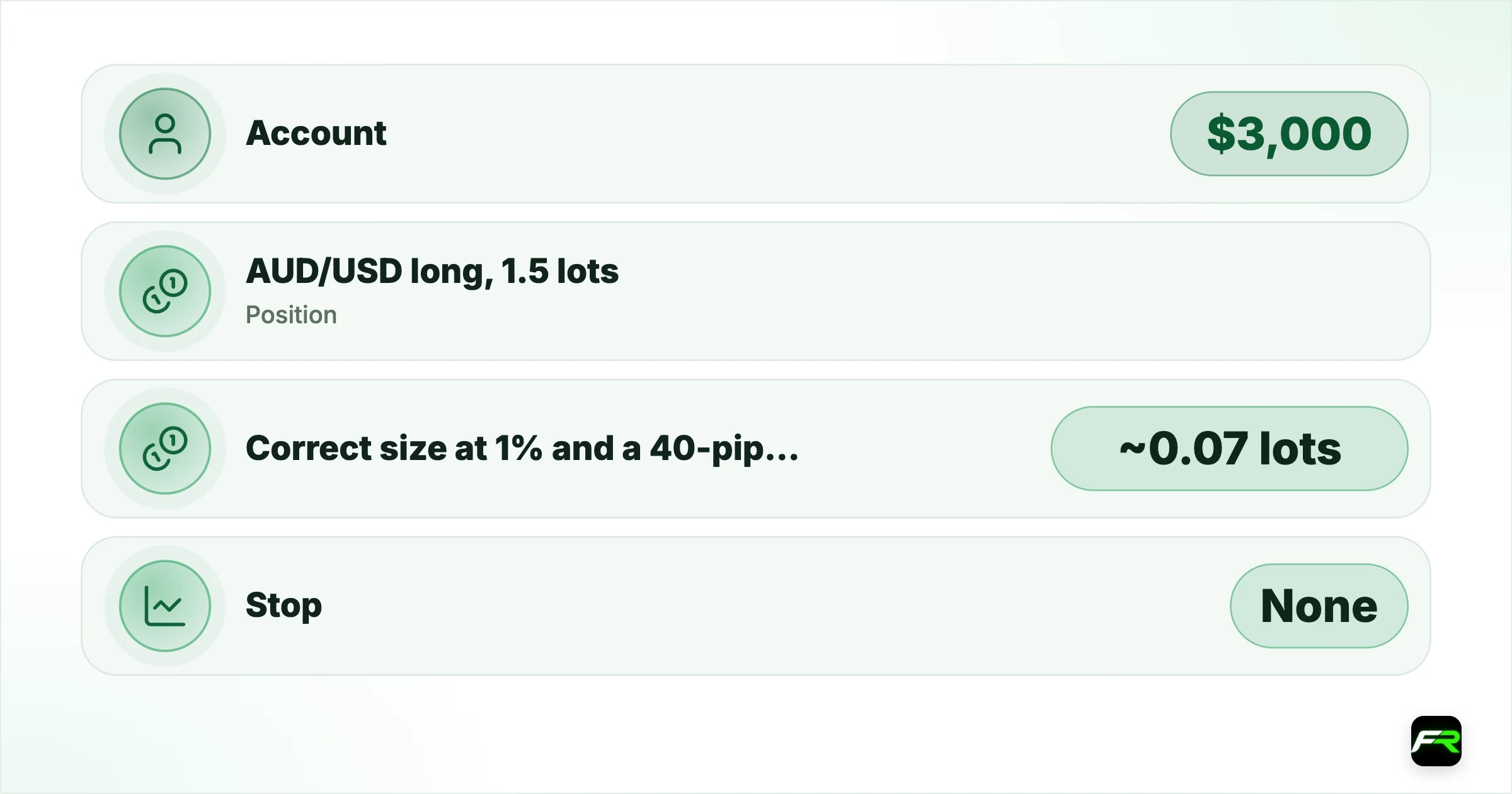
| Account | $3,000 |
|---|---|
| Position | AUD/USD long, 1.5 lots (~$15/pip) |
| Correct size at 1% and a 40-pip stop | ~0.07 lots |
| Stop | None |
| Event within 18 hours | RBA rate decision |
| What happened | RBA held, AUD rallied ~55 pips, trader closed 40 pips in for +$600 |
| Loss if the RBA had cut rates | Plausibly -$1,500 or worse on the same size |
Why it won
The Reserve Bank of Australia held rates and the statement was read as mildly hawkish. AUD/USD rallied about 55 pips over the next few hours. The trader closed the position near 0.6620, 40 pips in, for a profit of about $600, a 20 per cent gain on the account in a single trade. On the chart it looks like a great call. The level held, the direction was right, the timing was good.
It won because a coin landed heads. The trader had no information about what the RBA would do that the market did not already have. If the RBA had cut, or the statement had been dovish, AUD/USD could easily have dropped 60 to 100 pips, and at $15 per pip with no stop that is a $900 to $1,500 loss, a third to a half of the account, in an evening. The trade had close to an even chance of each outcome and a payoff that was far worse on the downside than it was good on the upside.
For Quang, the win felt like confirmation that his read on the market was good and that his usual position sizes were too timid. Over the next three weeks he traded larger, took two more positions into news events, and gave back the $600 plus another $400. He now describes that AUD/USD trade as the most expensive winning trade of his life, because it cost him $1,000 in the trades it encouraged. He went back to 0.07-lot positions and a stop on everything.
How to tell a skilled win from a lucky one
Ask three questions about any winning trade. Was the position sized so that being wrong would have cost one to two per cent? Was there a stop that defined the loss before entry? Did you have a reason to be in the trade that did not depend on guessing the outcome of a scheduled event? If the answer to all three is yes, it was a skilled trade whether it won or lost. If any answer is no, it was a gamble that happened to pay, and you should feel the same discomfort about it as you would about a loss.
- Skilled win: planned entry, defined stop, 1 per cent risk, no reliance on an event coin-flip. Repeat it happily.
- Lucky win: oversized, no stop, or held through an event you could not predict. The money is real, the process is broken, and copying it will eventually cost you more than you made.
The danger of a lucky win is not the trade itself. It is that your brain files it as evidence that your rules are too cautious. Treat an undisciplined winner as a near miss, not a success.
What the trader should have done
The disciplined version of this trade: long AUD/USD from 0.6580, stop at 0.6540, target 0.6680, position size about 0.07 lots to risk roughly $30 on the account. Close the trade before the RBA decision, or hold a fraction of it through with the understanding that it can gap. That version makes about $30 on the same 40-pip exit instead of $600, and it makes it without ever putting the account at risk. Over a hundred trades, the disciplined version compounds. The oversized version blows up on trade number fifteen.
Frequently asked
If the trade made money, what is the problem?
The process had a large chance of a big loss and only made money because the event went the trader's way. Repeated, that process loses. A single outcome does not tell you whether a decision was good; the odds and the payoff structure do.
How do I stop myself abandoning my rules when I feel strongly?
Pre-commit. Write your maximum position size and your no-trading windows on your monitor. Some traders set a hard leverage cap in the platform so an oversized order is physically rejected. The feeling of conviction is exactly when the rules matter most.
Is it ever fine to hold through an RBA or Fed decision?
Experienced traders sometimes do at small size with a stop and the expectation of a gap. For anyone still building consistency, flat before the decision is the right choice every time.
How much should a $3,000 account risk per trade?
One per cent is $30, two per cent is $60. On a 40-pip stop that is roughly 0.07 to 0.15 lots on AUD/USD, not 1.5 lots.
What moves AUD/USD around an RBA meeting?
The rate decision itself, the tone of the accompanying statement, and any change to the forward guidance. AUD is also sensitive to Chinese data and commodity prices, so a surprise there can move it independently of the RBA.
Related reading
The team behind this guide
Researched, checked and approved by five forex specialists
Every guide is written, fact-checked and edited before it goes live, and updated when the facts change. Spotted an error? Tell us.