IC Markets





































China's Yuan Fixing Explained: What the Daily Rate Really Means
The PBOC publishes a yuan reference rate every morning. What the fixing is, how the market reads it, and why USD/CNH moves on it.
 WriterAbir KhanWriterWrites the guides · checks every figure against primary sources View profileAbout Abir →
 Market analysisTanbir Habib RiyadForex & Crypto AnalystForex and crypto analyst · technical and fundamental analysis View profileAbout Tanbir →
 Fact-checking & riskJannatul FerdaushFact-Checker & Risk AnalystFact-checks every figure · risk analysis · Applied Statistics, University of Dhaka View profileAbout Jannatul →
 Trading reviewJowel RanaCo-Founder & Forex TraderCo-founder · forex trader · reviews guides from a trader's view View profileAbout Jowel →
 Final approvalRanjan NiskrityFounder, Owner & Forex TraderFounder and owner · forex trader · signs off every guide View profileAbout Ranjan →
Key takeaways
- The PBOC publishes the yuan's central reference rate around 09:15 Beijing time (01:15 GMT); onshore CNY can trade 2% either side.
- The signal is the gap between the fixing and model estimates: stronger than expected means the PBOC is defending the yuan.
- A surprise fixing can move USD/CNH 100 to 250 pips in the following hour.
- Treat the fixing like a central-bank event: wide stops, and no large position held into it.
The daily yuan fixing is the closest thing forex has to a scheduled, government-set price. Every morning around 09:15 Beijing time, the People's Bank of China (PBOC) publishes a central reference rate for the onshore yuan (CNY) against the US dollar, released through the China Foreign Exchange Trade System (CFETS), which posts the daily RMB central parity rate along with an explanation of how it is calculated. The onshore currency is then allowed to trade within 2 per cent on either side of it for the day. The offshore yuan (CNH), which retail brokers offer, is not formally banded but takes its signal from the same number.
How the fixing is set
The PBOC calculates the fixing using a formula that inputs the previous day's close, the moves in a basket of other currencies overnight, and a 'counter-cyclical factor' that the PBOC can adjust at its discretion. CFETS describes the published part of that process, quotes collected from market makers before the open with the highest and lowest removed, on its central parity page; the counter-cyclical factor itself is not published. That last element is the important one for traders: it means the fixing is not a mechanical output. When the PBOC wants to signal that it will not tolerate rapid yuan weakness, it sets the fixing stronger than the formula alone would suggest. When it is comfortable with a softer yuan, it lets a weaker fixing through.
How the market reads it
Analysts run their own models of what the fixing 'should' be, and they compare the actual print to that estimate. The gap is the signal:
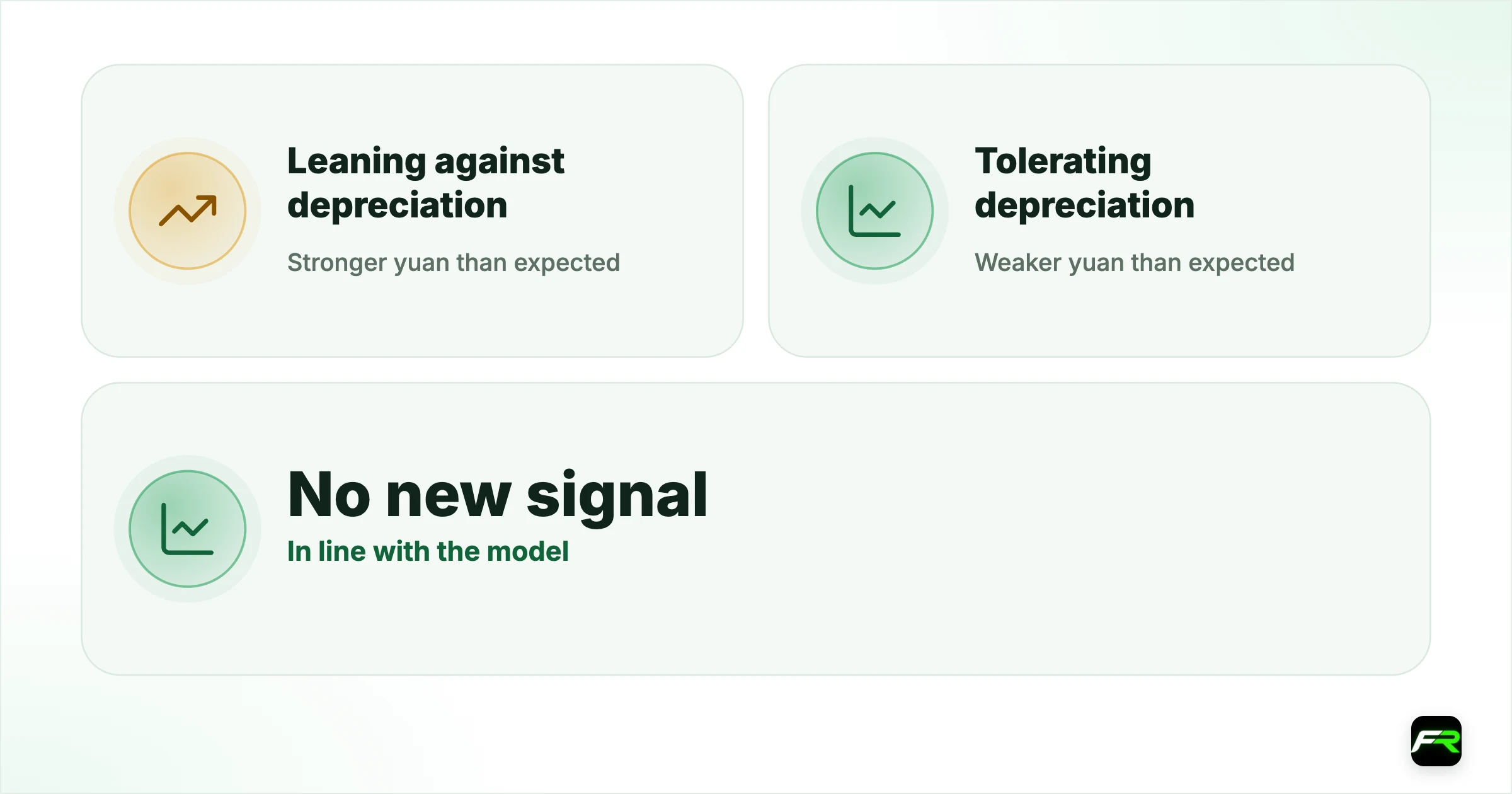
| Fixing vs the model estimate | PBOC signal | Typical USD/CNH reaction |
|---|---|---|
| Stronger yuan than expected | Leaning against depreciation | USD/CNH falls |
| Weaker yuan than expected | Tolerating depreciation | USD/CNH rises |
| In line with the model | No new signal | Small reaction |
Why it moves USD/CNH
A stronger-than-expected fixing tells the market that the PBOC does not want USD/CNH to keep rising, and speculators who are long USD/CNH (betting on a weaker yuan) reduce positions, pushing the pair down. A weaker-than-expected fixing gives the go-ahead for more yuan weakness. Because the offshore yuan is more freely traded, USD/CNH often moves more than the onshore rate on a surprising fixing. Moves of 100 to 250 pips in the hour after the fixing are not unusual on a surprise.
Li Feng shorted the yuan (bought USD/CNH) on weak Chinese data, holding overnight. The next morning the PBOC set the fixing notably stronger than models expected, signalling it would defend the currency, and USD/CNH dropped about 180 pips against his position within the session. He now treats the fixing as the primary event for the pair and never holds a USD/CNH position into it without a stop sized for that kind of move.
Trading around the fixing
- The fixing is at 09:15 Beijing time, which is 01:15 GMT. A position open into it is exposed to a scheduled event.
- Do not assume the fixing will follow the data. The PBOC frequently leans against the obvious direction.
- The reaction is usually strongest in the first 30 to 60 minutes as the market digests the signal.
- Wider stops are essential on USD/CNH generally, and especially around the fixing.
There is a difference between the fixing (the reference rate) and intervention (the PBOC actually buying or selling). A firm fixing is a signal; if the market ignores it, the PBOC can and does step in directly through state banks, which produces sharper moves.
For the rules and brokers that apply where you live, see our guide to forex rules for mainland China.
Frequently asked
What time is the yuan fixing?
Around 09:15 Beijing time each business day, which is 01:15 GMT. The onshore market then trades within a 2% band around it for the day.
Is the fixing a fixed price for the whole day?
No. It is the centre of a trading band for the onshore yuan (CNY), which can move up to 2% either side of it. The offshore yuan (CNH) trades freely but takes its cue from the same signal.
Why does the PBOC set the fixing instead of letting the market decide?
China manages its currency rather than free-floating it. The fixing is the main tool for guiding the yuan's path, allowing gradual moves in line with policy while limiting speculation and volatility.
What is the counter-cyclical factor?
A discretionary adjustment the PBOC can apply to the fixing formula to lean against moves it considers excessive. When it is active and set to strengthen the yuan, it signals the PBOC is defending the currency.
How big can the move be after a surprise fixing?
USD/CNH can move 100 to 250 pips in the hour after an unexpected fixing, and more if the PBOC follows up with direct intervention. It is a scheduled event that should be treated like a central-bank meeting.
Related reading
The team behind this guide
Researched, checked and approved by five forex specialists
Every guide is written, fact-checked and edited before it goes live, and updated when the facts change. Spotted an error? Tell us.