IC Markets




































Trading Around Lunar New Year: What Happens to CNH Liquidity
Around Chinese New Year, offshore yuan liquidity drops sharply: spreads widen and moves get exaggerated. How to trade it.
 WriterAbir KhanWriterWrites the guides · checks every figure against primary sources View profileAbout Abir →
 Market analysisTanbir Habib RiyadForex & Crypto AnalystForex and crypto analyst · technical and fundamental analysis View profileAbout Tanbir →
 Fact-checking & riskJannatul FerdaushFact-Checker & Risk AnalystFact-checks every figure · risk analysis · Applied Statistics, University of Dhaka View profileAbout Jannatul →
 Trading reviewJowel RanaCo-Founder & Forex TraderCo-founder · forex trader · reviews guides from a trader's view View profileAbout Jowel →
 Final approvalRanjan NiskrityFounder, Owner & Forex TraderFounder and owner · forex trader · signs off every guide View profileAbout Ranjan →
Key takeaways
- Mainland China closes for about a week over Lunar New Year, and Hong Kong closes for the first two to three days.
- Onshore CNY trading and the PBOC's daily fixing stop, so offshore CNH loses its anchor.
- USD/CNH spreads often widen to two or three times normal, and small flows cause outsized moves.
- The first fixing after the holiday can jump as a week of news gets priced in; many traders flatten until it prints.
Chinese New Year is the largest holiday in the region, and mainland Chinese markets close for roughly a week. During that window, onshore yuan (CNY) trading effectively stops, and the offshore yuan (CNH), which retail brokers offer, loses a major source of its liquidity and its pricing anchor. The result is a thinner, more volatile USD/CNH market for about a week, plus reduced activity in other regional pairs and gold.
What closes and when
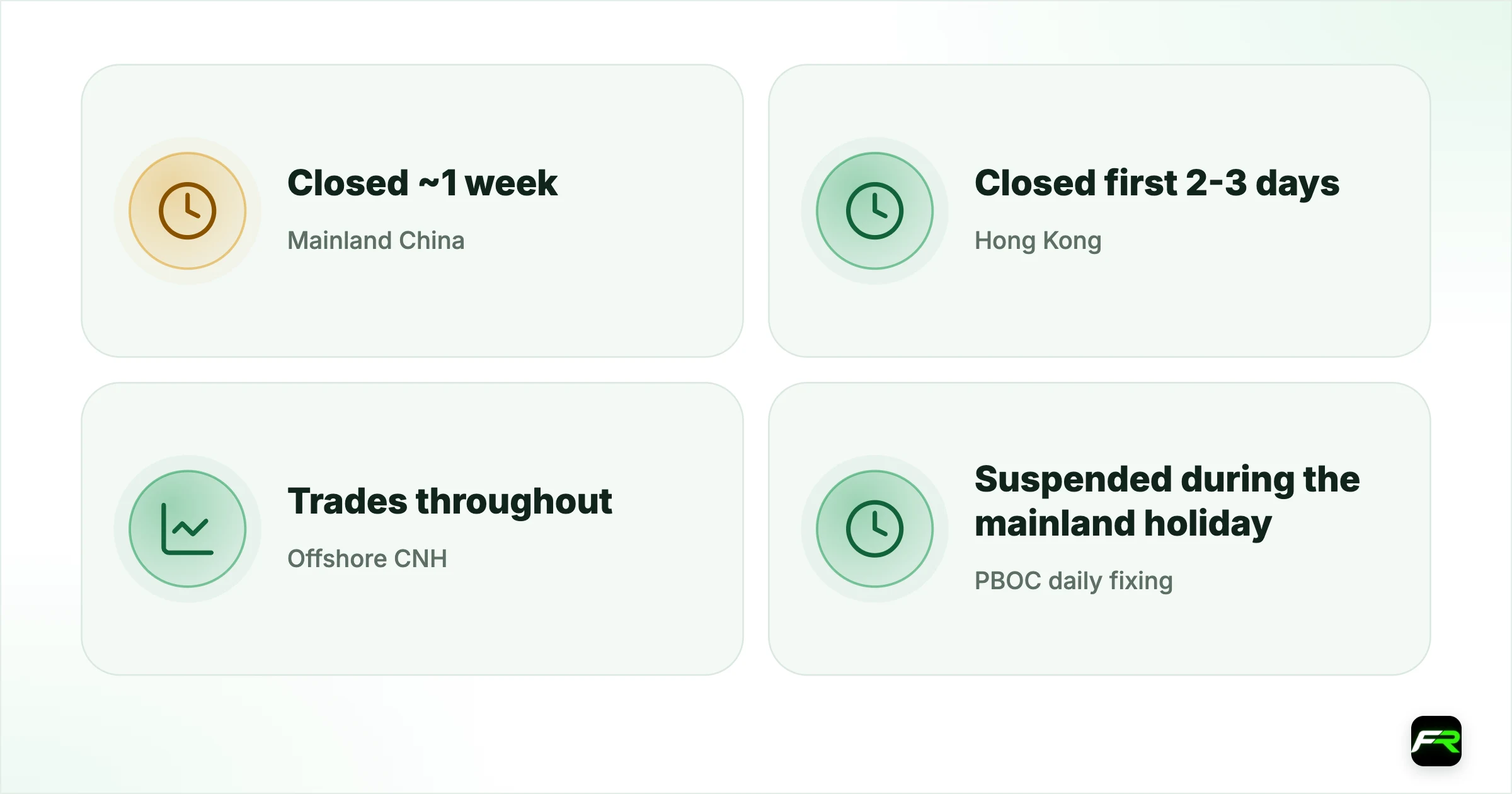
Mainland China’s markets and banks close for the CNY holiday, typically a full week (the exact dates shift each year with the lunar calendar, usually late January or February). Hong Kong also closes for the first two to three days. Onshore yuan trading is suspended for the mainland holiday. The offshore CNH market keeps trading, but with mainland participants absent and Hong Kong partly closed, the depth is a fraction of normal.
| Market | CNY holiday status | Effect on USD/CNH |
|---|---|---|
| Mainland China (CNY, onshore) | Closed ~1 week | No onshore anchor for the offshore rate |
| Hong Kong | Closed first 2-3 days | Further reduced offshore liquidity early |
| Offshore CNH | Trades throughout | Thin, spreads wide, moves exaggerated |
| PBOC daily fixing | Suspended during the mainland holiday | No daily signal; resumes with a potential jump |
How the market behaves
Three things happen. First, the USD/CNH spread widens, often to two or three times its normal level, because far fewer banks are quoting. Second, moves get exaggerated: with the onshore anchor gone and shallow order books, a modest flow can push USD/CNH further than it would normally, and there is no fixing the next morning to correct it. Third, when the mainland reopens and the PBOC sets its first fixing after the break, there can be a sharp adjustment as the offshore and onshore rates re-converge and the accumulated week of news gets priced in one go.
Zhang used to keep his normal USD/CNH position through the CNY week and was caught out twice: once by a 200-pip drift on thin liquidity that hit his stop at a bad fill, once by the reopening jump when the first post-holiday fixing came in firm and the pair gapped. He now flattens USD/CNH before the holiday and does not re-enter until the mainland has reopened and the first fixing has printed. He treats the whole week as a no-trade zone for that pair.
The knock-on effects
It is not only USD/CNH. Regional activity generally drops during the CNY week: AUD pairs are quieter because a lot of Australia-China trade flow pauses, and gold can see reduced physical demand from China even as the offshore paper market keeps trading. Overall it is a lower-conviction week for USD/CNH, AUD pairs and gold specifically, and volumes across the region typically ease alongside them.
How swap and rollover costs change during CNY week
The overnight swap on a USD/CNH position is priced off the interest-rate gap between the dollar and the offshore yuan, and that gap gets noisy once the onshore market shuts and the PBOC stops publishing its daily guidance. A position held through the break can see its swap widen or shift unpredictably from one night to the next, on top of the wider spread already covered above. If you are holding anything in USD/CNH over the week, check the swap your broker is charging rather than assuming it behaves as it does in a normal week.
Where to check the exact CNY dates each year
The mainland and Hong Kong closures do not always line up, so check both separately rather than assuming one calendar covers it. The most directly useful source for a trader is the CFETS trading calendar, published by China's official interbank market operator under the PBOC, which lists the exact days onshore trading is closed. Hong Kong publishes its own holiday schedule separately through the Hong Kong Stock Exchange.
How to handle the week
- Flatten USD/CNH and any China-sensitive position before the mainland holiday begins.
- If you must hold something, size it half of normal and use a wider stop for the low-liquidity slippage.
- Do not re-enter USD/CNH until the mainland has reopened and the first PBOC fixing after the break has printed.
- Expect wider spreads across regional pairs and lower reliability in technical setups for the week.
- Watch the reopening: the first day back can produce an outsized move as a week of news gets absorbed.
The exact CNY dates change every year with the lunar calendar. Check the specific dates ahead of time and mark the mainland closure and the Hong Kong closure separately, since they differ.
Frequently asked
Does forex close for Chinese New Year?
The global forex market stays open, but mainland Chinese markets and banks close for about a week, onshore yuan trading is suspended, and offshore CNH liquidity drops sharply. Other regional activity also slows.
What happens to the PBOC fixing during CNY?
It is suspended for the mainland holiday. When the mainland reopens, the first fixing after the break can produce a sharp move as the offshore and onshore rates re-converge and a week of news is priced in.
Should I trade USD/CNH during Chinese New Year?
Most traders avoid it. Spreads widen well beyond their normal level, moves get exaggerated in the shallow market, and there is no daily fixing to anchor the rate. Flatten before the holiday and wait for the mainland to reopen.
How long is the Chinese New Year holiday?
Mainland China typically closes for a full week (dates shift with the lunar calendar). Hong Kong closes for the first two to three days. Check the specific dates each year.
Do swap and rollover fees change during Chinese New Year week?
Yes. The swap on a USD/CNH position is priced off the dollar-yuan rate gap, and that gap becomes less predictable once the mainland market closes and the PBOC stops publishing its daily fixing. Expect the swap on any CNH position held through the week to move more than usual, not just the spread.
Does CNY affect gold or AUD?
Gold can see reduced Chinese physical demand during the week, and AUD pairs are quieter because Australia-China trade flow pauses. Both effects are modest compared with the USD/CNH liquidity drop.
Related reading
The team behind this guide
Researched, checked and approved by five forex specialists
Every guide is written, fact-checked and edited before it goes live, and updated when the facts change. Spotted an error? Tell us.