IC Markets




































What Algorithmic Trading Growth Means for Retail Traders in Asia
Algorithms now drive a rising share of forex volume. What changed for retail traders, and what still gives a manual trader an edge.
 WriterAbir KhanWriterWrites the guides · checks every figure against primary sources View profileAbout Abir →
 Market analysisTanbir Habib RiyadForex & Crypto AnalystForex and crypto analyst · technical and fundamental analysis View profileAbout Tanbir →
 Fact-checking & riskJannatul FerdaushFact-Checker & Risk AnalystFact-checks every figure · risk analysis · Applied Statistics, University of Dhaka View profileAbout Jannatul →
 Trading reviewJowel RanaCo-Founder & Forex TraderCo-founder · forex trader · reviews guides from a trader's view View profileAbout Jowel →
 Final approvalRanjan NiskrityFounder, Owner & Forex TraderFounder and owner · forex trader · signs off every guide View profileAbout Ranjan →
Key takeaways
- About 59% of global FX trading now runs through electronic execution (BIS 2025), much of it driven by algorithms.
- Algorithms brought tighter spreads and cleaner fills in liquid hours, but instant news reactions and thinner books around events.
- Widely taught setups get crowded, and clusters of retail stops beyond obvious levels do get hunted.
- A manual trader's edge lies where speed doesn't matter: patience, selectivity, macro context and discipline.
The forex market a manual retail trader learns on today is different from the one that existed 15 years ago. An estimated 59% of global FX trading now goes through electronic execution, per the 2025 BIS Triennial Survey, see the turnover guide for what the rest of that figure is made of. A large and growing share of that volume is generated by algorithms: bank pricing engines, high-frequency trading (HFT) firms acting as market makers, and systematic funds. For a retail trader in Asia, this has real consequences, some helpful and some not, and it is worth being clear-eyed about both.
What got better
- Tighter spreads. Algorithmic market makers compete to quote the best price, and the spread on the majors during liquid hours is a fraction of what it was a decade ago.
- Faster, cleaner fills in liquid conditions. Execution is near-instant and slippage in the deep majors during London and New York is minimal.
- More consistent pricing. The wild spread blowouts on ordinary days are rarer, because there is always an algo willing to quote.
What got harder
- News reactions are instant. Algorithms parse a central-bank statement in milliseconds. The idea that a fast human can read the release and trade the move is gone; by the time you have read it, the first 50 pips have happened. That speed advantage, not any single trick, is the edge HFT firms hold over a manual trader in the first seconds of a release.
- Some technical edges eroded. Simple, widely-known patterns get front-run or faded by systematic strategies. If a setup is in every beginner course, assume it is crowded.
- Stop hunting is real at the micro level. Clusters of retail stops just beyond obvious levels are visible to sophisticated players, and price sometimes spikes to trigger them before reversing.
- Liquidity around events is thinner, not deeper. Algo market makers pull quotes around scheduled news to avoid being run over, so the book empties exactly when volatility peaks.
What still works for a manual trader
Algorithms are fast and consistent, but they compete hardest in the short-term, high-frequency space. A manual retail trader is not trying to win there. The edges that remain are the ones that require patience, judgement and a longer holding period:
- Waiting. An algo has to keep trading. A human can sit out for days waiting for one high-quality setup. Selectivity is a real advantage.
- Context and narrative. Understanding that a BoJ meeting is due, that the carry trade is stretched, or that oil just spiked, and positioning around it over days, is not a game speed wins.
- Discipline. The biggest edge a retail trader can have is simply not making the errors most retail traders make: overleveraging, no stops, revenge trading. That has nothing to do with algorithms.
- Risk management. Position sizing to one per cent and holding through a drawdown correctly is a behavioural edge, not a speed edge.
Melati spent a year trying to scalp the one-minute chart and getting worn down by tight, fleeting moves that reversed the moment she entered. She concluded she was competing directly with faster participants and would always lose. She switched to a swing approach: a handful of trades a week, held two to five days, based on a macro view plus a technical level. Her results improved immediately, not because the new strategy was cleverer, but because she stopped fighting on ground where speed decides the outcome.
Spreads then and now
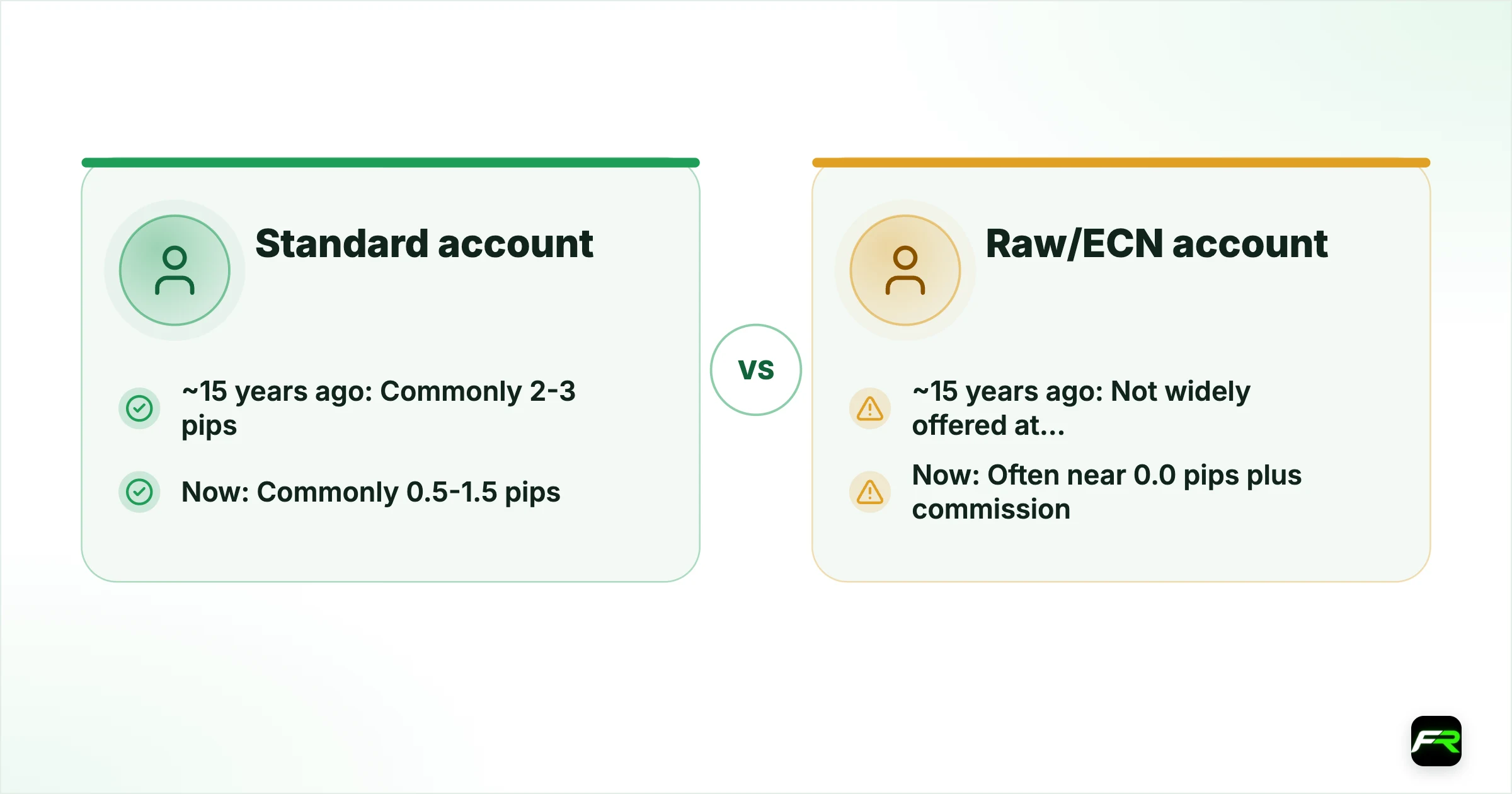
| Typical EUR/USD retail spread | ~15 years ago | Now |
|---|---|---|
| Standard account | Commonly 2-3 pips | Commonly 0.5-1.5 pips |
| Raw/ECN account | Not widely offered at retail | Often near 0.0 pips plus commission |
Rough, broker-quoted figures rather than a formal study, but the direction is well established: algorithmic market making is the main reason spreads on the majors have compressed this much over that period.
The practical conclusion
The growth of algorithmic trading is a reason to trade slower, not faster. Move away from the timeframes where milliseconds matter, lean on patience and context and discipline, and accept that the days of a human reading a news release and beating the market to the move are over. The losing-traders guide covers the habits that still separate the minority who make it.
Frequently asked
Can a retail trader compete with algorithms?
Not on speed or short-term scalping, where algorithms dominate. A retail trader competes by trading slower: waiting for high-quality setups, holding for days, and positioning around a macro view. Discipline and risk management are behavioural edges that speed does not touch.
Is news trading still possible for a manual trader?
Trading the moment of a release is not; algorithms react in milliseconds. Trading the move in the day or two after a release, once the direction is established, is still viable for a human.
Do algorithms hunt retail stops?
Sophisticated players can see where clusters of stops sit just beyond obvious levels, and price sometimes spikes to trigger them before reversing. Placing stops slightly beyond the crowd, or beyond structure rather than at round numbers, helps.
Did algo trading make spreads better or worse?
Better in normal, liquid conditions, because algo market makers compete to quote the tightest price. Worse around scheduled events, when those same market makers pull quotes and the book thins out.
What percentage of forex trading is now algorithmic?
An estimated 59% of global FX turnover goes through electronic execution, per the 2025 BIS Triennial Survey, and a large share of that is algorithmic: bank pricing engines, HFT market makers and systematic funds rather than manual dealing.
Is stop hunting real or a myth?
Real at the micro level. Clusters of retail stops sitting just beyond obvious round-number levels are visible to sophisticated players, and price sometimes spikes to trigger them before reversing. It is not a conspiracy against any one trader, placing stops beyond structure rather than at the obvious round number reduces how often it catches you.
What timeframe should a retail trader use given all this?
Higher timeframes, hourly and above, with trades held for days, where patience and context matter more than execution speed. The one-minute and five-minute charts are where you are most directly competing with faster participants.
Related reading
The team behind this guide
Researched, checked and approved by five forex specialists
Every guide is written, fact-checked and edited before it goes live, and updated when the facts change. Spotted an error? Tell us.