IC Markets




































How US Federal Reserve Decisions Ripple Into Asian Currencies
The Fed sets rates for the United States, but its decisions move USD/JPY, USD/INR, USD/IDR and gold as much as any local event. Here is the transmission chain, in plain terms.
 WriterAbir KhanWriterWrites the guides · checks every figure against primary sources View profileAbout Abir →
 Market analysisTanbir Habib RiyadForex & Crypto AnalystForex and crypto analyst · technical and fundamental analysis View profileAbout Tanbir →
 Fact-checking & riskJannatul FerdaushFact-Checker & Risk AnalystFact-checks every figure · risk analysis · Applied Statistics, University of Dhaka View profileAbout Jannatul →
 Trading reviewJowel RanaCo-Founder & Forex TraderCo-founder · forex trader · reviews guides from a trader's view View profileAbout Jowel →
 Final approvalRanjan NiskrityFounder, Owner & Forex TraderFounder and owner · forex trader · signs off every guide View profileAbout Ranjan →
Key takeaways
- The dollar is on one side of every major Asian pair, so Fed decisions move USD/JPY, USD/INR, USD/IDR and gold more than most local events.
- Hawkish Fed: stronger dollar, USD/JPY up, rupee and rupiah weaker, gold down. Dovish Fed: the reverse.
- The statement, the dot plot and the press conference move markets more than the rate itself, and the release lands overnight in Asia.
- For USD/CNH the next morning's PBOC fixing decides how much of a Fed move sticks.
The Federal Reserve meets eight times a year, and for a trader anywhere in Asia those dates matter more than most local central-bank meetings. The dollar is on one side of every major Asian pair, so when the Fed moves rates or shifts its guidance, USD/JPY, USD/CNH, USD/INR, USD/IDR and gold all react, often more than they would to a domestic release. This guide walks through why.
The rate-differential channel
Money flows toward higher risk-adjusted returns. When the Fed raises rates or signals higher-for-longer, US assets pay more, capital flows toward the dollar, and the dollar strengthens against almost everything. That pushes USD/JPY up (the US-Japan gap widens), pressures the rupee and rupiah (money leaves emerging-market bonds for US ones), and weighs on gold (which pays no yield and competes with real US rates). When the Fed cuts or signals cuts, the chain runs in reverse: a weaker dollar, a stronger yen, firmer emerging-market currencies, and higher gold.
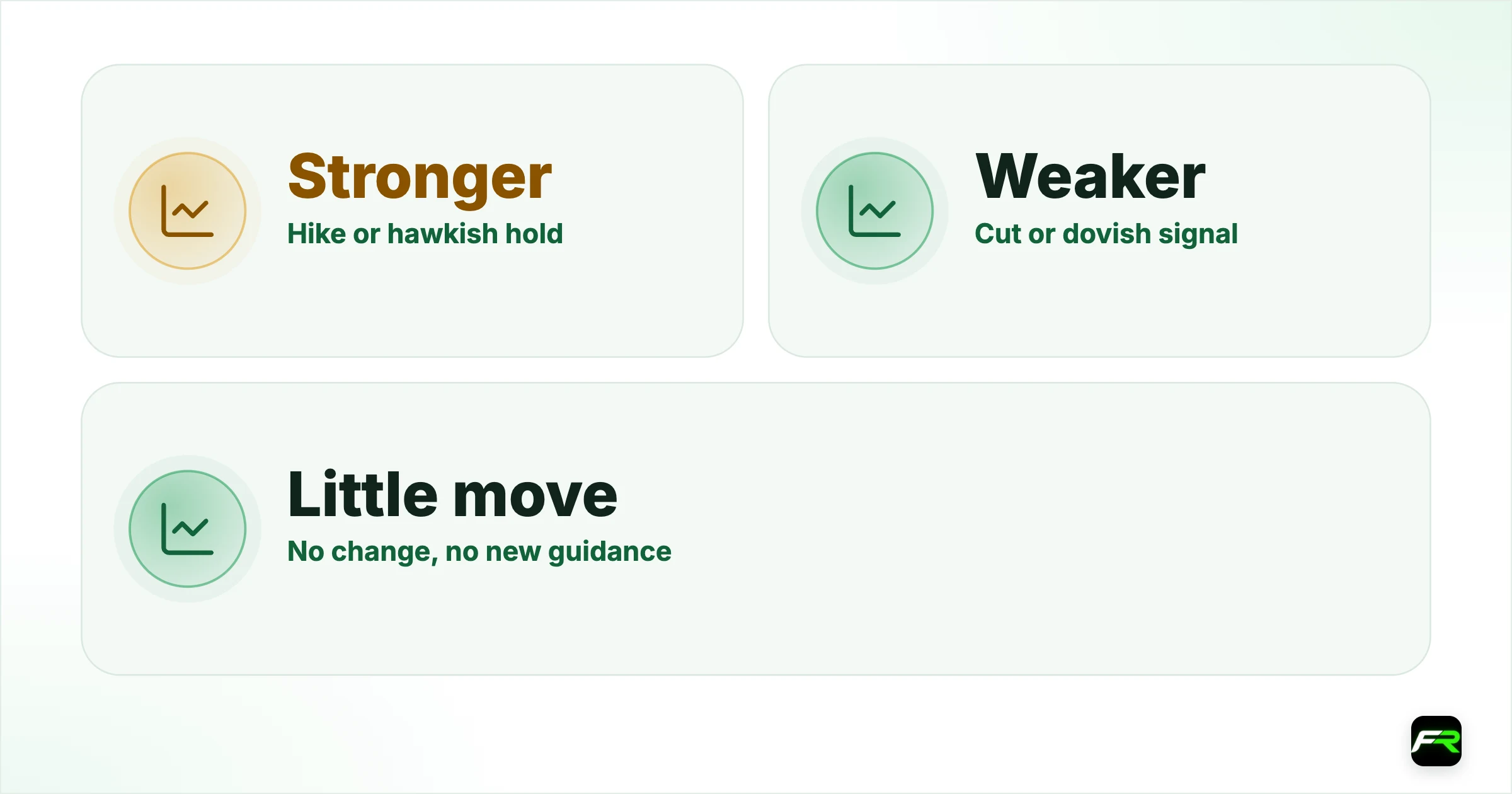
| Fed action | Dollar | USD/JPY | Rupee / rupiah | Gold |
|---|---|---|---|---|
| Hike or hawkish hold | Stronger | Up | Weaker (USD/INR, USD/IDR up) | Down |
| Cut or dovish signal | Weaker | Down | Stronger | Up |
| No change, no new guidance | Little move | Range | Range | Range |
The risk-sentiment channel
Beyond the direct rate effect, Fed decisions set the global risk mood. A Fed seen as supportive of growth (cutting into a soft patch without a recession) tends to lift risk assets, which supports the flow-sensitive Asian currencies like the rupiah and the Korean won. A Fed seen as forced to keep rates high to fight inflation tends to hurt those same currencies, because capital retreats to the safety of the dollar and US Treasuries.
What actually moves the market on the day
The rate decision itself is usually priced in. What moves the market is the statement wording, the updated economic projections (the 'dot plot', released four times a year as part of the Summary of Economic Projections, under "Projection Materials" on the Fed's FOMC calendar page), and the chair's press conference. The press conference in particular can reverse the initial reaction to the statement within half an hour. For Asian traders, the release lands at 18:00 or 19:00 GMT (early morning in most of Asia), so the reaction plays out overnight and you often wake up to the move.
Farah stopped holding any position through a Fed decision after waking up twice to find a trade had been stopped out by an overnight move she never saw. The Fed lands in the early hours for Malaysia. She now closes everything before the New York close on Fed days and looks at the chart fresh the next morning, trading the established move rather than the reaction.
How to handle Fed weeks
- Mark the eight FOMC dates on your calendar at the start of the year. The Federal Reserve publishes the full schedule on its FOMC meeting calendar; the four meetings marked with an asterisk are the ones that come with a new dot plot.
- Be flat or holding only small defined-risk positions into the decision if you cannot watch it live.
- Expect a two-way move: statement reaction, then press-conference reaction.
- The tradeable trend often establishes in the day or two after, once the market has digested the projections and the tone.
How the Fed Transmits to USD/CNH Specifically
USD/CNH follows the same rate-differential logic as the other pairs, with one extra layer: the People's Bank of China actively manages how much of a Fed move it lets through. When the Fed turns hawkish and the dollar strengthens, the gap between US and Chinese interest rates widens (China has been easing policy while the US held rates high), and USD/CNH naturally drifts higher. How far it goes depends on the PBOC's response.
- The daily fixing. If the PBOC does not want the yuan to weaken quickly after a hawkish Fed, it sets the morning reference rate stronger than models expect. The market reads that as a line in the sand, and USD/CNH often gives back part of its Fed-driven rise within hours. Our guide to the yuan fixing explains how to read that signal.
- Offshore liquidity. Because CNH trades in Hong Kong, the PBOC can make shorting the yuan more expensive by draining offshore yuan liquidity, which pushes up the cost of borrowing CNH and squeezes speculative positions.
- State bank flows. Large Chinese state banks have at times been reported selling dollars around key levels, which slows the move without any formal announcement.
The practical result: USD/CNH usually reacts to a Fed surprise in the same direction as USD/JPY, but by less and more slowly, and the real test comes at the next morning's fixing (01:15 GMT) rather than at the Fed release itself. A trader holding USD/CNH through a Fed week should treat the following fixing as part of the same event.
The Fed also affects Asian central banks directly. Bank Indonesia and others sometimes move rates specifically to keep pace with the Fed and defend their currencies, so a Fed decision can trigger a chain of regional responses over the following weeks.
Frequently asked
Why does a US rate decision move the Japanese yen?
USD/JPY is driven by the gap between US and Japanese interest rates. A Fed hike widens that gap, making dollars more attractive to hold than yen, so USD/JPY rises. A cut narrows it and USD/JPY falls.
What time is the Fed decision for Asian traders?
The FOMC statement is released at 14:00 US Eastern, which is 18:00 or 19:00 GMT depending on daylight saving. That is the early hours of the morning across most of Asia, so the move happens overnight.
Why does the Fed affect gold so much?
Gold pays no interest, so it competes with real (inflation-adjusted) US yields. Higher real yields make holding gold more costly relative to Treasuries, pressuring the price. Lower real yields do the opposite.
What is the dot plot?
A chart, published with four of the eight FOMC meetings as part of the Summary of Economic Projections, showing where each policymaker expects rates to be over the next few years. A shift in the median dot can move markets more than the rate decision itself. The Fed posts it under Projection Materials on its FOMC calendar page.
How does a Fed decision affect USD/CNH?
A hawkish Fed widens the US-China rate gap and pushes USD/CNH higher, but the People's Bank of China often limits the move through a stronger-than-expected daily fixing or by tightening offshore yuan liquidity. The next morning's fixing is usually the real test of how much of the Fed move sticks.
Should I trade the Fed meeting?
Trading the moment of the release is close to gambling because of the two-way spike. The move in the following day or two, once the projections and tone are digested, is more tradeable.
Related reading
The team behind this guide
Researched, checked and approved by five forex specialists
Every guide is written, fact-checked and edited before it goes live, and updated when the facts change. Spotted an error? Tell us.