IC Markets





































Why New Traders in Asia Lose Money Fastest on Gold, Not Forex
Gold is where many new traders start and where they lose fastest: high volatility, sizing that ignores it, and a market always in the news.
 WriterAbir KhanWriterWrites the guides · checks every figure against primary sources View profileAbout Abir →
 Market analysisTanbir Habib RiyadForex & Crypto AnalystForex and crypto analyst · technical and fundamental analysis View profileAbout Tanbir →
 Fact-checking & riskJannatul FerdaushFact-Checker & Risk AnalystFact-checks every figure · risk analysis · Applied Statistics, University of Dhaka View profileAbout Jannatul →
 Trading reviewJowel RanaCo-Founder & Forex TraderCo-founder · forex trader · reviews guides from a trader's view View profileAbout Jowel →
 Final approvalRanjan NiskrityFounder, Owner & Forex TraderFounder and owner · forex trader · signs off every guide View profileAbout Ranjan →
Key takeaways
- Gold moves $40 to $70 a day, so forex-style $5 stops get hit by noise even when the direction is right.
- One lot of gold is $100 per $1 move; 0.1 lots is $10 per $1, so an ordinary $30 swing costs $300.
- A $1,000 account risking 2% with a $25 stop should trade about 0.008 lots, rounded to 0.01.
- Learn on EUR/USD or USD/JPY first, and stay flat around US CPI, jobs data and Fed decisions.
Ask a room of new traders in Jakarta, Manila or Mumbai what they trade and a large share will say gold. It is in the news constantly, it trends hard, and the moves are big enough to feel exciting. It is also, for a beginner, the fastest way to lose an account, faster than EUR/USD or USD/JPY. The reasons are specific and fixable, but most new traders learn them the expensive way.
Reason one: the volatility
Gold's daily range through 2026 has often been $40 to $70, and intraday swings of $15 to $25 within an hour are routine. A beginner who is used to thinking in 20-pip stops on EUR/USD applies the same thinking to gold, places a $5 stop, and is knocked out on noise within minutes. Then price goes where they expected, without them. Repeat that ten times and the account is down significantly on directional reads that were often correct.
Reason two: position sizing that ignores it
On gold, one lot (100 ounces) means a $1 move in the price is $100. A beginner who opens 0.1 lots thinking it is small is actually running $10 per $1 of price, so a $30 move, an ordinary session, is a $300 loss. On a $1,000 account that is 30 per cent. The correct position for a $1,000 account risking two per cent with a $25 stop is about 0.008 lots, which many brokers round to 0.01, and even that risks $25. Gold's volatility forces tiny positions, and beginners almost never size that small.
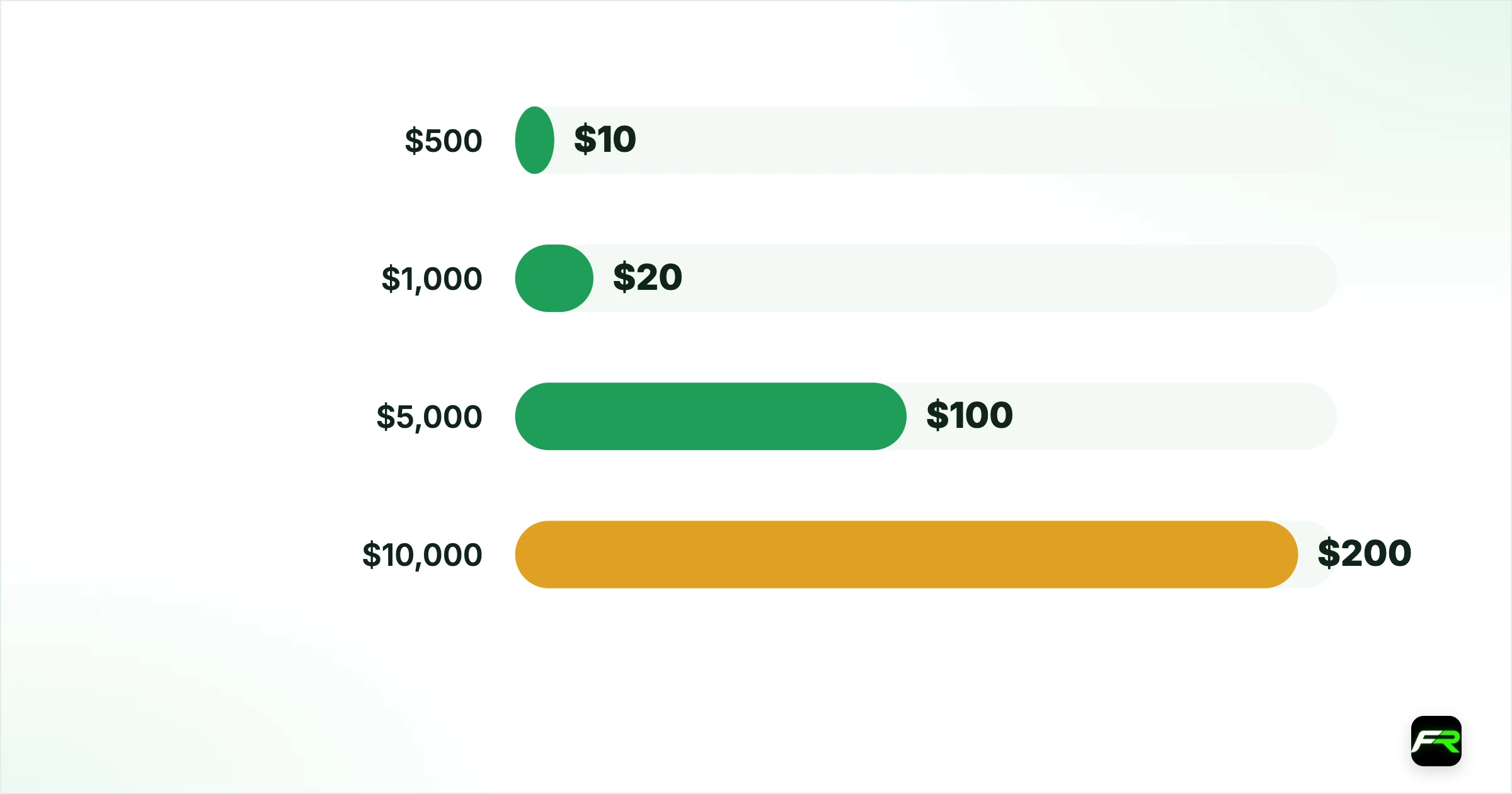
| Account | 2% risk | $25 gold stop | Correct lot size |
|---|---|---|---|
| $500 | $10 | $25 | ~0.004 (below many minimums) |
| $1,000 | $20 | $25 | ~0.008 (round to 0.01) |
| $5,000 | $100 | $25 | ~0.04 |
| $10,000 | $200 | $25 | ~0.08 |
Reason three: the news pull
Gold is always in the headlines: records, central-bank buying, geopolitical risk, rate expectations. That constant presence makes it feel like the obvious thing to trade and creates a sense that a big move is always about to happen, which encourages oversizing and holding through events. Gold also reacts hard to US data and Fed communication, so a beginner holding a position through a US inflation print can see $30 to $50 of movement in seconds.
Kwan traded gold with $4 stops on a $2,000 account for months, wanting his losses under $30. He was stopped out on noise constantly and down 25 per cent on a strategy his backtest said should work. He switched to structure-based stops of $15 to $22, accepted 0.02-lot positions, and his win rate rose from 33 per cent to 44 per cent. His conclusion: the tight stops were not reducing his risk, they were guaranteeing his losses.
The gold stop-loss placement guide covers structure-based stops on gold in detail.
How to trade gold as a beginner, if you must
- Size positions by risk, not by lots. Two per cent of the account, calculated from a structure-based stop.
- Accept tiny positions. On a small account that means 0.01 to 0.02 lots, and a good day might make $10.
- Place stops beyond structure with a $2 to $5 buffer, never at a fixed tight distance.
- Stay flat around US data (CPI, jobs, Fed decisions), which move gold violently.
- Consider learning on a slower major pair first. EUR/USD is a more forgiving teacher.
Gold is not a good first instrument. If you are still building consistency, EUR/USD or USD/JPY will teach you the same skills with less damage from a sizing mistake. Come to gold once your risk process is solid.
The honest summary
Gold rewards a disciplined trader with correct position sizing and structure-based stops, as the $2,000 to $8,000 case study shows. It punishes a beginner who brings forex-sized stops and lot-based thinking to an instrument that moves two or three times as fast. The instrument is not the problem. The mismatch between how gold moves and how a beginner sizes for it is the problem, and it is entirely avoidable.
Frequently asked
Why is gold harder for beginners than forex?
It moves two to three times as fast as the major pairs, so forex-sized stops get hit on noise, and its lot maths (a $1 move is $100 on one lot) means beginners routinely open positions far larger than they realise.
What stop distance should I use on gold?
Structure-based, beyond the level that invalidates your trade, plus a $2 to $5 buffer. On intraday timeframes in 2026 conditions that is usually $10 to $25, not the $3 to $5 a beginner tends to use.
What position size should a $1,000 account trade gold with?
Two per cent is $20. With a $20 to $25 stop, that puts the position around 0.01 lots, which is at or near many brokers' minimum. If you cannot size that small, the account is too small for gold.
Should I avoid gold entirely as a beginner?
It is not off-limits, but EUR/USD or USD/JPY are more forgiving teachers of the same skills. Come to gold once you can size positions by risk and place structure-based stops consistently.
Why does gold move so much on US data?
Gold pays no yield, so it competes with real US interest rates. US inflation and jobs data change rate expectations, which repositions gold quickly, often $30 to $50 in the minutes after a release.
Related reading
The team behind this guide
Researched, checked and approved by five forex specialists
Every guide is written, fact-checked and edited before it goes live, and updated when the facts change. Spotted an error? Tell us.