IC Markets



























Why Millions of New Traders in Asia Are Opening Their First Forex Account This Year
Millions of new retail forex traders across Asia: what's driving the wave, what most new accounts have in common, and what it means for you.
 WriterAbir KhanWriterWrites the guides · checks every figure against primary sources View profileAbout Abir →
 Market analysisTanbir Habib RiyadForex & Crypto AnalystForex and crypto analyst · technical and fundamental analysis View profileAbout Tanbir →
 Fact-checking & riskJannatul FerdaushFact-Checker & Risk AnalystFact-checks every figure · risk analysis · Applied Statistics, University of Dhaka View profileAbout Jannatul →
 Trading reviewJowel RanaCo-Founder & Forex TraderCo-founder · forex trader · reviews guides from a trader's view View profileAbout Jowel →
 Final approvalRanjan NiskrityFounder, Owner & Forex TraderFounder and owner · forex trader · signs off every guide View profileAbout Ranjan →
Key takeaways
- Retail forex in Asia has grown to several million active traders, led by Vietnam, Indonesia, the Philippines, Thailand and India.
- Smartphones, $10 minimums, high leverage, local e-wallets and influencer marketing drive the growth.
- The typical first account ($50 to $300, 1:500 leverage, no stop) is down sharply or closed within three months.
- Survivors size by risk (1% to 2% per trade), use a stop on every trade and treat the first account as paid practice.
Retail forex participation across Asia has climbed for years, and broker data now points to several million active traders across the region, with the fastest growth in Vietnam, Indonesia, the Philippines, Thailand and India. If you have recently opened your first account, you are part of a large cohort, and understanding the wave you are in is useful, because most of these accounts share the same trajectory.
What is driving it
- Smartphone access. Trading that once needed a desktop and a wire transfer now needs a phone and an e-wallet. The barrier to opening an account has collapsed.
- Low minimums and high leverage. Offshore brokers accept $10 deposits and offer leverage that makes a small account feel like it can do something.
- Local payment integration. GCash, DANA, bKash, FPX and local bank transfers make funding an account feel routine.
- Social media and influencers. A large volume of trading content in local languages, much of it promoting a particular broker for a commission, presents trading as an accessible side income.
- Economic pressure. In a region where wage growth has lagged the cost of living for many, the pitch of an extra income stream lands hard.
What these accounts have in common
| Typical first account | Detail |
|---|---|
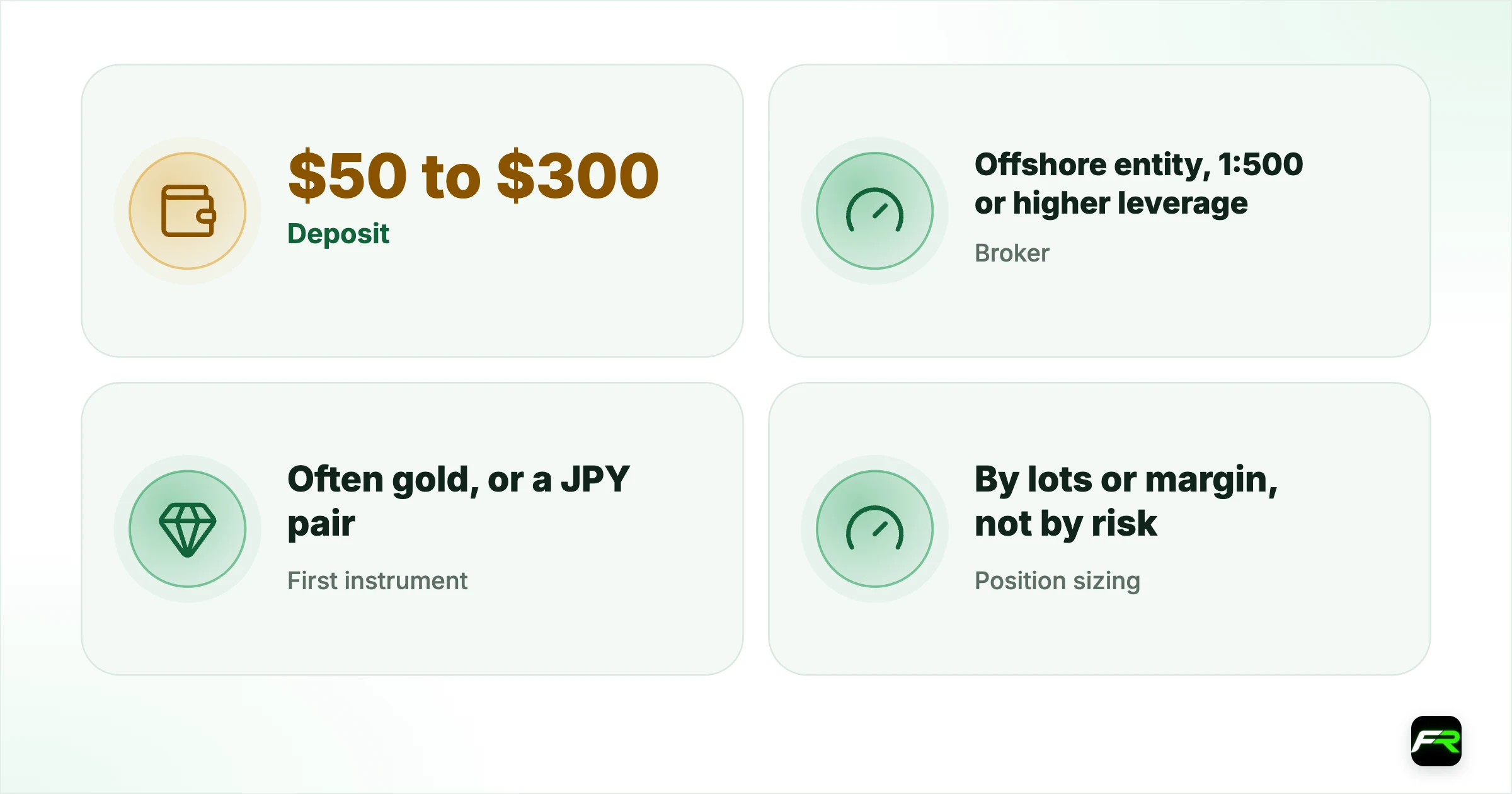
| Deposit | $50 to $300 |
| Broker | Offshore entity, 1:500 or higher leverage |
| First instrument | Often gold, or a JPY pair |
| Position sizing | By lots or margin, not by risk |
| Stop loss | Frequently none, or too tight |
| Outcome in the first 3 months | Most are significantly down or closed |
This is not a judgement. It is a consistent trajectory across the region. The accounts that survive are the minority that get the position sizing right early, take stops, and treat the first small account as practice rather than income. The losing-traders guide covers the split in detail.
Where this growth data comes from
There is no single official census of retail forex accounts in Southeast Asia. The "several million active traders" figure used here is an aggregate drawn from broker-disclosed account growth, payment-processor data (GCash, DANA, bKash and similar wallets reporting rising forex-linked transaction volume) and regional industry commentary, not one hard government number. Treat it as a directional estimate rather than a precise count, which is also why exact figures vary between sources that cover this trend.
What the growth means for you
Two things. First, you are trading against an increasingly professional market. A larger share of forex volume is algorithmic, reactions to news are instant, and simple retail patterns are crowded. This is a reason to trade slower and lean on patience and discipline rather than speed. The algo trading guide covers what still works.
Second, the broker and content ecosystem around you is optimised to keep you trading, not to make you profitable. The influencer promoting a broker earns on your deposits and losses. The broker’s marketing emphasises leverage and promotions. Neither is neutral. Your interests and theirs are not aligned, and building your own process, with your own risk rules, is the only real defence.
A 25-year-old in Ho Chi Minh City sees a friend post trading screenshots, watches a few Vietnamese YouTube videos, and opens a $100 account with the broker one of them promotes. Leverage is 1:500. He trades gold at 0.1 lots because it feels small. Two losing sessions and the account is down 40 per cent. He adds another $100, sizes up to recover, and it is gone within a month. It is the typical outcome for a first account funded this way, not an unlucky exception, and it is avoidable with position sizing that nobody in his information diet mentioned.
If you are just starting
- Deposit an amount that is genuinely disposable, and treat the first account as paid practice, not income.
- Learn position sizing by risk before you place a real trade. One to two per cent per trade, calculated from the stop.
- Put a stop on every trade, on the platform, before anything else.
- Pick one strategy and one or two pairs. Ignore the pull to trade everything.
- Be aware that the content you are consuming is mostly monetised through your trading activity, and seek out sources that are not.
Forex trading is legal for individuals across most of the region, with Indonesia running a full licensing system and a few countries (Nepal, Bangladesh, and in effect Sri Lanka) prohibiting it. See the FX Recap broker section for your country’s exact position.
Which countries in Asia prohibit forex trading entirely?
Nepal and Bangladesh both prohibit retail forex trading outright, and Sri Lanka's currency-control rules make it prohibited in effect even without a specific ban naming it. Everywhere else covered on this site allows it in some form, though licensing and restrictions vary widely by country, Indonesia, for instance, runs a full licensing system rather than an open market.
Frequently asked
How many retail forex traders are there in Asia?
Broker data points to several million active retail traders across the region, with the fastest growth in Vietnam, Indonesia, the Philippines, Thailand and India. Exact figures vary by source and definition.
Why has retail forex grown so fast in Asia?
Smartphone access, low minimum deposits, high leverage from offshore brokers, local payment integration, a large volume of trading content in local languages, and economic pressure that makes an extra income stream appealing.
Do most new traders make money?
No. Broker disclosures and independent data consistently show that the large majority of retail accounts lose money, and most new accounts are significantly down or closed within a few months. The minority who survive get position sizing right early.
Is the trading content I see on social media trustworthy?
Much of it is monetised through broker referrals, meaning the creator earns on your deposits and losses. That does not make all of it wrong, but it is not neutral. Seek out sources that are not paid by your trading activity.
Should I open a forex account if everyone else is?
Only with money you can afford to lose entirely, treating the first account as practice. The scale of the wave does not change the fact that most accounts lose; it just means more people are learning the same lesson at once.
Related reading
The team behind this guide
Researched, checked and approved by five forex specialists
Every guide is written, fact-checked and edited before it goes live, and updated when the facts change. Spotted an error? Tell us.