IC Markets





































Bank Indonesia and the Rupiah: Why USD/IDR Reacts to Capital Flows
USD/IDR follows foreign money in and out of Indonesian bonds and stocks. Why the rupiah is so flow-sensitive, and how Bank Indonesia responds.
 WriterAbir KhanWriterWrites the guides · checks every figure against primary sources View profileAbout Abir →
 Market analysisTanbir Habib RiyadForex & Crypto AnalystForex and crypto analyst · technical and fundamental analysis View profileAbout Tanbir →
 Fact-checking & riskJannatul FerdaushFact-Checker & Risk AnalystFact-checks every figure · risk analysis · Applied Statistics, University of Dhaka View profileAbout Jannatul →
 Trading reviewJowel RanaCo-Founder & Forex TraderCo-founder · forex trader · reviews guides from a trader's view View profileAbout Jowel →
 Final approvalRanjan NiskrityFounder, Owner & Forex TraderFounder and owner · forex trader · signs off every guide View profileAbout Ranjan →
Key takeaways
- The rupiah trades on foreign bond flows more than on domestic data.
- Risk-on conditions and falling US rates bring inflows; risk-off conditions and rising US yields send USD/IDR higher.
- Bank Indonesia smooths sharp moves and sometimes raises rates just to defend the currency.
- Track US yields, the dollar index and BI's data on foreign ownership of government bonds for early signals.
The rupiah trades on flows more than on almost anything else. Indonesia runs a large, liquid government bond market that foreign investors hold a significant share of, and it has historically relied on foreign capital to help fund its current account. When global conditions turn risk-friendly and money flows into emerging-market bonds, the rupiah strengthens. When conditions turn risk-off and that money leaves, the rupiah weakens quickly, and USD/IDR can move several per cent in weeks.
The flow channel
A foreign fund buying Indonesian government bonds has to buy rupiah to do it, which supports the currency. A fund selling those bonds sells rupiah, which pressures it. Because foreign ownership of Indonesian bonds is large relative to daily FX turnover, these flows dominate the rupiah’s direction. The triggers for the flows are mostly external: US interest rates, the global risk mood, the dollar index, and China’s growth outlook, since a weak China weighs on the whole region.
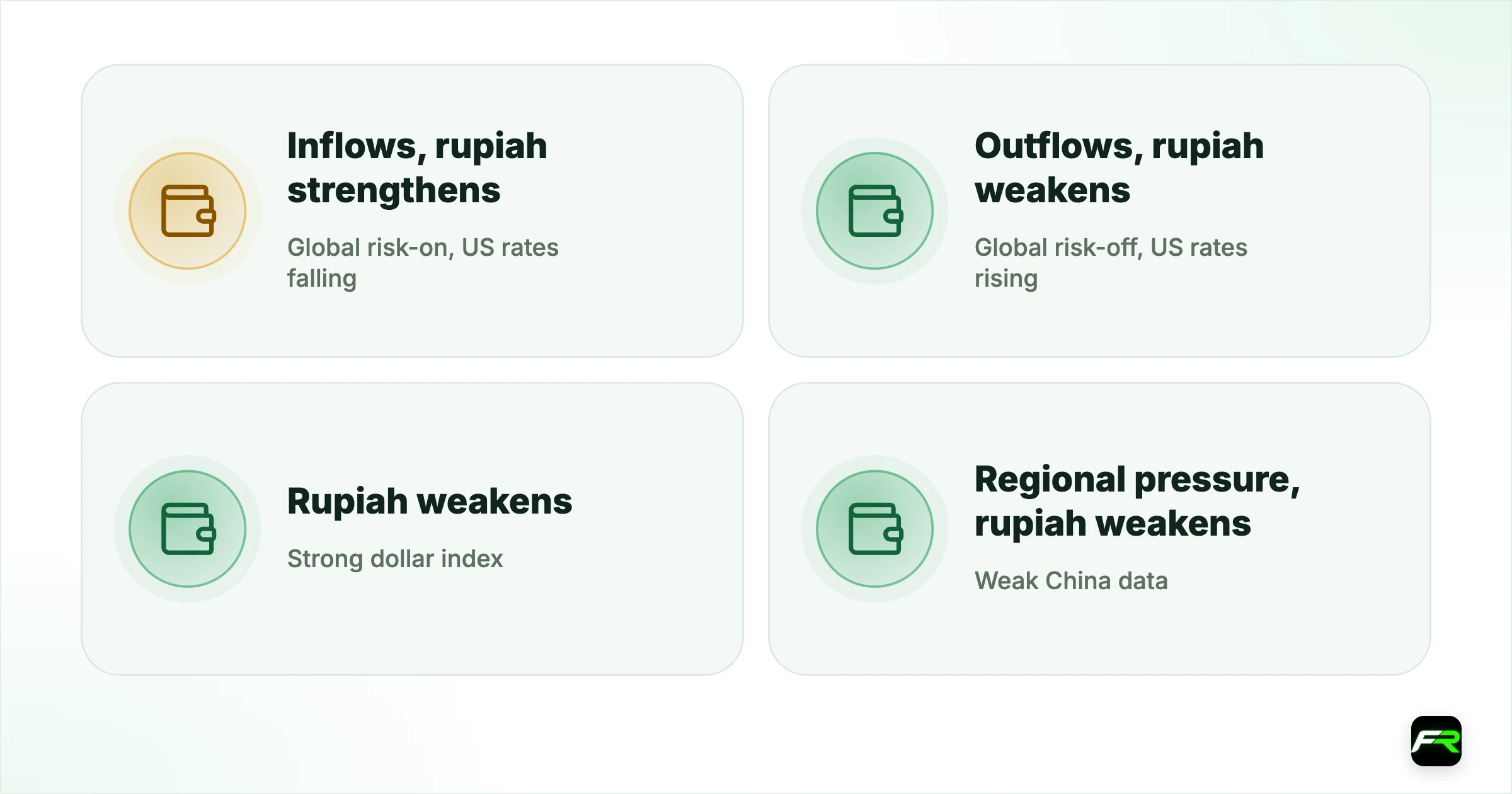
| Condition | Rupiah direction | USD/IDR |
|---|---|---|
| Global risk-on, US rates falling | Inflows, rupiah strengthens | Falls |
| Global risk-off, US rates rising | Outflows, rupiah weakens | Rises |
| Strong dollar index | Rupiah weakens | Rises |
| Weak China data | Regional pressure, rupiah weakens | Rises |
What Bank Indonesia does
Bank Indonesia (BI) sets the policy rate and intervenes in the FX and bond markets to limit rupiah volatility. Its stated approach is to allow the rupiah to move with fundamentals while smoothing disorderly swings. In practice that means BI sells dollars from its reserves and buys bonds to slow a sharp depreciation, and it will sometimes raise rates specifically to defend the currency and keep foreign bondholders in place, even when the domestic economy would not otherwise call for a hike.
Rina trades a small offshore account and used to be surprised by rupiah moves that had no obvious Indonesian cause. She started tracking the US 10-year yield and the dollar index alongside USD/IDR and the relationship became obvious: when US yields jumped, USD/IDR followed within a day or two, regardless of what was happening in Indonesia. She now treats the rupiah as a leveraged bet on the global risk mood rather than a domestic story.
The domestic factors that still matter
- The BI policy meeting (monthly) and any rate move framed as currency defence.
- The current account balance. A wider deficit makes the rupiah more dependent on foreign funding and more fragile in a sell-off.
- Inflation. Contained inflation gives BI room to cut rates, which can be rupiah-negative if it narrows the yield advantage.
- Political and fiscal headlines that affect the credibility of the bond market.
Trading implications
USD/IDR is offered by many brokers serving Southeast Asia but it is not a beginner pair. It has periods of very low volatility punctuated by fast depreciation episodes, wide retail spreads, and a strong dependence on external variables. If you trade it, watch US yields and the dollar index as leading indicators, keep positions small, and be aware that BI intervention can cap or reverse a move without warning.
Where to Check Foreign Bond Flow Data
Bank Indonesia publishes both halves of this picture directly. Its Economic and Market Data section carries the regularly updated ownership breakdown of IDR-denominated government securities (SBN), including the foreign-held share, alongside the announcements from each Board of Governors policy meeting. A rising foreign-ownership share alongside a firming rupiah confirms the inflow story described above; a falling share during a rupiah slide confirms the reverse, and it is usually visible in this data before it shows up as a sustained move in USD/IDR.
For Indonesian residents, forex trading is legal and regulated by Bappebti, though most traders use offshore brokers. See our Indonesia broker guide for the practical detail on funding, tax and choosing a firm.
Frequently asked
Why is the rupiah so sensitive to US interest rates?
Foreign investors hold a large share of Indonesian government bonds. When US rates rise, the relative appeal of Indonesian bonds falls, money flows out, and the outflow sells rupiah, pushing USD/IDR up.
Does Bank Indonesia let the rupiah float?
It is a managed float. BI allows the rupiah to move with fundamentals but intervenes with reserves and bond purchases to smooth disorderly moves, and will raise rates to defend the currency when needed.
What time does Bank Indonesia announce rate decisions?
BI’s Board of Governors meeting is monthly, with the decision typically announced in the afternoon Jakarta time (around 07:00 to 08:00 GMT).
Is USD/IDR good to trade?
It is a managed, flow-driven pair with wide retail spreads and sudden depreciation episodes. It is not a good first pair. Watch US yields and the dollar index if you do trade it.
What is a current account deficit and why does it matter for the rupiah?
It means Indonesia imports more than it exports and needs foreign capital to cover the gap. A wider deficit makes the rupiah more dependent on that capital staying, and more vulnerable when it leaves.
Related reading
The team behind this guide
Researched, checked and approved by five forex specialists
Every guide is written, fact-checked and edited before it goes live, and updated when the facts change. Spotted an error? Tell us.