IC Markets





































What China’s GDP Data Means for USD/CNH Traders
Which Chinese data moves USD/CNH, how the PBOC's daily fixing filters the reaction, and why the yuan doesn't move like a free-floating currency.
 WriterAbir KhanWriterWrites the guides · checks every figure against primary sources View profileAbout Abir →
 Market analysisTanbir Habib RiyadForex & Crypto AnalystForex and crypto analyst · technical and fundamental analysis View profileAbout Tanbir →
 Fact-checking & riskJannatul FerdaushFact-Checker & Risk AnalystFact-checks every figure · risk analysis · Applied Statistics, University of Dhaka View profileAbout Jannatul →
 Trading reviewJowel RanaCo-Founder & Forex TraderCo-founder · forex trader · reviews guides from a trader's view View profileAbout Jowel →
 Final approvalRanjan NiskrityFounder, Owner & Forex TraderFounder and owner · forex trader · signs off every guide View profileAbout Ranjan →
Key takeaways
- Chinese data moves USD/CNH less than you'd expect because the PBOC filters the reaction through its daily fixing.
- Weak data plus a weak fixing is a real signal; weak data plus a firm fixing means the PBOC is leaning against the move.
- GDP and the monthly releases land around 02:00 GMT, and the next morning's fixing (about 01:15 GMT) often decides the trade.
- USD/CNH is calm most of the time but has fat tails and wider spreads, so size small and use wide stops.
USD/CNH is the offshore Chinese yuan against the dollar, the version retail brokers offer. It does not trade like EUR/USD or USD/JPY. The People’s Bank of China (PBOC) guides it heavily through a daily reference rate and, at times, direct intervention, so the yuan’s reaction to economic data is muffled compared with a free-floating currency. Understanding that filter is the key to trading it.
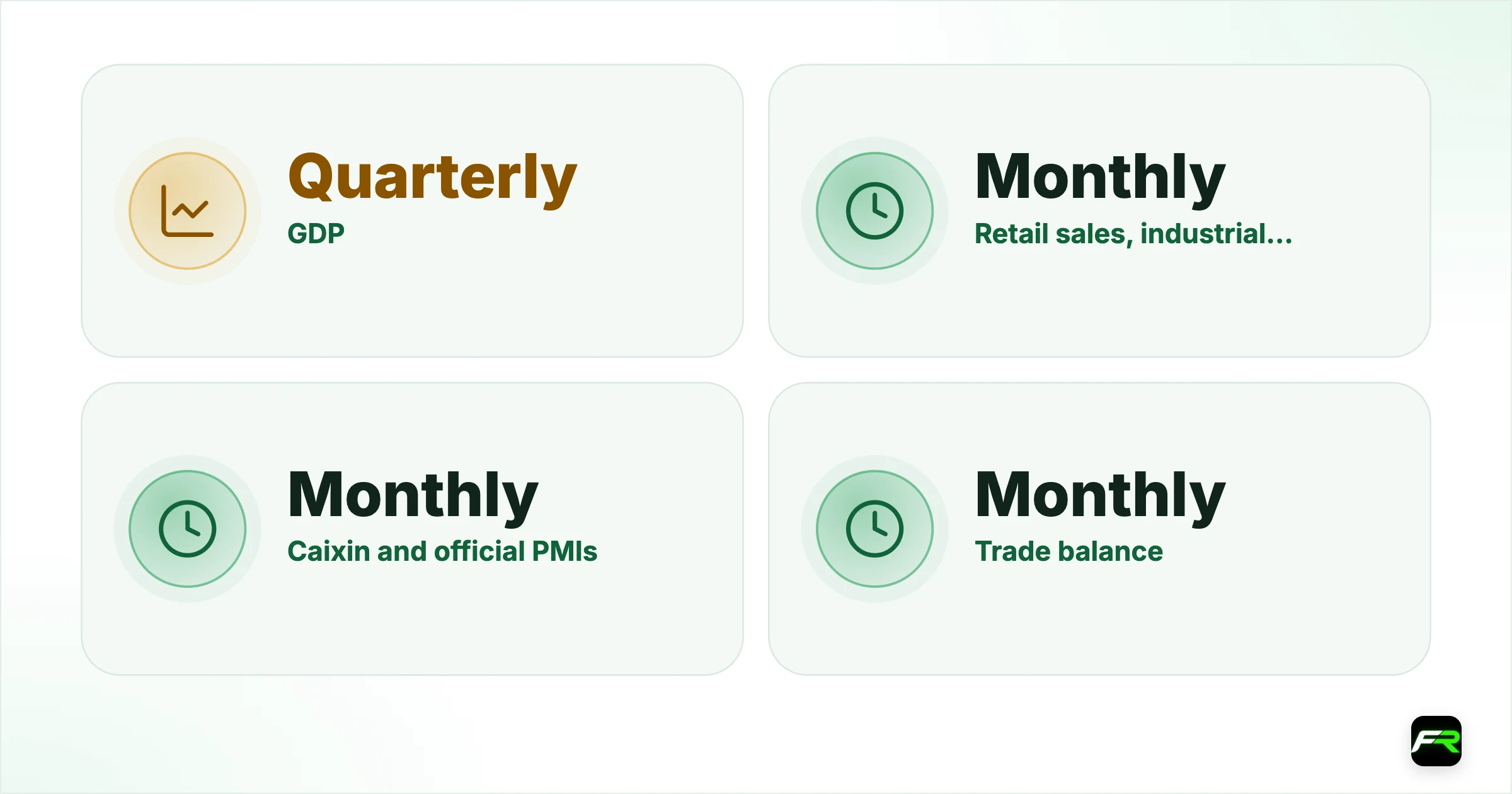
The data that matters
| Release | Frequency | What it signals |
|---|---|---|
| GDP | Quarterly | Headline growth vs the official target |
| Retail sales, industrial production | Monthly | Domestic demand and factory activity |
| Caixin and official PMIs | Monthly | Forward-looking business conditions |
| Trade balance | Monthly | Export strength, current-account flows |
| Credit and money supply | Monthly | Policy stance and stimulus flow |
A GDP or activity print that comes in clearly below expectations raises the odds of more stimulus and a more tolerant PBOC stance on a weaker yuan, which tends to push USD/CNH up. A strong print does the reverse. But the size of the reaction depends on whether the PBOC lets it through.
The PBOC fixing filter
Every morning around 09:15 Beijing time, the PBOC publishes a reference rate for the onshore yuan (CNY), and the onshore currency is allowed to trade within a 2 per cent band around it. The offshore yuan (CNH) is not formally banded but takes its cue from the same signal. When data is weak, the market often expects USD/CNH to rise, but if the PBOC then sets the fixing stronger than models predict, it is signalling that it does not want a rapid yuan depreciation, and USD/CNH can fall back despite the soft data. The yuan fixing guide covers this mechanism in full.
Zhang learned to check the fixing before acting on data. Twice he shorted the yuan (bought USD/CNH) on weak Chinese numbers, only to see the PBOC set a firm fixing the next morning and the pair drop 150 pips against him. He now treats the data as one input and the fixing as the decision-maker: weak data plus a weak fixing is a real signal, weak data plus a firm fixing means the PBOC is leaning against it and he stays out.
Why the yuan is not a normal FX trade
For long stretches, USD/CNH moves in a narrow, managed range, then jumps on a policy shift, a trade headline, or a change in the PBOC’s tolerance. It has lower day-to-day volatility than the majors but a fatter tail: the big moves are bigger and harder to anticipate. Retail spreads on USD/CNH are also wider than on the majors because liquidity is thinner. For most beginners it is not a good first pair.
How to trade around a release
- Note the release time (GDP and monthly data land around 02:00 GMT).
- Do not assume the obvious reaction. Weak data does not automatically mean a weaker yuan if the PBOC leans against it.
- Wait for the next fixing before committing to a directional view driven by the data.
- Size small and use a wide stop. USD/CNH can gap on a trade or policy headline with no warning.
USD/CNH positions held overnight are exposed to the next morning’s PBOC fixing, which is a scheduled event that regularly moves the pair 100-plus pips. Treat it like any other central-bank event.
Sources and where to check it yourself
- National Bureau of Statistics of China: official GDP, retail sales, industrial production and release calendar
- CFETS RMB central parity rate: the daily fixing the PBOC publishes each morning
For the rules and brokers that apply where you live, see our guide to forex rules for mainland China.
Frequently asked
What time does China release GDP?
Quarterly GDP and the monthly activity data (retail sales, industrial production) are typically released around 10:00 Beijing time, which is 02:00 GMT.
Why doesn’t the yuan react much to bad data?
Because the PBOC manages it through the daily fixing and, at times, direct intervention. It will often lean against a move it does not want, so the currency does not respond to data as freely as the majors do.
Is USD/CNH good for beginners?
Not really. Spreads are wider, liquidity is thinner, and the main driver (the PBOC fixing and policy stance) is hard to anticipate. USD/JPY or EUR/USD are simpler starting points.
What is the difference between CNY and CNH?
CNY is the onshore yuan, tightly controlled and traded within a band around the daily fixing. CNH is the offshore yuan, traded more freely in Hong Kong and elsewhere. Retail brokers offer USD/CNH.
Does China’s GDP affect other Asian currencies?
Yes. Weak Chinese growth tends to weigh on the Australian dollar (China is Australia’s largest trading partner) and on trade-exposed Asian currencies. A soft print can move AUD/USD independently of anything Australian.
Related reading
The team behind this guide
Researched, checked and approved by five forex specialists
Every guide is written, fact-checked and edited before it goes live, and updated when the facts change. Spotted an error? Tell us.